
Upland Epoxy Floors has been installing garage floor epoxy in West Covina for more than 20 years, and the first thing we want to establish on any quote here is which decade the slab underneath was poured in. That is not idle curiosity. It decides the preparation, the repair budget and sometimes the product itself.
This city went up in two distinct waves. The 1950s account for 35.3 percent of the housing stock and the 1970s for another 23.1 percent, with a measurable dip between them, and the garages those two waves produced have almost nothing in common beyond the word garage.
So two houses on the same street can genuinely need different floors, and a contractor working from one assumption will get one of them wrong. What follows is how we tell the two apart and what changes once we know.
Two Building Waves, Two Kinds of Slab
The Fifties Tracts
Between 1950 and 1960 this city went from under 5,000 residents to more than 50,000, one of the fastest-growing in the country across that decade. The garages built to keep pace with that are more than a third of the housing stock today, and they were laid out for the cars and the storage habits of that moment.
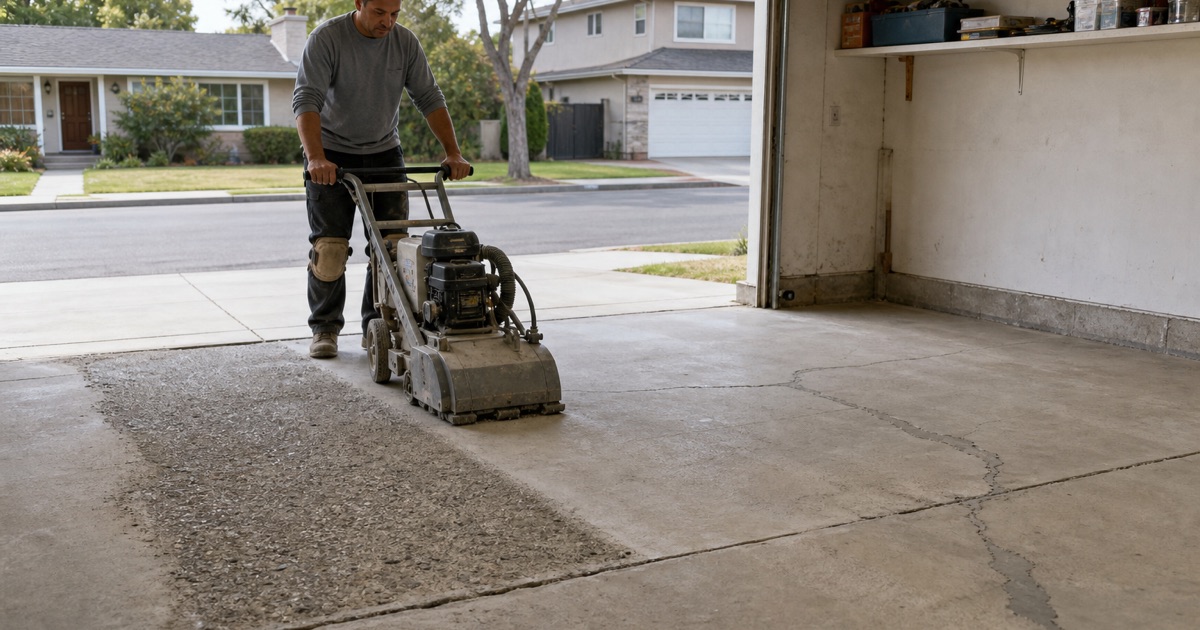
In practice that means a tight bay with little room to swing equipment along the walls, a slab poured before under-slab vapor retarders became routine, and seventy years of oil, brake dust and weekend projects worked into the surface. None of that rules out a coating. It rules out pricing one before reading the concrete.
The Seventies Wave and the Door Into the House
The second wave produced 23.1 percent of the city’s 34,287 units, and it is a different building. Those garages are generally wider, far more often attached to the house with an interior door, and sitting on concrete a full generation younger than the first wave’s.
A wider bay is also more floor to look at, so the finish conversation matters more on this stock. We lay a full sample board of the flake blend on your own slab and look at it in your own light, because a chip card held up indoors tells you very little about how a blend reads across twenty feet of concrete with the door rolled open.
Why One Street Can Hold Both
Between the waves the city slowed markedly: the 1960s account for just 13.1 percent of housing, a real dip between two peaks. Infill, rebuilding and later subdivision mean the eras were never sorted into tidy districts, so neighboring properties on one block can easily belong to different ones.
That is the whole reason this page is shaped the way it is. Detached houses are 64.4 percent of the stock, some 22,077 of them, which is a very large number of garages to quote, and using the address as a shortcut to the specification is the quickest route to getting one of them wrong.
Looking for epoxy flooring closer to Vincent? See Vincent Epoxy Flooring.
Working Out Which Wave a Garage Belongs To
The Slab Answers the Question, the Elevation Does Not
Build era is not something we settle by studying a house from the curb. Exteriors get restuccoed, doors get replaced, roofs get redone, and a bay can be extended or rebuilt without any of that reaching the front elevation, so appearance is a hint and never a conclusion.
What we go on is the concrete. The joint layout, the depth and condition of the saw cuts, how the slab meets the foundation, what earlier repairs were done in and how the surface behaves under the first grinder pass all tell us more in ten minutes than the facade tells us at all. Where the two readings disagree, the slab wins, because the slab is the thing being coated.
Moisture Measured Rather Than Assumed
Slab age changes what a moisture test is likely to find, and it never removes the need to run one. Concrete poured without a vapor retarder underneath moves ground moisture upward continuously, while newer slabs usually have one, but a retarder punctured or bridged during the pour is entirely invisible afterward.
So both eras get measured identically. In-situ relative humidity probes go into the slab, the reading is taken to the ASTM F2170 method, and the number is written down before any material is ordered, moisture failure being the one thing that nearly every coating warranty in this trade excludes.
The Paper Record and What It Settles
Where history genuinely matters, because a bay was converted or a garage does not match its neighbors, the record is more reliable than anything we can read off the finish. Building permits in this city go through the West Covina Building Division, submitted through the One Stop Building Permit Center portal, with a counter open in person Monday through Thursday.
A coating is not structural work, so most of these jobs never send anyone to that counter. But learning that a bay was rebuilt decades after the house went up changes the preparation, the repair allowance and occasionally the product, and that is worth checking before a crew is standing in the driveway.
Preparation That Changes With the Era
Opening Seventy-Year-Old Concrete
The oldest slabs carry the most history: oil soaked in where an engine used to drip, shrinkage cracking, a spalled lip at the door line and patchwork nobody recorded. All of it is opened mechanically, with diamond grinding to a named ICRI concrete surface profile, and never with acid etching.
Etchant is simply the wrong tool on concrete like this. It leaves residue behind in the pores, bites unevenly across a floor that absorbed oil in patches, and offers no way to hit a specified profile. Grinding liberates respirable crystalline silica, so extraction runs on the machine as standard, and in a narrow fifties bay there is nowhere for anyone to stand clear of it.
Newer Slabs, Different Problems
The later wave is not automatically the easier job. Those floors are more likely to have had a curing compound or a sealer applied at some point in their working life, and anything of that kind has to come off completely rather than be coated over, because a primer bonded to a sealer is only ever as strong as the sealer’s own grip.
The profile we grind to follows the coating rather than the customer’s preference. A heavier 100% solids epoxy buildup wants a more open surface than a thin polyaspartic system does, so the segment and the pass count get chosen after the buildup is decided, and the epoxy primer is matched to what the ground concrete actually looks like once it is open.
Repairs Priced Before the Grinder Starts
Cracks, spalls and joints are the part of a garage floor most often found halfway through and invoiced afterward. We price them into the quote instead: crack repair, spall repair mortar along the door line where the slab has broken down, and an explicit decision for every control joint.
That decision is to fill it, honor it through the finish or bridge it, taken from what the joint is doing rather than from what is fastest. A coating run blind over a live joint prints that line back through the surface inside a year, and the older wave’s slabs are the ones whose joints are most likely to still be moving. Getting it wrong is not a small blemish either, because the crack reappears along the most visible line on the floor.
Odor, Cure and Floors Shared With Other People
The Interior Door Changes the Job
An attached garage with a door into the kitchen or the hallway turns cure odor into a household matter rather than a site matter. Whatever goes down in that bay will find the gap under that door, and a family sleeping above it for two nights is owed a plan rather than an apology.
So on attached bays we select for low odor as well as for performance, seal the interior door for the duration, and ventilate out through the opening instead of into the house. Where somebody in the household is particularly sensitive to it, we will say plainly which product to rule out, even when that is the one we would otherwise have chosen.
A Cure Schedule With Three Dates On It
Nobody can plan a weekend around a single ready-in-24-hours number. Walking on a new floor, putting the shelving and the second refrigerator back on it, and driving a car with hot tires onto it are three different loads that become safe on three different days.
We hand that over in writing, staged, together with the slab temperature and dew point readings taken on the morning of the pour. Those same readings set batch size and how many people work the gauge rake and the notched squeegee, because one product runs about 60 minutes of pot life at 55 degrees and roughly 20 minutes at 95.
Structured Parking at the Larger Complexes
This city also holds the largest share of big multifamily buildings we work in: 12.3 percent of housing, around 4,220 units, sits in structures of fifty units or more. The parking under and behind those buildings is a commercial-scale coating job decided by a board or a management company rather than by any one resident.
It gets phased for exactly that reason. Residents cannot surrender their parking for a week, so the deck is sectioned and bays are closed and reopened in sequence, with access agreed in advance even though truck approach here is straightforward, with two freeways serving the city and wide arterials off them.
There is a legal edge to that work as well. SCAQMD Rule 1113 caps floor coatings at 50 grams per liter of volatile organic compounds and industrial maintenance coatings at 100, and subsection (c)(6) prohibits applying, or soliciting the application of, an industrial maintenance coating for residential use, which is what parking serving apartments is. That is why our residential and commercial quotes come off separate product lines.
- 20+ Years Experience
- Licensed & Insured
- Free On-Site Estimates