
Upland Epoxy Floors installs epoxy flooring in Vincent, a community of 3,927 homes where most residents do not use the name Vincent for the place they live. Of those units, 93.6 percent are detached houses, 77.9 percent are owner-occupied, and 71.6 percent of the whole stock was built in the single decade of the 1950s.
Two things make working here different from working in an incorporated city, and neither of them is about the coating. The first is that the address on your utility bill belongs to a different name than the census gives this community. The second is that there is no municipal government behind that address, so anything that needs a permit goes to the county instead.
Both of those are administrative rather than technical, and both are the sort of detail a contractor from outside the valley gets wrong. Once they are settled, the rest of the job is what seventy-year-old concrete always is, and this page covers that too.
When the Address on the Quote Says Somewhere Else
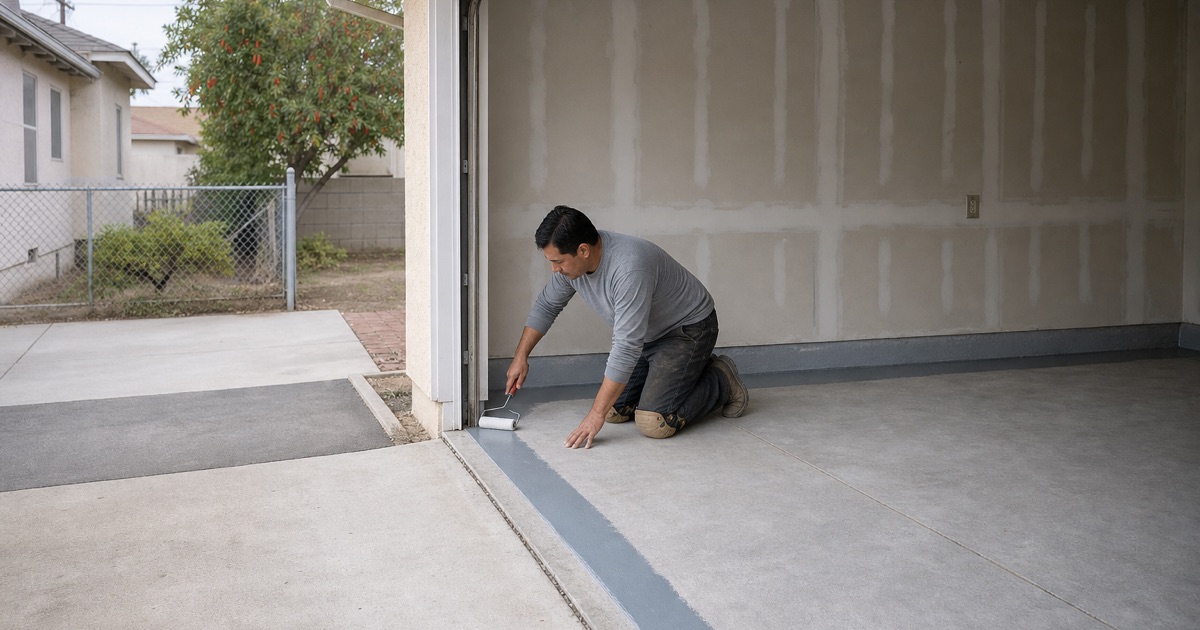
A Community That Writes Another Name on Its Mail
This is a census-designated place rather than a city, and it does not put its own name on its envelopes. Arrow Highway is the dividing line: addresses south of it are written with one neighboring city’s name and the ZIP code 91722, while addresses north of it are written with a different neighboring name and 91702.
So we do not expect anybody here to call us and say they live in Vincent. People give us the name the post office wants, and we write the quote to that address, because an estimate that argues with somebody’s own mailing address is an estimate that looks like it was produced by a stranger.
Why We Confirm the Parcel, Not the Envelope
What the mail says and what governs the property are two different questions, and here they genuinely diverge. The community covers just 1.473 square miles, and a house a block away can sit inside an incorporated city with its own building department, its own fees and its own inspectors.
So the jurisdiction gets read off the parcel rather than inferred from the address on the door. It takes a few minutes at the quoting stage and it removes the one mistake nobody can fix later: preparing a job under the wrong authority and finding out at inspection.
What That Actually Changes on a Quote
For most garage coatings the answer is nothing at all, and that is worth saying plainly rather than making the paperwork sound bigger than it is. A coating bonded to an existing slab is a finish, not a structural alteration, and the vast majority of the floors we do here never require anybody to open a file.
Where it matters is at the edges of the scope. Replacing a section of slab, altering drainage at the door line, or converting a bay into something other than parking all move the job into permit territory, and knowing in advance which counter that goes to is the difference between a two-week delay and none.
Looking for epoxy flooring closer to Grand Terrace? See Epoxy Flooring in Grand Terrace.
County Rules on an Unincorporated Lot
Who Issues the Permit Here
There is no local building department in this community and no municipal permit counter to walk into. Building and safety for unincorporated land in this part of the valley is the Los Angeles County Department of Public Works, Building and Safety Division, working out of its San Gabriel Valley district office.
That is a different counter, a different fee schedule and a different inspection route from any incorporated address, and the differences are procedural rather than trivial. Scheduling an inspection, submitting a plan and reaching a plan checker all work their own way, which is one more reason we settle the jurisdiction question before a crew is booked rather than after.
The County Handles the Lot, Not the Coating Chemistry
It is worth separating the two authorities, because customers reasonably assume one office covers everything. The county governs what may be built or altered on the parcel. It has nothing to say about which resin can legally be applied inside the building once it stands.
That second question belongs to the air district, and the air district does not stop at a city line. Being unincorporated changes the permit counter and changes nothing at all about which products are legal to install in a private garage here.
The Product Rules Do Not Change at the Boundary
Under South Coast Air Quality Management District Rule 1113, a floor coating is limited to 50 grams per liter of volatile organic compounds, while an industrial maintenance coating is allowed up to 100. Subsection (c)(6) then prohibits applying, or soliciting the application of, an industrial maintenance coating for residential use.
Every house in this community is residential use, whichever name the mail carries and whoever issues the permits. So the garage floors here come off our residential product line, and a contractor offering something tougher on the grounds that it is only a garage is offering something they are not permitted to install.
A Pocket of Slabs Poured in One Decade
Seventy Percent of a Community, Built at Once
The numbers here are extreme even by the standards of post-war valley tracts. 94.2 percent of the housing predates 1980, the 1950s alone account for 2,813 of the 3,927 units, and only 15 units in the entire community have been built since 2000.
That gives us one dominant slab and one dominant garage layout, which makes the estimating consistent. It also means nobody here should be quoted as though a modern floor is possible, because there are almost no modern floors in this community to quote.
What Seventy Years Does Underneath a Car
A slab of this age was poured before under-slab vapor retarders became routine, so ground moisture has been moving up through it continuously for its entire service life. That is the condition that decides whether a coating bonds at all, and it is invisible until it is measured.
We drill in-situ relative humidity probes, read them to the ASTM F2170 method and record the number before ordering anything, because moisture failure is the exclusion written into almost every coating warranty in this trade. A high reading is answered with a moisture mitigation system under the buildup, never with more material on top.
Shot Blasting, Diamond Grinding and Which the Floor Gets
The surface has its own history: settlement cracking, patches somebody made decades ago, and oil that has soaked well past the top of the concrete. That gets opened mechanically to a named ICRI concrete surface profile, and we never acid etch, which leaves residue in the pores and bites unevenly on exactly this kind of floor.
Which machine does the work depends on the slab. Shot blasting produces an aggressive, uniform profile quickly across an open floor, while diamond grinding gives more control at the edges and on a floor carrying an unknown old coating, and on some of these garages the honest answer is both, with the blast doing the field and the grinder doing the perimeter.
Repair Counted on Site, Never Over the Phone
On concrete like this the preparation and repair can outweigh the coating in labor, which is why a firm price offered over the phone without seeing the floor should be treated as a warning rather than a convenience. We measure it, count it and put it in the quote as its own items.
That means crack chasing and filling, spall repair mortar where the edge at the door has broken down, and an individual decision for each control joint to be filled, honored through the finish or bridged. Coating straight across a joint that is still working reproduces it on the surface within a year.
Working a Small Lot on a Narrow Street
Where the Truck and the Vacuum Go
This is a dense community of small lots, with short driveways, garages that are often detached and set well back, and street parking that is already full. There is frequently nowhere on the property to put a box truck, so a rig ends up occupying part of a narrow residential street instead.
We plan that before the day rather than negotiate it at seven in the morning: where the vehicles sit, how far the vacuum hose has to run back to the machine, and which neighbor is going to be blocked. Grinding and blasting both liberate respirable crystalline silica, so extraction runs on the equipment and the containment is protecting the house next door as much as our own crew.
Emptying a Garage That Is Doing Real Work
Households here are large for detached houses of this size, and it shows in the garages. These are working storage spaces under genuine pressure, holding what a full house cannot, and very few of them are one afternoon away from being empty.
Every item has to be out of the building before a machine starts, including the shelving along the walls, and that is a scheduling conversation at the quote rather than a surprise on the morning. Where a household needs a staged approach, it is better to book the work two weeks out and have the bay genuinely clear than to lose the first half day to moving somebody’s belongings onto the driveway.
Heat on the Day, and a Cure Schedule With Dates
An uninsulated garage in this part of the valley holds afternoon heat long after the air has started to drop, and that moves the chemistry rather than just the comfort. A product giving a crew roughly 60 minutes of working time on a 55-degree slab gives them about 20 minutes at 95, so batch size and crew positions follow the slab temperature and dew point read that morning.
The job then closes with a written cure schedule rather than a single number. Walking on the floor, carrying the storage back in, and parking a car with warm tires on it happen on three different days, and a household that has just spent a week clearing the bay deserves to know exactly when each of those becomes safe.
- 20+ Years Experience
- Licensed & Insured
- Free On-Site Estimates