
Upland Epoxy Floors installs epoxy flooring in South El Monte, and the person who calls us here is far more often a plant manager, a shop owner or a multi-tenant industrial landlord than a homeowner. Industrial uses take up roughly 54% of this city’s land area inside 2.85 square miles, and the daytime population of about 44,000 is more than double the number of people who live here.
That reverses the usual order of a page like this. The floor we get asked about sits under lathes, presses, benches and forklift wheels in one of the more than 1,300 businesses operating here, and it has been absorbing oil and coolant for decades before anybody thought about putting a coating on it.
So the work divides differently in this city. On a shop floor the coating itself is the last and smallest part of the job, while the contamination, the preparation and the sequencing around production carry the time and almost all of the risk. Everything below is written from that end rather than from the resin.
Floors in Metal and Machine Shops
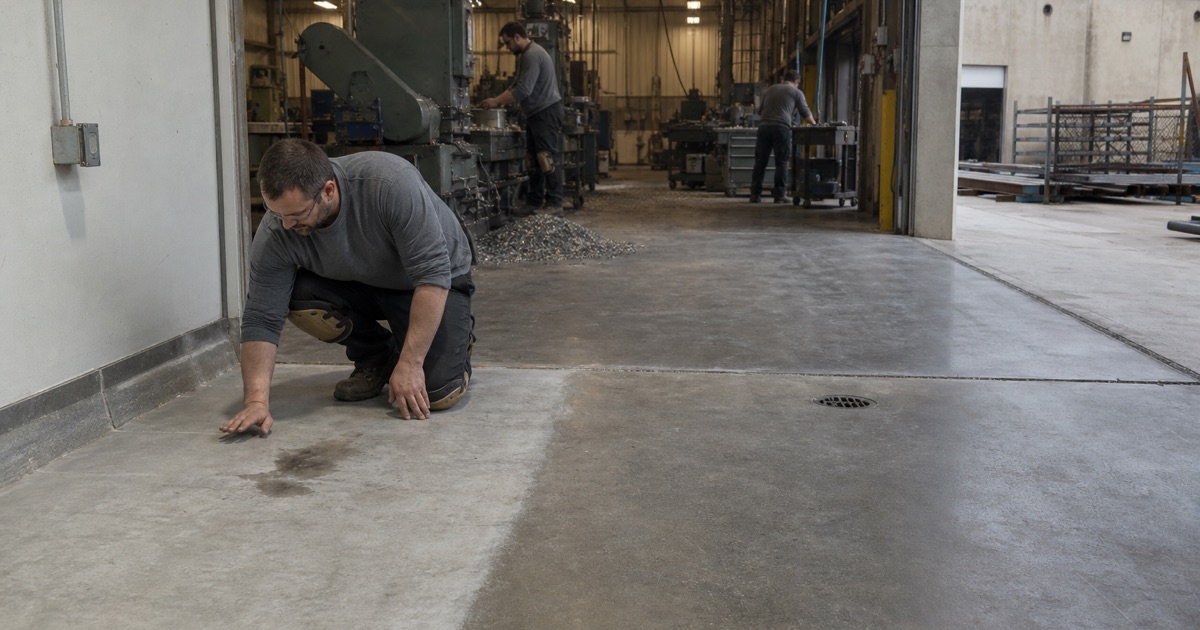
What a Machine Shop Floor Is Actually Asked to Do
A shop floor takes punishment a garage never sees. Bar stock gets dropped, chips and swarf get dragged underfoot, pallets land harder than anyone intends, and machine feet concentrate several thousand pounds onto pads the size of a hand. Impact resistance and mil build matter here in a way that surface appearance does not.
That points the specification toward a heavier buildup than a rolled film. A 100% solids epoxy placed at a real thickness, with quartz aggregate worked in where abrasion is worst, absorbs the impact and keeps a serviceable surface underneath it, which a thin coating chosen for looks will not do past the first year.
Anchors, Trenches and Everything Cut Into the Slab
A slab that has held machinery for sixty years is not a flat plane. It carries anchor penetrations from equipment that has been moved twice, patched utility trenches, saw cuts, floor drains and coolant channels, and each of those is a detail that has to be decided rather than covered over.
We map them before quoting. Penetrations get filled and made flush, patched trenches get assessed for whether they will move, and joints get filled with a semi-rigid joint filler, honored through the new surface or bridged depending on what crosses them. Coating straight over a joint is how a new floor develops the old floor’s cracks within a season.
Two Tenants in One Building, Two Specifications
The multi-tenant buildings here can hold operations with genuinely different floor requirements behind the same roof. The city’s base runs from textiles and consumer electronics through to research and development on medical instruments and devices commissioned by aeronautical and maritime work, and static control, cleanability, chemical resistance and slip rating are not interchangeable properties.
So a landlord asking for one specification across a building usually gets one unit wrong. Where an electronics or instrument tenant needs a static dissipative floor built and verified to an ANSI/ESD S20.20 program, that is a different system from the impact-rated floor in a fabrication bay next door, and both are cheaper to get right at the unit than to rework later.
Looking for epoxy flooring closer to San Marino? See Epoxy Flooring in San Marino.
Cutting Fluid, Oil and Sixty Years of Contamination
Oil That Went In Long Before the Current Tenant
The industrial stock along the Santa Anita Avenue corridor dates from post-war development in the 1950s and 1960s, and after that much manufacturing the contamination sits well below the surface. It is invisible on a swept floor and it does not announce itself until the grinder opens the concrete and the color changes.
Which is why we assess for it rather than assume. Deeply saturated concrete has to be removed to sound material or treated before priming, because an epoxy primer will not bond to oil no matter how good the profile above it looks, and a floor that debonds in the oil-soaked bay is the one nobody forgets.
Choosing a System Against a Real List
Chemical resistance gets specified against what the shop actually uses, not against a general durability claim. Water-soluble coolant, straight cutting oil, hydraulic fluid, solvent-based degreasers and the parts washers used to clean all of it attack a coating in different ways, and a system that shrugs off one can soften under another.
So the first question on a machine shop estimate is what is in the drums and what gets sprayed on the floor. Where the exposure is aggressive and constant, urethane cement earns its place over a standard epoxy buildup, and where it is intermittent an epoxy system with the right topcoat is the cheaper and equally sound answer.
Moisture Under a Slab Poured in the 1950s
Concrete of this era went down before under-slab vapor retarder practice was routine, so ground moisture can move up through it indefinitely regardless of what goes on top. This is the condition almost every coating warranty carves out of its own coverage, and it does not care how good the preparation was.
The reading therefore gets taken and written down before material is ordered, with in-situ relative humidity probes to the ASTM F2170 method or calcium chloride to ASTM F1869, and ASTM F710 governing how the surface is assessed. Where the moisture vapor emission rate comes back high, a moisture mitigation system goes in beneath the buildup rather than a heavier topcoat over the problem.
Working Around a Shop That Cannot Stop
Phasing Around Machines That Are Not Moving
Most of the equipment in these buildings is not going anywhere for a floor. Machines are anchored, leveled and connected to power, air and coolant, and unbolting one to coat under it is a bigger job than the coating. So the floor gets divided around what stays, and the scope is written as zones rather than as one square-foot figure.
The coating is then terminated at a clean edge that the next phase ties into, with the detail around machine bases and pads worked by hand. That hand work is slower than open floor per square foot and it gets its own time in the estimate, because pretending otherwise is how a phased job runs late.
Shutdown Windows, Nights and Weekends
Production sets the calendar and we scope backwards from it. A shutdown window, a weekend or an overnight gap is what a shop can offer, and we would rather commit to fewer square feet in a window and hand it back when we said than take on more area and give it back late to an operation with orders against it.
Every zone gets a written cure schedule that separates foot traffic, equipment and material return, and loaded forklift traffic, instead of a single number that quietly means the longest of the three. Where a bay has to run in the morning, a polyaspartic or polyurea topcoat over an epoxy build buys back hours a straight epoxy system cannot.
Dust and Odor at the Demising Wall
In a multi-tenant building the neighbors keep working while we do not. Sealing the demising wall, the shared loading area and any common corridor against dust and fumes is a condition of being allowed on site at all, and it is the part of the plan a landlord will ask about first.
Grinding concrete also releases respirable crystalline silica, so containment and extraction run on our equipment as standard rather than as an add-on. Odor gets sequenced into the quietest part of the window, and we confirm what ventilation is available before quoting rather than discovering the shared air handling on the night of the grind.
Heat Under a Metal Roof
Slab temperature and dew point are read on the morning of the pour rather than lifted from a forecast. The same product that gives a crew roughly sixty minutes of working time on a 55-degree slab gives them closer to twenty at 95 degrees, and a large uninsulated building runs well above outside air by mid-afternoon.
On a big open floor that changes crew size and batch discipline rather than just the start time. Mixes get smaller and more frequent, more mixers run at once, and the gauge rake and notched squeegee team is paced to the working time the slab is giving. On the largest pours that argues for an overnight or early morning placement outright.
Preparation, Layout and Which Rules Apply
The Preparation Is Most of the Job
On this stock the grinding, repair and detailing usually outweigh the coating in both hours and cost, and an estimate that does not reflect that is hiding something. Decades of forklift traffic leave worn joint edges and spalled thresholds, and spall repair mortar and crack routing get measured and priced up front rather than found on the second night.
The profile itself is opened with diamond grinding to a named ICRI concrete surface profile, never with acid etching, and shot blasting covers wide open areas faster with a deeper, more consistent texture. One crew carries the job from that first pass through to the topcoat, with no subcontracted surface preparation, because the bond is decided in the stage most contractors hand off.
Aisle Marking and Safety Striping
Aisle lines, pedestrian walkways and equipment exclusion zones belong inside the coating system rather than painted on afterward. Striping laid within the buildup and sealed under the topcoat wears at the rate the floor around it does, instead of scuffing away under the first month of wheel traffic and needing repainting every year.
That means the layout has to be settled before we coat. Machine positions, forklift turning room and walkway routes get marked up with whoever runs the floor, because moving a line after the topcoat is down means grinding a section out of a floor that is only weeks old.
Two Product Lines and Where Rule 1113 Draws the Line
Permits here come from the City of South El Monte Building & Safety Division at 1415 Santa Anita Avenue, with applications submitted through the city’s online permit portal, and tenant improvement work usually drives the schedule a coating has to fit inside. SCAQMD Rule 1113 then caps floor coatings at 50 grams per liter of volatile organic compounds and industrial maintenance coatings at 100.
That 100 gram category is genuinely in play on the industrial side of this city, which makes subsection (c)(6) matter more here than almost anywhere: it prohibits applying or soliciting industrial maintenance coatings for residential use. We quote commercial and residential work from separate product lines for that reason, and on the residential side, with half of occupied housing rented and roughly one home in ten a mobile home without an enclosed garage, we confirm who owns the slab and whether there is one before quoting anything at all.
- 20+ Years Experience
- Licensed & Insured
- Free On-Site Estimates