
Upland Epoxy Floors installs epoxy flooring in Sierra Madre, where the hardest part of most days is settled before the grinder is ever switched on. There is no freeway serving this city, so every truck, machine and pail arrives on surface streets, and there are no traffic signals anywhere inside it except at the city limits.
That is less a piece of trivia than an accurate description of the street network. These roads were laid out at village scale and never widened for a modern work vehicle, so where a rig can stand safely and legally is a real question at a good number of these addresses rather than a formality.
So we plan access first here and specification second. This page follows that order: reaching the slab, working on it with houses close by on either side, and only after that what actually goes down on the concrete.
Getting a Crew and a Grinder Into the Village
Everything Arrives on Surface Streets
The run out here from our hub is a little over twenty miles and none of it ends on a freeway, because there is no freeway access to this city at all. That shapes a working day rather than merely lengthening it: the last stretch is slow, and the number of stops a crew can honestly commit to shrinks accordingly.
We would rather account for that openly than pretend travel is free. It means we tend to book a full day at one address instead of squeezing it between two others, and it means the material list gets checked twice before anyone pulls away, since a forgotten pail is not a ten-minute errand from this side of the valley.
Where the Truck Actually Stands
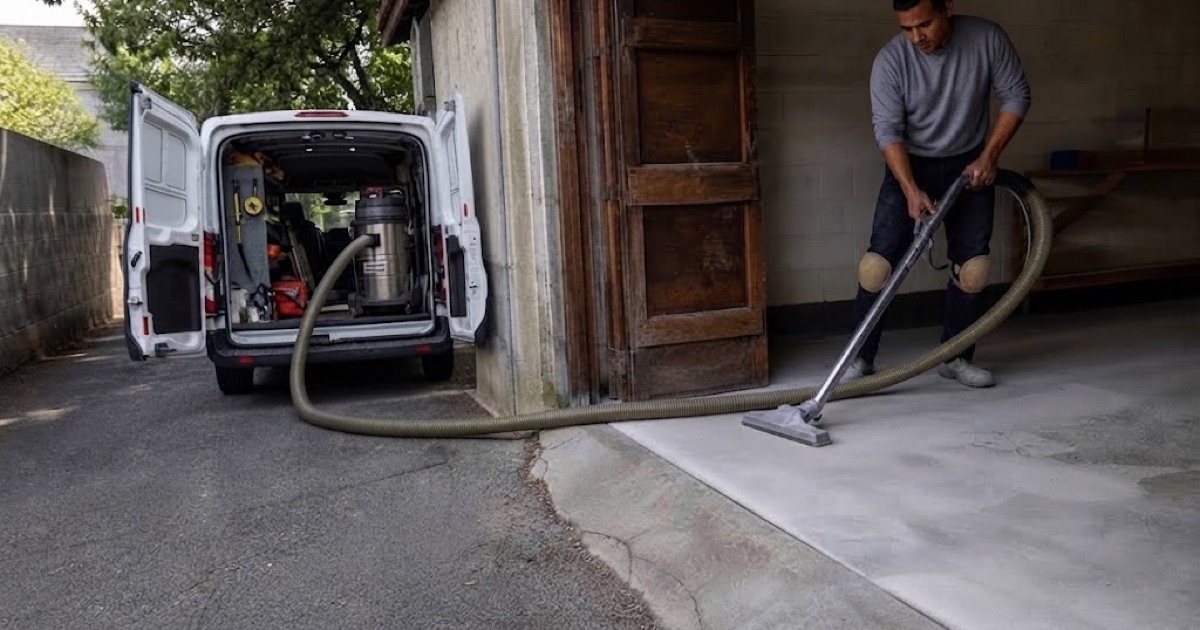
A box truck, a planetary grinder and a dust extraction rig all need somewhere to sit within hose reach of the door. On a street with no shoulder and cars parked along both sides, that somewhere is frequently in front of a neighbor’s house rather than the customer’s own frontage.
So staging is agreed before the day: where the vehicles sit, how long they are there, whose access has to stay clear, and where a hose crosses a public walkway. It is a quarter of an hour of planning that heads off the one problem on a job like this that no amount of skill on the floor can repair afterward.
Canyon Addresses Get Looked At Before They Get Quoted
The streets climbing north toward the trailheads and the wilderness park at the top of the city are a different proposition again. The roads narrow and wind under heavy tree cover, driveways are steep and short, several are shared between houses, and a fair number offer nowhere at all to turn a vehicle around.
Those addresses we walk before committing a truck to the trip. We measure the distance from wherever the rig can stand to the slab itself, because a vacuum on the end of too much hose is not really extracting anything, and if the honest answer is that smaller equipment has to go in, that is far better known at the quote.
Looking for epoxy flooring closer to South El Monte? See South El Monte Epoxy Flooring.
Old Detached Garages Off Rear Lanes
A Garage That Does Not Face the Street
Plenty of the older properties here keep the garage at the back of the lot, reached by a lane, an alley or a strip of driveway running the full length of the house. There is nothing unusual about that for the period. It simply means the equipment does not roll off a tailgate onto the floor.
We work the route out with the owner first: what fits down the side, what has to be carried by hand, where the machine takes its power from, and how far the extraction has to be piped back. Where a run is genuinely too long we move the vacuum closer and take the penalty in cable rather than accept weaker dust capture.
Concrete Poured Before the Practice Changed
This is genuinely old housing stock. 17.6 percent of the units here date from 1939 or earlier and a further 12.1 percent from the 1940s, with the 1950s the largest single decade at 21.5 percent and 79.8 percent of everything standing built before 1980.
Slabs from the earliest of those groups went down before under-slab vapor retarders were standard, so ground moisture has been rising through them for their entire lives. In-situ relative humidity probes go into the concrete, the reading is taken to the ASTM F2170 method and written into the quote, and where it comes back high the answer is a moisture mitigation system underneath the buildup rather than extra material over the top.
Small Bays Holding Everything the House Cannot
The lots here are small and the garages match them. An older single bay or tight two-bay yields less finished floor than most owners picture once the real interior is measured, and less clearance to run a machine along the walls, so a larger share of the perimeter is finished on hand-held edging equipment.
They also tend to be full. On a small lot the garage is often the only proper storage a household has, and the bay has to be completely clear, shelving included, before a machine is started. That belongs in the conversation at the quote so the schedule allows for it, rather than surfacing on the first morning.
Repair on Concrete This Old
Eighty or ninety years leaves marks. Settlement cracking, a broken lip where the slab meets the apron at the door, control joints that have opened, and patchwork done by somebody long since gone are the normal condition on these floors rather than the unlucky one.
Each of those gets its own line in the quote before the truck is loaded, and each joint gets a decision, filled or honored through the finish or bridged, instead of a default. What we will not do is skim a filler across a crack or feather mortar over a crumbling edge, because a repair that is not keyed into sound concrete only moves the failure a few inches and buys a season.
Dust, Noise and Close Neighbors
Containment on a Tight Lot
Grinding concrete liberates respirable crystalline silica, which is why extraction runs on our machines as standard rather than on request. On lots this size that containment is doing a second job as well, because the next house is often close enough that its windows look directly into the bay being worked.
So the opening is sealed down to a working gap instead of left wide, the extraction is checked before the machine starts rather than after the dust appears, and the cleanup at the end covers the driveway and the lane and not only the floor we were paid to coat.
Wind Days Are the Wrong Days
There are days here when opening a garage to the outside is simply a poor plan. Strong dry winds coming down off the foothills carry grit into everything they reach, and a floor still curing will take that grit permanently into its surface rather than shedding it later.
We would rather move a date than hand over a floor with the weather embedded in it. That call gets made in the morning, in the same conversation as the slab temperature reading, and it is one of the very few reasons we will ask to reschedule once a crew is already booked.
Noise, Hours and Odor
A planetary grinder is loud, and this is a small, quiet town whose city seal carries a drawing of the wisteria vine planted here in the 1890s. Sound travels between properties, so working hours are agreed with the customer, and on a shared lane we would rather the neighbor heard about it from us the day before than from the machine at eight.
Odor is the same courtesy in a different form. Where a bay is attached or the buildings sit close together we lean toward low-odor systems, and SCAQMD Rule 1113 sets the outer limit on that choice regardless, holding a floor coating to 50 grams per liter of volatile organic compounds against 100 for an industrial maintenance coating, which subsection (c)(6) bars from residential use altogether.
Rented Bays, Cure Times and the Floor You Look At
Who Signs, and Where a Permit Comes From
Not every inquiry here is a homeowner with one garage. 44.2 percent of occupied units are rented and 28.3 percent of the housing stock sits in buildings of two units or more, so a fair share of calls come from a small building owner asking about a shared or tuck-under bay rather than about a private one.
Those jobs need the owner’s authorization rather than the occupant’s, and they need a sequence that leaves some parking usable while the work runs. Where a scope grows past a coating into structural or drainage work, permits are issued by the city’s Planning and Community Preservation Department, Building and Safety Division, on West Sierra Madre Boulevard.
Shade, Heat and How Fast a Floor Cures
Cure is not one number across this city. The flats around Kersting Court and the boulevard heat up through an inland afternoon, while an address up under dense tree cover stays cooler all day, and that gap shows up immediately in the working time of whatever is being mixed.
A product that allows a crew roughly 60 minutes on a 55-degree slab allows about 20 minutes at 95, so slab temperature and dew point are read on the morning of the pour and batch size follows the reading. A shaded bay is the opposite problem: nothing rushes, but the cure stretches, which is why the schedule goes out in writing with separate dates for foot traffic, storage and the car.
The Finish, Seen on Your Own Slab
Only at this point does color enter the conversation, which is the reverse of the order most people expect. Vinyl flake broadcast to refusal earns its place on this housing stock because it breaks up the repairs an old floor needs and puts texture underfoot, and a polyaspartic topcoat over it holds up against hot tire pickup far better than epoxy left bare.
Blends are chosen from a full sample board laid on your own concrete in your own light, since a bay shaded by mature trees and one open to the flats will read the same blend quite differently. The same crew then grinds, primes and topcoats the floor, because surface preparation is the part of this trade we will not hand to anybody else.
- 20+ Years Experience
- Licensed & Insured
- Free On-Site Estimates