
Upland Epoxy Floors installs epoxy flooring in Santa Fe Springs, where most of the slabs that need coating have machines standing on them rather than cars parked on them. The city carries roughly 55 million square feet of industrial and manufacturing space across more than 3,000 businesses, and its daytime workforce runs past 30,000 against a resident population of 19,219 at the 2020 census.
That ratio decides what a coatings contractor is actually asked to do here. The economy is light industry rather than heavy, spread across advanced manufacturing, logistics, food production and aerospace, and the aerospace and defense operations sited in the city include Lockheed Martin, Boeing, L-3 Communications and GE’s Middle River Aircraft Systems.
Where parts are machined to a tolerance, a floor stops being a finish and becomes part of the environment the work happens in. It gets judged on whether it sheds particles, whether it can be cleaned to a standard, whether it holds a static charge and whether a pallet jack crossing it raises dust, and appearance comes last rather than first.
The Working Building Comes First
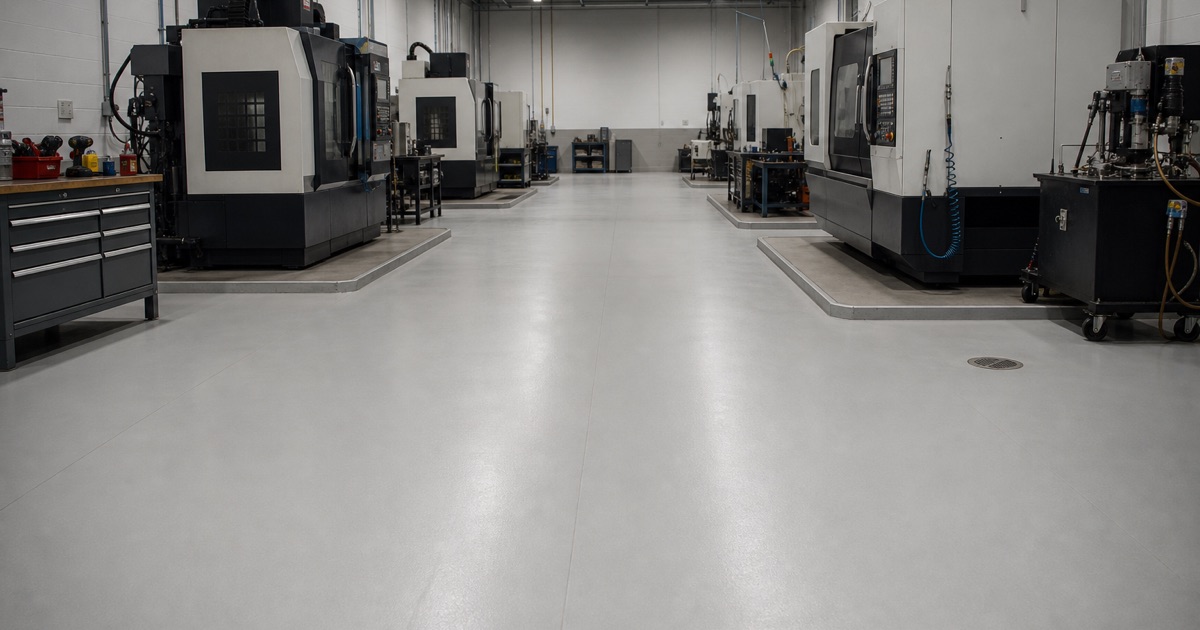
Two Industrial Floors for Every House
The commercial weighting here is unlike anywhere else we work, and pretending otherwise would produce a page about garages for a city that is mostly warehouses, machine shops and plants. Roughly three thousand businesses occupy that 55 million square feet, and they are the reason we make the drive.
Residential work in the city is real but small by comparison, and it is a different conversation with a different product on the truck. We treat the two as separate books of work rather than quoting a plant floor and a house from the same page, which the sections further down explain in more detail.
Getting a Crew Through the Gate
Precision and defense tenants run secured sites, and that means badge-in access, escorted contractors and a lead time on clearing names before anybody touches a slab. None of that exists on a residential job, and a schedule that ignores it slips before the first grinder comes off the trailer.
So we start the paperwork when the scope is agreed rather than the week before the pour. Crew names, vehicle details and site inductions get submitted early, because a coating crew standing at a guard station is burning the same daylight the customer is paying for.
Coating a Building That Does Not Stop
Distribution and manufacturing floors here are almost always occupied and running, and the product keeps moving whether or not a floor is being resurfaced. Realistic scopes are night shifts, weekend shutdowns, or phasing bay by bay so a roped-off section is ground, coated and handed back before the next shift needs it.
Phasing changes the material decision as much as the calendar. A polyaspartic or polyurea topcoat returns to service in a fraction of the time a straight epoxy needs, which often earns its cost back in shifts that never stopped, and the cure schedule we issue separates foot traffic, racking and vehicle return so a supervisor knows what can happen when.
Looking for epoxy flooring closer to La Palma? See La Palma Epoxy Flooring.
Cleanliness Written Into the Specification
A Floor That Does Not Shed
In a precision machining or assembly environment the floor is a particulate source, and dusting concrete puts grit into the air above workpieces held to tolerances measured in thousandths. A sealed, monolithic resin surface stops the slab itself from generating debris, which is the whole reason these floors get specified.
That pushes the buildup thicker than a decorative floor would ever need. A proper mil build with a solid epoxy primer bonded into an opened profile gives a continuous, non-porous surface with no seams for swarf, coolant mist or fine dust to work into, and it takes a scrubber without breaking down.
The Wall Junction and the Drain
Most cleanable floors fail at their edges rather than in the middle. A coating that stops at a raw wall junction leaves a right-angle crack the length of the room that collects everything the floor is supposed to shed, and no cleaning regime reaches into it.
An integral cove base carries the coating up the wall in a radius so a mop, a squeegee or a hose sweeps straight through the junction with nothing to catch on. Where there are drains, the coating is terminated properly into them and the falls are checked first, since a resurfaced floor holds water in exactly the same low spots the old one did.
Static Control Where Electronics Are Handled
Electronics assembly, test and repair areas need the floor to bleed charge away rather than store it, and that is a different product family from a hard-wearing shop coating. Static dissipative flooring is built with a conductive layer and grounding tied back into the building, so the floor is part of an electrostatic discharge control program rather than a surface underneath one.
It also has to be verified rather than assumed. Electrical resistance is a measured property with a range specified for the area, ANSI/ESD S20.20 is the standard those programs are written against, and a floor sold as anti-static with no resistance figure attached is a claim rather than a specification.
Containing the Dust We Make
Grinding concrete releases respirable crystalline silica, which is a regulated hazard for our crew and an immediate problem for a plant with production continuing forty feet away. Containment and vacuum extraction run as standard, and on a phased job the barrier separating our bay from a live one is doing real work.
It is also why we open the mechanical profile by diamond grinding to a named ICRI concrete surface profile rather than acid etching. Acid puts a liquid on a floor that has to be neutralized and rinsed away inside an operating building, and it produces a less reliable bond than the profile a grinder cuts.
Slabs That Have Held Machines and Hydrocarbons
Oil in the Ground and in the Concrete
The Santa Fe Springs Oil Field peaked at as much as 345,000 barrels a day in the 1920s and had given up more than 440 million barrels by 1938, and extraction still goes on inside the city. Hydrocarbons are part of the industrial history here in a way they simply are not in a residential suburb.
The floors show it. Machine bays hold decades of cutting oil and coolant, forklift maintenance areas hold hydraulic fluid, and none of it is visible depth-wise until the surface starts coming off. We grind, look at what is underneath and treat contaminated areas rather than coating over a slab that will reject the bond in patches.
Machine Pads, Joints and Point Loads
Equipment bases and anchor points break a floor into pieces the coating has to respect. Joints get an actual decision — filled, honored or bridged according to what each one is doing — because a joint that still moves under an unbroken film telegraphs through it and then splits the finish along its own line.
Cracks and spalls get priced from what we find at the survey rather than raised once the machines are running. On a floor carrying point loads from equipment feet and steel-wheeled traffic, a spall repair mortar placed properly at an edge is what stops a small failure turning into a hole that grows every time a pallet jack crosses it.
What Crosses the Floor All Day
Forklifts, pallet jacks and steel-wheeled carts abrade a floor in a way foot traffic never approaches, and they concentrate load onto very small contact areas. That argues for a heavier build and a topcoat chosen for abrasion and chemical resistance against the specific fluids the building actually uses.
We ask for that list instead of promising general durability. Cleaning chemistry, coolants, solvents and whatever gets spilled at the workstations all attack a coating differently, and a floor specified against a real inventory outlasts one chosen because it looked tough in a sample case.
Heat Inside a Metal-Skinned Building
Working time is a function of the slab surface rather than of the weather app. An hour of pot life on concrete at 55 degrees collapses to nearer twenty minutes once the same concrete reads 95, so the readings get taken where the material will actually go and the batch sizes are cut to suit them.
A metal-skinned warehouse with the roll-up doors open runs a slab surface well above the air temperature outside it, which catches out crews working from a weather app. The gauge rake and notched squeegee only move so fast, so on a hot slab we mix smaller and put more hands on the spread rather than losing a batch in the bucket.
The Residential Side and the Line Between Them
Half the Housing Came Out of One Decade
The houses here are concentrated in a single postwar burst: 45.3% of the city’s 5,927 housing units were built between 1950 and 1959, and 69.2% of them went up before 1980. Detached single-family homes make up 58.2% of the stock, with another 15.1% sitting in buildings of fifty units or more.
Slabs of that age generally went down before under-slab vapor retarders were routine, so moisture is the substrate risk on almost every house here. Probes go into drilled holes and sit until the concrete equilibrates around them, which is what the ASTM F2170 relative humidity method asks for, and the figure they return is written into the quote rather than into somebody’s memory. Moisture failure is the exclusion sitting in nearly every coating warranty.
Two Product Lines, and a Legal Reason for It
The air district draws a line straight through the middle of our product list. Rule 1113 sets the ceiling for a floor coating at 50 grams of volatile organic compounds per liter and for an industrial maintenance coating at 100, and its subsection (c)(6) makes it unlawful to apply or even to offer that second category on residential work.
In this city that line cuts in the direction people do not expect. The product that is correct and lawful on a distribution center floor is not lawful to offer for a home garage a mile away, so residential and commercial quotes come off separate product lines and a homeowner who has seen the plant floor down the road hears why their floor is specified differently.
Planning Around a Four-Day Counter
Permits and inspections come from the City of Santa Fe Springs Building and Safety Division inside the Planning and Development Department, and the counter runs Monday through Thursday, 7:30 to 11:30 in the morning and 2:00 to 4:30 in the afternoon, with City Hall closed on Fridays.
That four-day week is worth building into a program rather than discovering mid-job, particularly on a phased floor tied to a shutdown weekend. The city works to the 2025 California Building Standards Code, and where a floor forms part of a wider tenant improvement we take the answer from that counter instead of guessing at it.
- 20+ Years Experience
- Licensed & Insured
- Free On-Site Estimates