
Upland Epoxy Floors installs epoxy flooring in San Marino, and this is one of the few cities on our map where the first approval a job needs is not for the floor but for the people coming to build it. Every contractor working inside the city limits holds a City business license, and commercial vehicles need permission to work here at all.
The buildings are unusual too. Single-family detached houses account for 98.6% of the city’s 4,439 housing units, with no mobile homes and not one structure of five units or more anywhere in the city, and 82.8% of those houses are owner-occupied.
Most of them are also old. Fully 92.9% of the stock predates 1980, 40.8% was built in 1939 or earlier, and 69.0% of the city went up before 1950, so the garage we are asked to look at is usually detached, set back from the street, and poured by somebody working to nobody’s specification.
Permission to Work Here Comes Before Permission to Coat
The Business License Every Trade Carries
San Marino requires all contractors working in the city to obtain a City business license, and that applies to construction, plumbing, painting and a coatings crew alike. We settle it before a date goes in the calendar rather than treating it as paperwork to catch up on afterward.
The city runs its own counter for the rest as well. Plan check and building inspection come from the City of San Marino’s Building and Safety Division at 2200 Huntington Drive, so where a floor forms part of a wider scope the question goes there. We do not guess at what a scope requires and then apologize later.
A Vehicle Permit Before the Rig Parks
The commercial vehicle requirement is the part that catches outside contractors. San Marino is restrictive of commercial operations generally and one of the few cities in the region that requires commercial vehicles to hold a permit to work within its limits, which puts a loaded truck and a towed dust extractor squarely inside the rule.
Commercial activity in the city is confined to Huntington Drive and the old town on Mission Street, so a work vehicle on a residential block is conspicuous by design. Handling that in advance means the morning of the grind is spent grinding, and an owner who cleared a day for us spends it watching progress instead of a stationary truck.
Why the Measuring Visit Does More Here
At close to twenty-six miles, this is the longest run on our schedule. A return trip for one dimension we could have taken the first time costs a working morning, which is a very different penalty from the one a job fifteen minutes away carries.
So a single visit collects everything that decides the quote: bay dimensions, doorway width, headroom, the moisture reading, the condition of whatever is on the slab now, and the distance from the nearest legal place to stand a truck. The second visit is meant to be the one where material comes off it.
Looking for epoxy flooring closer to Santa Fe Springs? See Epoxy Flooring Services in Santa Fe Springs.
Carriage Houses, Detached Bays and the Drive Down to Them
Buildings Poured Before Anyone Wrote a Standard
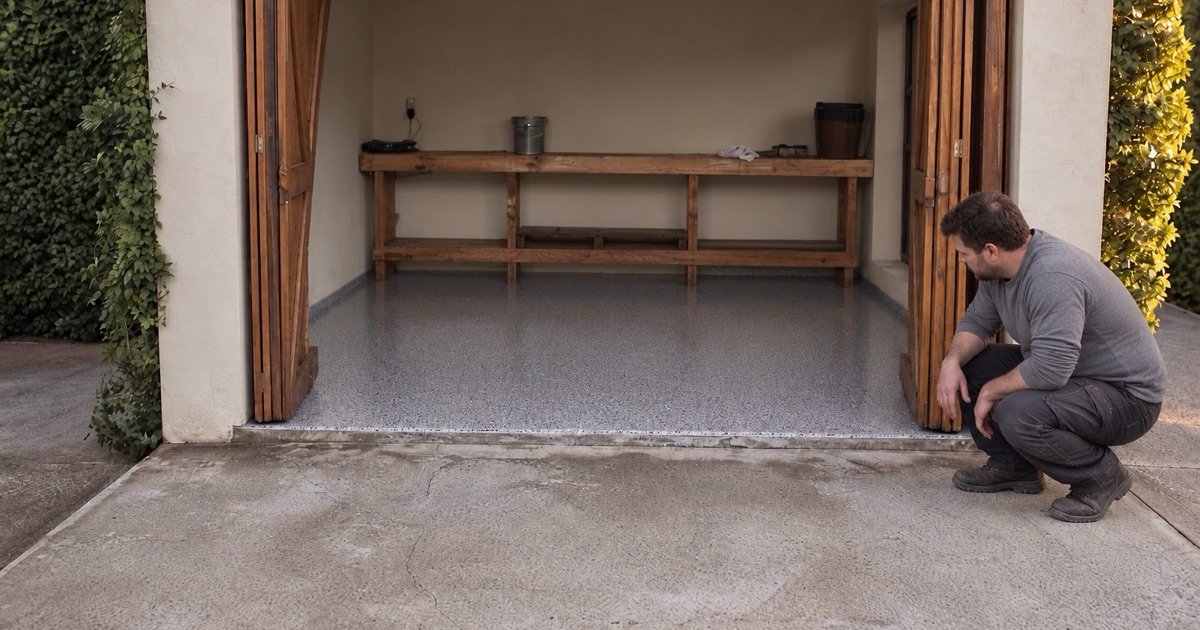
With four in ten houses dating to 1939 or earlier, a real share of what we quote is not a garage in the modern sense. Estate-era outbuildings, carriage houses and former chauffeur’s quarters turn up regularly, often with living or storage space above the bays and a slab placed long before a residential garage floor had a standard to meet.
Almost nothing transfers from one of them to the next. Headroom, doorway width, whether there is a drain and which way the floor falls toward it, and how the slab meets the walls all change building to building, which is why these get measured individually rather than priced from a photograph.
A Driveway Sized for a 1930s Car
The route to a detached San Marino garage is typically a long side driveway, frequently past a gate, and ninety years of mature planting has narrowed it from both edges. A drive laid out for a car of that period rarely accepts a modern box truck, and that is something to establish with a tape rather than in a mirror.
When the truck has to stay at the curb, the job turns into a question of reach. Power, water and the hose back to the extraction rig all have to make the distance, so we record that run on the first visit; a rig parked out of range is a lost day at the far end of a long drive.
One Owner, One House, One Slab
Because the city is almost entirely detached houses held by the people living in them, nearly every conversation happens with a resident owner spending discretionary money on a property they intend to keep. There is no board to satisfy and no unit turnover driving the date.
That changes which answers matter. The questions we get are about how long a floor lasts and how it will look in ten years rather than how fast it can be handed over, and they deserve specifics about buildup and preparation rather than reassurance about quality.
The One Building Here That Is Not a House
The Huntington Library, Art Collections and Botanical Gardens occupies about 120 acres on Oxford Road, and institutional work of that kind runs on nothing like a residential rhythm. Back-of-house shop, storage and support floors sit inside a public institution with visitors on the grounds and collections to protect.
The constraints there are about timing more than chemistry. Access windows, odor, noise and where a crew can stage are dictated by the institution’s own calendar, so the sequence gets agreed with facilities first and the coating schedule is built to fit inside it rather than the other way around.
What Ninety-Year-Old Concrete Actually Requires
Moisture Is a Gate, Not a Formality
Slabs of this vintage were placed before under-slab vapor retarders were standard practice, so there is generally nothing separating the concrete from the ground beneath it. Vapor driving up through a slab is the failure almost every coating warranty excludes, and a dry-looking floor tells you nothing about it.
We read it with in-situ relative humidity probes to the ASTM F2170 method and write the number down before any material is ordered. If that reading calls for a moisture mitigation system underneath the buildup, it is a different scope and a different order, and it belongs in the quote rather than in a phone call on day two.
Oil You Cannot See Until the Machine Runs
An unsealed slab that has held cars since before the war has taken on a great deal of oil, and how deep that contamination goes is invisible until the surface starts coming off. Grinding finds it. Assuming it away produces a bond failure shaped like an old drip pan.
We open the profile by grinding rather than etching, cutting it to a named ICRI concrete surface profile, and a single crew carries the floor from that first pass through to the topcoat. Preparation handed off to somebody else is preparation nobody answers for, and on concrete this old the preparation is most of the job.
Cracks, Spalls and Joints That Have Moved
Nine decades of settlement leaves cracks, and edges that have met a jack stand or a swinging car door leave spalls. Both get priced from what the measuring visit turns up rather than raised once the machines are running, which is the difference between a line item and an argument.
Joints get a decision rather than a coat of resin. Depending on what a joint is doing we fill it, honor it or bridge it, because a joint that still moves under a coating telegraphs through and then splits the finish along its own line, which reads as a defective floor even when everything above it was done correctly.
Product Class, Finish and a Light Footprint
The Rule That Decides What Can Go Down
Coating categories are not interchangeable in this air basin. Under South Coast Air Quality Management District Rule 1113 the ceiling on a floor coating is 50 grams of volatile organic compounds per liter, twice that on an industrial maintenance coating, and subsection (c)(6) shuts the harder category out of residential work entirely.
In a city that is 98.6% single-family detached, that subsection governs very nearly every floor we lay here. Residential and commercial work therefore comes off separate product lines, which is a legal division rather than one we invented, and an owner asking for the hardest-wearing material available is owed the reason the honest answer is a residential one.
Slab Temperature Sets the Working Window
Pot life is set by the slab, not by the label. A product that stays workable for close to an hour on a 55-degree floor is finished in about twenty minutes once that floor reads 95, so we take slab temperature and dew point on the day of the pour and size the batches and the crew from what the concrete tells us.
Shade cuts the other way. A detached bay under mature trees runs cooler than an exposed slab and cures more slowly for it, which is why the cure schedule we hand over separates foot traffic, furniture and vehicle return instead of collapsing three different thresholds into a single number.
A Finish That Belongs on the House
Design review and zoning here are strict, the historic preservation posture is strong, and anything visible from the street on an older property draws more attention than it would in a post-war tract. An interior bay is rarely the subject of that, but a carriage house standing open onto a front drive can be.
Finish selection therefore happens on the floor itself. We lay a full sample board on the owner’s own slab in its own light, because a flake blend that reads warm under one fixture in a closed bay reads cold with the doors open, and on a period property the gap between those two renderings is the entire decision.
Leaving No Evidence at the Curb
Grinding concrete releases respirable crystalline silica, so containment and extraction run as standard for the crew before anyone else. On lots where a detached garage sits close to a neighbor’s hedge rather than across a wide setback, that same containment is what keeps dust off a property nobody hired us to work on.
The rest is ordinary consideration that this city rewards. Where vehicles stand, which hoses cross the drive and when the noisiest stage happens all get agreed beforehand, and the street looks the same at the end of the day as it did at the start.
- 20+ Years Experience
- Licensed & Insured
- Free On-Site Estimates