
Upland Epoxy Floors has installed epoxy flooring in San Dimas for more than twenty years, and an unusual share of it has gone down outdoors around water rather than inside a building. Pool decks, spa surrounds, aquatic plant rooms and the concrete between a house and its back yard are a steady part of what we are asked to quote here.
Those floors are a harder problem than an interior slab, and they are harder in ways that are easy to underestimate. A deck is barefoot traffic on a wet surface, in direct sun, over concrete that is taking moisture from the ground below and chlorinated water from above, all at once and all year.
Get any one of those wrong and the floor tells on you quickly: it gets slick, or it gets too hot to stand on, or it starts lifting at the edge nearest the coping. The interior work follows the same discipline, so this page starts outside and works its way back into the garage.
Pool Decks and Aquatic Surrounds
Traction on a Wet, Barefoot Surface
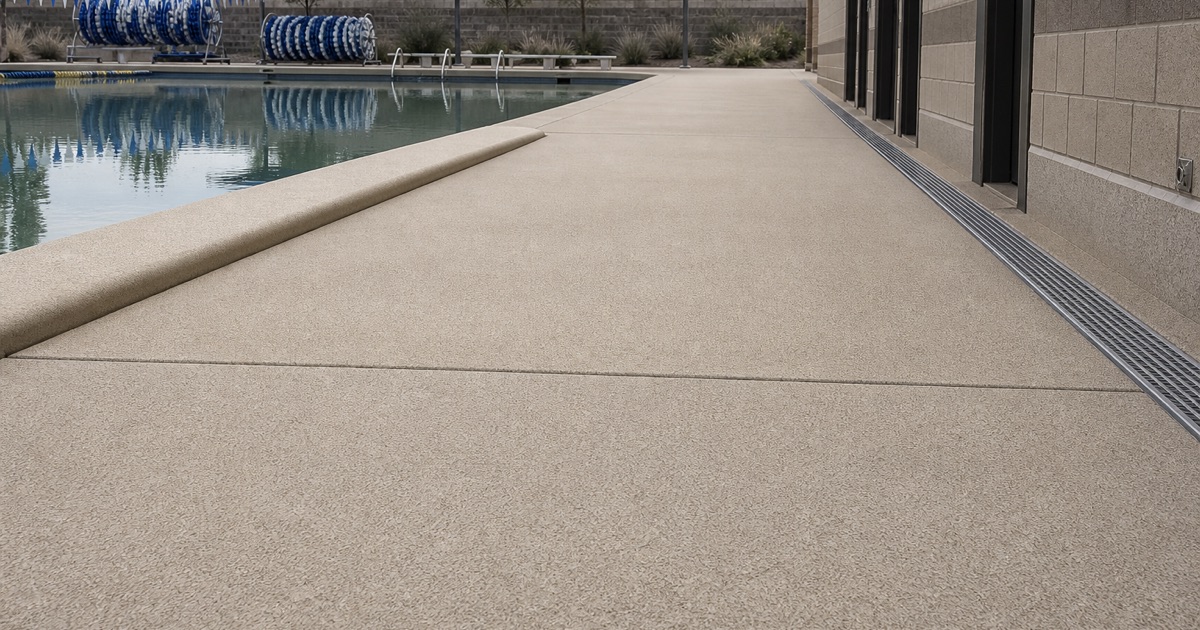
A pool deck is the one floor we install where people are guaranteed to be wet, barefoot and moving quickly, and it is the reason grip on these jobs is specified as a number rather than described as a feature. Traction is measurable as a dynamic coefficient of friction under ANSI A326.3, which gives an owner something to hold the finished surface to.
The grip itself comes from what is broadcast into the coating, not from the resin under it. A quartz aggregate broadcast produces real mechanical texture that keeps working when the surface is streaming water, and the grade of that aggregate is chosen so the deck stays comfortable on bare skin instead of behaving like sandpaper.
Surface Temperature and Sun Exposure
The second thing a deck has to survive is the sun sitting on it all afternoon. A dark, dense finish stores that heat and hands it straight back to whoever steps out of the water, and a deck nobody can cross barefoot in July has failed at its job however well it was installed.
So color choice outdoors is a thermal decision before it is a decorative one. Lighter, more reflective finishes run measurably cooler underfoot than dark ones, and on an exposed deck with no shade structure that difference is the gap between a usable surface and one that gets covered in towels.
Ultraviolet exposure also governs which product goes on top. Epoxy is the right body coat but it ambers and chalks in direct sun, so exterior work here gets a polyaspartic or polyurea topcoat over the epoxy build to hold color and gloss rather than leaving the epoxy exposed.
Preparing and Detailing the Deck Slab
Exterior slabs sit on damp ground with no vapor retarder worth relying on, and a coating that cannot cope with vapor pushing up from underneath will blister no matter how carefully it went down. We read the slab with in-situ relative humidity probes to the ASTM F2170 method and record the result before ordering material, because moisture failure is the exclusion written into nearly every coating warranty.
Profile is opened by diamond grinding to a named ICRI concrete surface profile. We do not acid etch, and around a pool that is more than a preference, since rinse water from etching has to go somewhere and the somewhere is usually the planting or the pool itself. Grinding also releases respirable crystalline silica, which is why extraction and containment run on our machines as standard.
Detailing at the water’s edge is what separates a deck that lasts from one that peels. The coating is terminated properly at the coping and carried into a cove where a wall or a raised bond beam meets the deck, and it is turned into deck drains rather than stopped short of them, because water finds the one unsealed edge and works underneath from there.
Looking for epoxy flooring closer to Chino? See Chino Epoxy Flooring.
Recreation and Aquatic Facility Floors
The Operating Season Sets the Schedule
Commercial aquatic work in this city runs on somebody else’s calendar. The water park at 111 Raging Waters Drive is a warm-weather operation, so deck, walkway and back-of-house floor work realistically belongs to the months it is not running rather than to the months a contractor would find convenient.
That compresses everything into a fixed window with a hard end date, which changes the specification as much as the schedule. We size the scope to what can be prepared, coated and fully cured inside the closure, and where a section cannot be finished properly in the time available we leave it for the next off-season instead of rushing a cure.
Plant Rooms, Pump Houses and Chemical Storage
The floors behind an aquatic facility take more punishment than the ones the public sees. Pump rooms and chemical storage areas deal with concentrated pool chemistry, constant damp and equipment vibration, and a standard decorative system is simply the wrong family of product for that room.
Urethane cement is what belongs in those spaces, because it tolerates the chemical attack and the hosing down without softening, and it can be laid thick enough to take equipment loads. Cove base turned up at every wall keeps a spill contained on the floor rather than running into the wall junction where nobody can clean it.
Buildings Around the Reservoir
Frank G. Bonelli Regional Park covers 1,800 acres around the 250-acre Puddingstone Reservoir, and its restrooms, concession buildings and maintenance shops are exactly the kind of high-traffic public floors that suit a seamless resinous system. Sand, lake water and heavy foot traffic wear these surfaces in ways a domestic floor never sees.
One practical note on that work: the park is run by Los Angeles County, so a facility job inside its boundary is a county procurement rather than a city one. It is a different buyer, a different approval chain and usually a different lead time from anything on the residential side of our schedule.
Garages in a City That Mostly Owns Its Homes
What the Tract Slabs Test At
About 63.3% of the city’s 12,370 housing units were built before 1980, with the 1970s alone accounting for 32.2% of them, which makes the typical garage here a tract slab roughly fifty years old. That is old enough to have moved and cracked, but modern enough that it was usually poured over a proper base.
In practice that means the moisture reading on an interior garage slab here comes back workable more often than not, and the job is a straightforward grind, repair and coat. We still take the reading rather than assuming it, because the cost of testing is trivial next to the cost of a floor that debonds across the middle bay.
Cracks and spalls get measured and priced at the walkthrough. Spall repair mortar at the door threshold and semi-rigid joint filler in the control joints go into the quote as visible lines, so nothing is discovered halfway through a job when the customer’s car is already on the driveway.
Hillside Driveways and Tuck-Under Garages
The hillside neighborhoods on the north and west sides of the city, Via Verde among them, sit on sloped lots with tuck-under and split-level garages reached by steep, narrow driveways. Backing a box truck down one of those and running a grinder and dust extractor from it is a genuinely different proposition from a flat suburban approach.
The slope matters underfoot too. A garage slab pitched toward the door will not hold a self-leveling product the way a flat one does, so the buildup is placed and worked with a gauge rake and notched squeegee to a controlled mil build rather than allowed to find its own level and pool at the low end.
Clearing a Storage Garage First
Up against San Dimas Canyon and the wildland edge, garages tend to be the household’s real storage, packed to the walls with everything that will not fit in the house. Every bit of it has to come out before we start, because the grinder needs the whole slab and the coating needs an uninterrupted edge at every wall.
We say that plainly at the estimate rather than letting it become an argument on the morning of the job. Owners who plan the clear-out over the weekend before get a full-coverage floor; owners who leave shelving in place get a coating that stops in a ragged line where the shelving stood.
How the Work Gets Specified and Run
An Owner Making the Decision
At 72.4% owner-occupied, the highest rate anywhere we work, the person we are quoting in San Dimas is almost always the person who will park on the floor. That makes the conversation a longer and more detailed one, because the outcome matters to them personally rather than as a line in a turnover budget.
So we bring a full sample board and lay the flake blends on the customer’s own slab, in their own light, with the door open. Chips read completely differently under a showroom lamp than they do in a garage at four in the afternoon, and a choice made from a printed card is how people end up surprised.
Every job also leaves with a written cure schedule that gives separate times for foot traffic, for furniture and shelving, and for driving a vehicle back on. Quoting one number for all three either keeps a floor out of use longer than necessary or invites hot tire pickup, where a warm tire lifts the coating off a slab that was not ready for it.
Heat, Pot Life and the Shape of the Day
We read slab temperature and dew point on the morning of the pour rather than trusting a forecast made a week earlier. The same material that gives a crew about sixty minutes of working time on a 55-degree slab gives them closer to twenty at 95, and an uninsulated garage in August sits firmly at the short end.
That is a scheduling fact, not a disclaimer. On hot days batches shrink, more mixing runs in parallel, and the exterior deck work starts at first light so the coating goes down before the slab has spent four hours absorbing sun.
What the Rules Allow and Who Does the Work
San Dimas sits under the South Coast Air Quality Management District, whose Rule 1113 caps floor coatings at 50 grams per liter of volatile organic compounds and industrial maintenance coatings at 100, while subsection (c)(6) bars applying or soliciting industrial maintenance coatings for residential use. We quote homes and commercial facilities from separate product lines because that is a legal boundary rather than a stylistic one.
Where a job touches permitted work, the authority is the City of San Dimas Building and Safety Division at 245 East Bonita Avenue, enforcing the California Building, Electrical, Plumbing and Mechanical Codes. Coatings themselves generally sit outside that process, but the pool, plumbing or electrical work they are scheduled around often does not.
One crew carries every job from the first pass of the grinder to the last pass of the topcoat, with no subcontracted surface preparation. Preparation is where these floors are won or lost, and handing it to somebody else means handing away the only stage that decides whether the coating bonds.
- 20+ Years Experience
- Licensed & Insured
- Free On-Site Estimates