
Upland Epoxy Floors has spent more than 20 years installing epoxy flooring in San Antonio Heights, and the work here is residential from the first quote to the final topcoat. Of the 1,216 housing units in the community, 93.7 percent are single-family detached and another 3.9 percent are single-family attached, with no mobile homes and no commercial or industrial floor stock anywhere inside the boundary.
Every slab we are asked to coat is therefore part of a house somebody lives in: a garage, a separate shop building at the back of the lot, a patio, a basement. With 84.2 percent of the 1,206 occupied units owner-occupied and a median owner value of $1,071,800, the person signing the quote is almost always the person who will be parking on that floor for the next fifteen years.
The second thing shaping the work is that this is an unincorporated census-designated place. There is no local government here and no association covering the community as a whole, so permits are a county matter, and the crew reaches most jobs by climbing narrow foothill streets at the mouth of San Antonio Canyon. Both facts change how a job gets quoted.
Estate Garages and Separate Shop Buildings
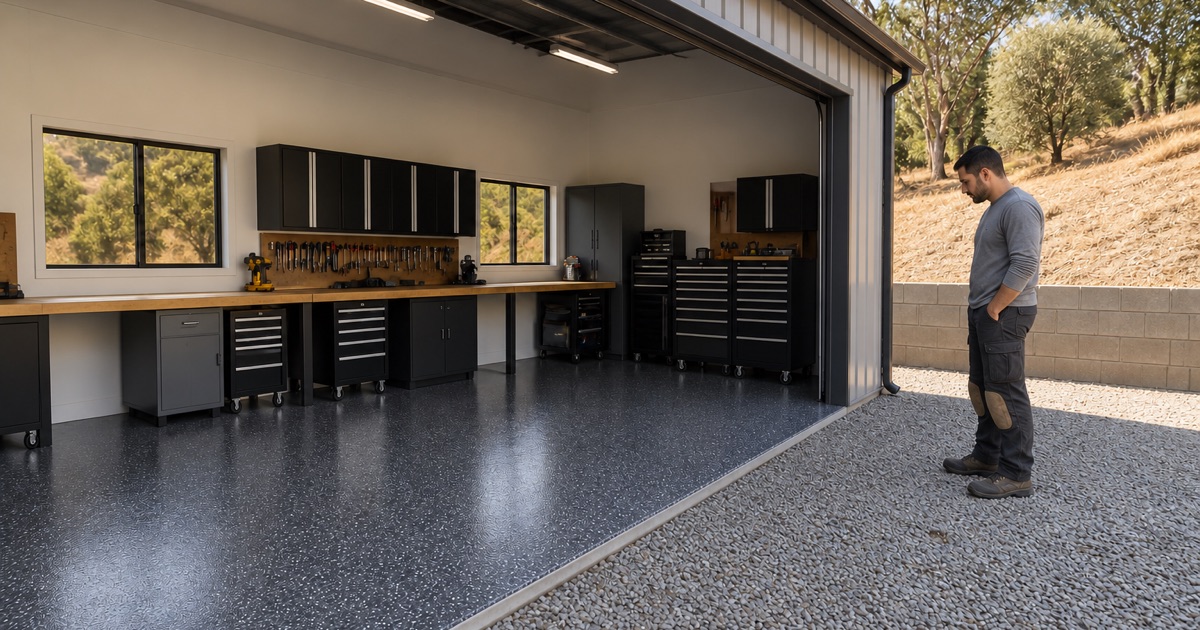
The Detached Shop Is Its Own Specification
A three-bay garage hung off the house and a standalone shop at the rear of the property ask different things of a coating. The shop is where the welder, the lathe, the parts washer and the floor jack live, and its slab takes point loads and dropped steel that a parking bay never sees. We specify the two buildings separately rather than pricing the whole property at one rate per square foot.
In practice that means a heavier mil build in the shop, a 100% solids epoxy body coat instead of a thin roll-on, and a topcoat chosen for chemical resistance against solvent, cutting fluid and battery acid. Where a jack or a dolly tracks the same line every weekend, we will often put polyaspartic over the epoxy, since it cures harder and faster than the resin carrying it.
Bays That Hold More Than Cars
Garages on lots this size tend to serve as overflow storage as much as parking, with a second refrigerator in one corner, wall shelving down a side and seasonal gear stacked along the far bay. That affects the calendar more than the specification, because every bit of it has to come off the slab before a grinder touches it and the owner needs a truthful date for putting it back.
So the cure schedule we hand over separates the three returns instead of quoting one number for all of them. Foot traffic comes back first, shelving and furniture later, vehicles last, because hot tire pickup happens when a warm tire parks on a coating that has not finished cross-linking rather than because the material was cheap.
Sloped Driveways, Sloped Slabs
A good number of garage slabs here are poured with a pronounced fall toward the door, since the approaches are steep and water has to have somewhere to go. A self-leveling product will not stay where the gauge rake put it on a floor like that, so we choose a body coat with enough body to hold position and work a notched squeegee across the fall rather than down it.
The same slope changes how the flake goes down. Broadcasting to refusal is simple on a flat floor, but on a grade we work in narrower sections so the resin is not migrating downhill while a crew member is still throwing into it. It is slower, and it is the difference between an even floor and one that reads heavy at the door.
Picking the Finish in Your Own Light
Flake blends look nothing alike on a sample card under shop lighting and on concrete in a canyon-shaded garage, so we lay the full sample board on your own slab and look at it where the floor will actually live. A blend that reads cool gray indoors can pull brown once foothill daylight comes through an open door.
Metallic finishes are the other request we get, usually for a shop the owner treats as a room rather than a utility space. They are a legitimate choice and we are straight about the trade: a metallic floor shows more of the slab’s history underneath it and demands a steadier hand at installation than a flake system covering the same area.
Looking for epoxy flooring closer to Claremont? See Epoxy Flooring Services in Claremont.
Building on an Unincorporated Lot
Who Actually Issues the Permit
San Antonio Heights has no building division of its own. Work in this community goes to the San Bernardino County Land Use Services Department, Building and Safety Division, which surprises owners whose mail arrives addressed to a post office in a city they do not actually live in. We name the correct counter while quoting so nobody burns a morning at the wrong one.
Recoating an existing slab is usually not a permit event in itself, but the work that tends to accompany it can be: converting a shop building to conditioned space, cutting in a floor drain, replacing a failed section of slab. When a job crosses that line we say so before the grinder comes off the trailer rather than partway through the week.
Fire Review and Clearance Around the Work
These are foothill parcels in fire-hazard country, and county fire review shapes what happens on a property here more than a valley homeowner expects. Access-road width, defensible-space clearance around the structures and the state of the driveway all come into it on anything more involved than a floor finish.
For our part it shows up as a staging question rather than a paperwork one. We want brush cut back around wherever the grinder, the vacuum and the material drums are going to sit, and we would rather settle that with an owner beforehand than drag hot equipment and hoses across dry fuel on an August afternoon.
The Rule That Decides What Is Legal to Apply
This community falls under the South Coast Air Quality Management District, whose Rule 1113 caps floor coatings at 50 grams per liter of volatile organic compounds and industrial maintenance coatings at 100. Subsection (c)(6) goes further and prohibits applying, or even soliciting the application of, an industrial maintenance coating for residential use.
Because every structure inside this boundary is residential, that is not a fine distinction here — it takes an entire product shelf off the table before the conversation starts. We quote residential and commercial work from separate product lines for exactly this reason, and on a job in this community only one of those lines is legally available.
Older Foothill Slabs and What Age Does to Concrete
Poured Before a Vapor Retarder Was Standard
Nearly a fifth of the housing here, 18.9 percent, went up before 1940, and much of the rest followed in the decades either side of mid-century. Slabs of that vintage in this part of the region were commonly placed straight onto graded soil with nothing beneath them to interrupt ground moisture working upward into the concrete.
Coat a slab like that and the coating traps moisture the concrete was never asked to hold, and delamination follows in sheets rather than spots. Moisture failure is the single exclusion almost every coating warranty in this trade carries, which is precisely why we treat it as the first question on an older property instead of a footnote at the end.
Reading the Slab Before Any Material Is Ordered
We set in-situ relative humidity probes into the slab and read them to the ASTM F2170 method, and that number is written down before a drum of anything is ordered. Where a slab reads high the answer is a moisture mitigation system underneath the buildup, not a heavier topcoat over the top of the problem, which only reschedules the failure.
The same visit records slab temperature and dew point, because a pour is governed by the day it happens on rather than by an average. One product gives a crew roughly 60 minutes of pot life at 55 degrees and about 20 minutes at 95, and a foothill slab can travel a long way through that range as canyon shade crosses it.
Cracks, Joints and Spalls at Eighty Years Old
Concrete this old arrives with a history written into it: settlement cracks, spalled edges at the door line, control joints that have opened up. We price crack repair, spall repair mortar and joint treatment up front, because the alternative is handing a change order to a homeowner whose garage is already emptied and ground open.
Joints get a decision rather than a coat of resin. Depending on whether the joint is still moving we fill it, honor it through the finished surface, or bridge it, and running a coating straight across a live joint simply prints that crack through the new floor inside a season.
Profile Comes From Grinding, Never Etching
We open the slab by diamond grinding to a named ICRI concrete surface profile and never with an acid etch. Etching leaves residue down in the pores and gives an uneven bite, and on concrete that has been absorbing oil since the Eisenhower administration a mechanical profile is the only preparation worth trusting.
Grinding releases respirable crystalline silica, so extraction runs on the machine as standard and the dust ends up in the vacuum rather than through the house. The same crew that grinds also lays the primer and the topcoat, since we do not subcontract surface preparation and the person who prepared a slab should be the one answering for how it bonded.
Getting a Crew and a Grinder Up the Canyon
Narrow Streets Need a Staging Plan
The community sits on steep grades at the mouth of San Antonio Canyon, reached by roads that climb north off the valley floor toward the high country. The streets are narrow and winding, curb parking is frequently absent, and a trailer-mounted grinder with a dust-extraction rig behind it cannot just be left wherever the crew finds a gap.
So staging gets settled ahead of the day instead of negotiated on arrival. We confirm where the truck and trailer will sit, how far the vacuum hose has to run to reach the slab in question, and whether the neighbors keep their access while we are working.
Walking Equipment Down a Steep Approach
Driveways in this community are often steep enough that a planetary grinder cannot be rolled down them safely, so the machine gets walked in under control. That costs time, and we would rather account for it honestly in the quote than quietly absorb it out of the schedule and rush the back half of the job.
Distance matters to the vacuum as well. Extraction loses pull over a long hose run, so the machine position and the hose route are planned together — a rig parked too far from a detached shop at the rear of a deep lot will not hold the dust it is rated to hold.
Wind, Grit and Open Containers
Santa Ana events funnel straight down this canyon and they are a real hazard to any open-container coating work. Wind drives grit and leaf litter into a wet floor, and there is no rescuing a topcoat that has cured with debris standing in it.
We watch the forecast and we will move a pour rather than start one into a wind event. It is an unwelcome phone call to make on a Thursday, and it is still far cheaper for everyone than grinding a contaminated floor back off six months later.
- 20+ Years Experience
- Licensed & Insured
- Free On-Site Estimates