
Upland Epoxy Floors installs garage floor epoxy in Rancho Cucamonga, where two things separate the job from the rest of our territory: the slabs are young and the neighborhoods are governed. Of 60,879 housing units, 71.0 percent were built in 1980 or later and 90.4 percent in 1970 or later, with only 4.5 percent predating 1960.
That youth is genuinely good news for a coating. A garage poured in the last forty-odd years almost certainly has a vapor retarder under it, the concrete is flat and square, and the failure mode that ends most floors in older communities is the exception here rather than the default assumption.
What replaces it is a procedural constraint instead of a physical one. Victoria, Terra Vista, Day Creek and The Resort are master-planned areas with associations that maintain the parks, pools and common landscaping, sub-associations run inside them — Independence at Terra Vista alone covers 545 units — and anything visible from the street while we work is something a homeowner may need to square with theirs.
Three-Car and Oversized Garage Bays
Why the Third Bay Is Rarely Holding a Third Car
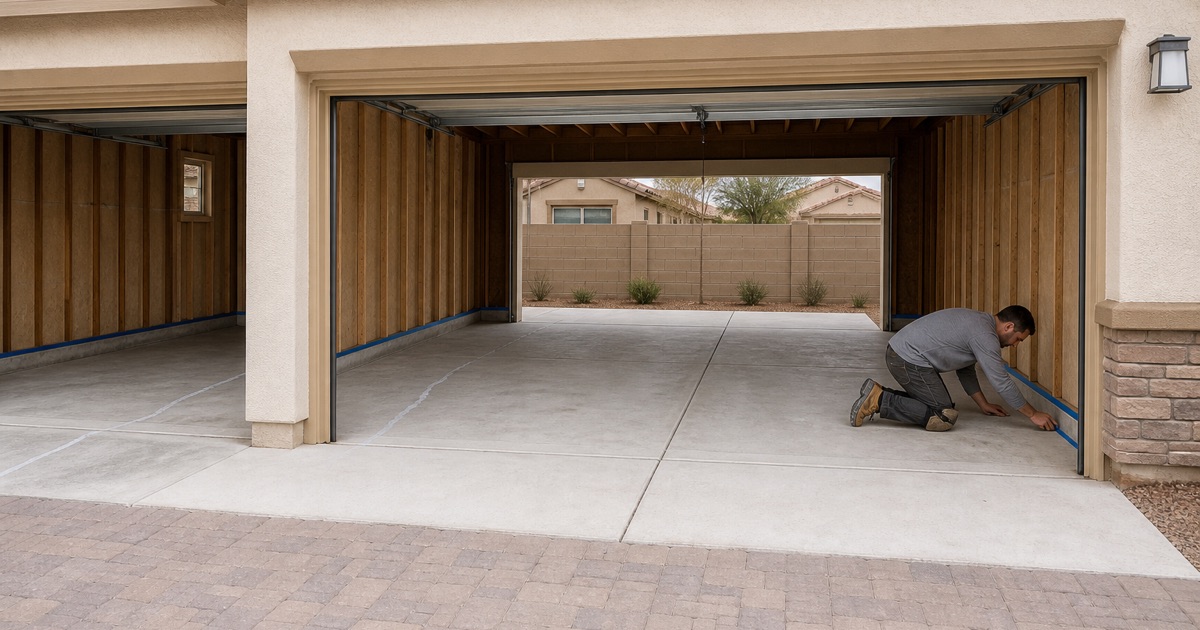
The oversized garage is the standard product of this era of building, and in practice the extra bay is a workshop, a gym, a storage wall or the place the second refrigerator has lived since 2011. That matters because those uses put different demands on the same slab: dropped tools and point loads in one bay, hot tires in another.
We ask what happens in each part of the floor before choosing a build. A bay that takes a bench, a compressor and a rolling toolbox earns a heavier mil build and a topcoat picked for chemical resistance, while the parking bays are specified around hot tire pickup and cleanability, and there is no rule saying the whole floor has to be identical underneath the same color.
Laying Out a Big Floor So It Reads as One Piece
A three-car slab is wide enough that installation sequence becomes visible in the finished floor. Work it in the wrong order and the wet edge between passes sets before it is joined, leaving a line down the middle of the bay that catches light for the rest of the floor’s life.
So a floor this size gets more people on it, not more time. One crew member on the gauge rake setting mil thickness, another on the notched squeegee keeping the edge live, and the flake going down behind them, because broadcast to refusal across a wide floor only looks even if the resin underneath is still open when the flake lands in it.
Getting Three Vehicles Back Inside
An oversized garage is often the only vehicle storage on the property, and the household plan for the days it is out of service is a real part of the job rather than an afterthought. Everything on the slab has to be out before we grind, and the vehicles cannot come back the moment the floor stops feeling tacky.
We hand over a written cure schedule that separates the three returns instead of quoting one number: foot traffic first, then shelving, benches and stored items, and vehicles last. Hot tire pickup is what happens when a warm tire parks on a coating that has not finished cross-linking, and it is entirely avoidable if the dates are honest and someone follows them.
Looking for epoxy flooring closer to La Verne? See Epoxy Flooring Services in La Verne.
Getting a Finish Through Architectural Review
What an Association Can Reasonably Take an Interest In
The coating itself is inside the building, but almost everything around it is on display. An open garage door showing a half-finished floor, a grinder and dust rig parked in the driveway, material drums stacked by the curb and a debris bin on the street are all things a neighbor sees and an association may have a view about.
We cannot promise how any particular board will respond, and we will not pretend otherwise. What we can do is give a homeowner the information a submission usually wants — what the work involves, how long the driveway is occupied and what the finished surface looks like — early enough to be useful rather than the week before we are due.
Working Tidy on a Street Where Everyone Can See
Master-planned streets are wide and the driveways are generous, so unlike the older parts of our territory the physical staging here is easy. The constraint is presentation: the same equipment that nobody notices on a rural lot is conspicuous on a street where every frontage is landscaped to the same standard.
We plan accordingly. Drums and tooling stay in the garage or on the truck rather than spread across the driveway, containment keeps grinding dust out of the neighbor’s cars, and where a tract is gated we settle access and gate codes ahead of the morning instead of idling at a call box with a loaded trailer.
Choosing Color Against the House Rather Than the Catalog
Because the housing is dimensionally consistent, neighbors compare finishes directly in a way they never do in a mixed-era community. A flake blend that looked fine on a card can land badly next to the stucco color, the door and the driveway concrete it has to sit beside every day.
So the blend is chosen from a full sample board laid on your own slab, in your own light, with the garage door open. Reds and warm tans read very differently against a beige elevation than they do indoors, and it takes ten minutes at the quote to settle something that is permanent once it is down.
What a Younger Tract Slab Actually Gives You
A Vapor Retarder You Can Usually Count On
Under-slab moisture is the failure that nearly every coating warranty in this trade excludes, and it is the reason a floor delaminates in sheets rather than wearing out honestly. In construction from the 1980s onward a vapor retarder beneath the slab is standard practice, so the odds are in the floor’s favor here in a way they simply are not on mid-century concrete.
Odds are not a reading, though, so we still set in-situ relative humidity probes and take the number to the ASTM F2170 method before ordering material. It is a short job on a sound slab and it converts an assumption into a written figure, which is worth having on the one house in twenty where a downspout has been discharging against the foundation for a decade.
Less Repair, But Not None
Younger concrete still moves. Tract slabs of this era were poured with control joints intended to crack the floor in straight lines rather than random ones, and after thirty or forty years some of those joints have opened, and settlement at the door line is common where the driveway has dropped away.
We price crack repair, spall repair mortar and joint treatment up front rather than finding it midway through the grind, and each joint gets a decision rather than a coat of resin over it. Depending on whether it is still moving we fill it, honor it through the finished surface, or bridge it — running a topcoat straight over a live joint just prints the crack back through the new floor.
Consistency Makes an Honest Quote Possible
There is a real advantage to a market of dimensionally similar garages: after twenty years, we know roughly what a bay in these districts measures and how much material a floor of that size draws. It makes an estimate genuinely predictable instead of hedged.
We would still rather stand on the slab than price it from a photograph. Prior coatings from a previous owner, an epoxy kit rolled on over a dirty floor, or a section of slab replaced after a plumbing repair all change the preparation, and finding them at the estimate is the difference between a fixed price and a revised one.
Sloped Approaches in the Foothill Tracts
The northern part of the city rises toward the mountains and the Alta Loma tracts up there sit on real grade, with driveways steep enough on some lots to matter. It is nothing like a canyon lot, but it is enough that the equipment approach is worth a look before the day.
Slope shows up inside the garage too, since a slab that falls toward the door will not hold a self-leveling product where the rake put it. On those floors we choose a body coat with enough body to stay put and work across the fall rather than down it, which keeps the mil build even from the back wall to the threshold.
Heat, Product Rules and the Day of the Pour
A Closed Garage in August Is Not a 70-Degree Room
Working time is set by the slab, not by the calendar. The same product gives a crew roughly 60 minutes of pot life at 55 degrees and about 20 minutes at 95, and a garage that has been shut all day in an inland summer holds heat in the concrete long after the door goes up.
We read slab temperature and dew point on the morning of the pour rather than trusting the previous week’s forecast. That reading sets batch size, crew positions and sometimes a start hour early enough that the neighbors are still asleep, which is a conversation worth having in advance on a street like these.
The Product Category Is a Legal Question
This whole area falls under the South Coast Air Quality Management District, whose Rule 1113 caps floor coatings at 50 grams per liter of volatile organic compounds and industrial maintenance coatings at 100. Subsection (c)(6) prohibits applying, or soliciting the application of, an industrial maintenance coating for residential use.
A residential garage is a residential building no matter how hard it is worked, so the higher-VOC shelf is off the table before the specification starts. We quote residential and commercial work from separate product lines for that reason, and inside those limits a 100% solids epoxy body coat under a polyaspartic topcoat still gives a garage floor everything it needs.
Preparation, Dust and Who Is Actually on Site
Every slab is opened by diamond grinding to a named ICRI concrete surface profile, never by acid etching. An etch cannot deliver a consistent mechanical profile and it cannot touch a previous coating at all, and profile is the entire basis on which the primer bonds.
Grinding generates respirable crystalline silica, so extraction runs on the machine as standard and the containment is doing double duty on a street of closely spaced homes. The crew that grinds is the crew that primes, broadcasts and topcoats — we do not subcontract surface preparation, because the people who opened the slab should be the ones accountable for how it holds.
- 20+ Years Experience
- Licensed & Insured
- Free On-Site Estimates