
Upland Epoxy Floors has been installing garage floor coating in Pomona for over twenty years, and in this city the same crew that finishes a two-car slab on Monday is often inside an exposition hall or a teaching clinic by Thursday. Pomona is the oldest and most varied place we work, and the range of buildings here is wider than anywhere else on our schedule.
What ties those jobs together is the concrete rather than the customer. Most of this city was built long before the details we now take for granted under a slab were standard, so the first honest question on almost every quote is not which finish somebody wants but whether the existing floor will hold a coating at all.
That question is answerable, and it is answerable cheaply if it is asked at the beginning. The sections below run from what the slab itself dictates, through the venue and institutional floors that make this city unusual, and end on the residential work that most people arrive here looking for.
What Pomona Concrete Brings to the Job
Mid-Century Slabs and Ground Moisture
Roughly two thirds of the city’s 44,373 housing units went up before 1980, and the 1950s alone account for more than a fifth of them. Slabs from that era were commonly poured without the sheet of plastic underneath that a modern floor takes for granted, which means ground moisture has an open path up through the concrete.
So we drill in-situ relative humidity probes and read them to the ASTM F2170 method, or run a calcium chloride test to ASTM F1869 where that suits the floor better, and the number goes on paper before any material is ordered. Moisture failure is the one condition almost every coating warranty writes itself out of, which makes it the reading worth paying for.
A high result is not the end of the job. It moves the specification toward a moisture mitigation system under the buildup and it changes the price, but a floor built on a known number lasts, and one built on an assumption delaminates in sheets somewhere around the second summer.
Old Coatings, Absorbed Oil and Prior Repairs
The legacy industrial buildings along Mission Boulevard carry decades of oil driven deep into the slab and often two or three earlier coating attempts on top of it. Preparation on floors like that is a much larger share of the job than it would be on a newer tilt-up, and pretending otherwise is how a quote comes in low and finishes over.
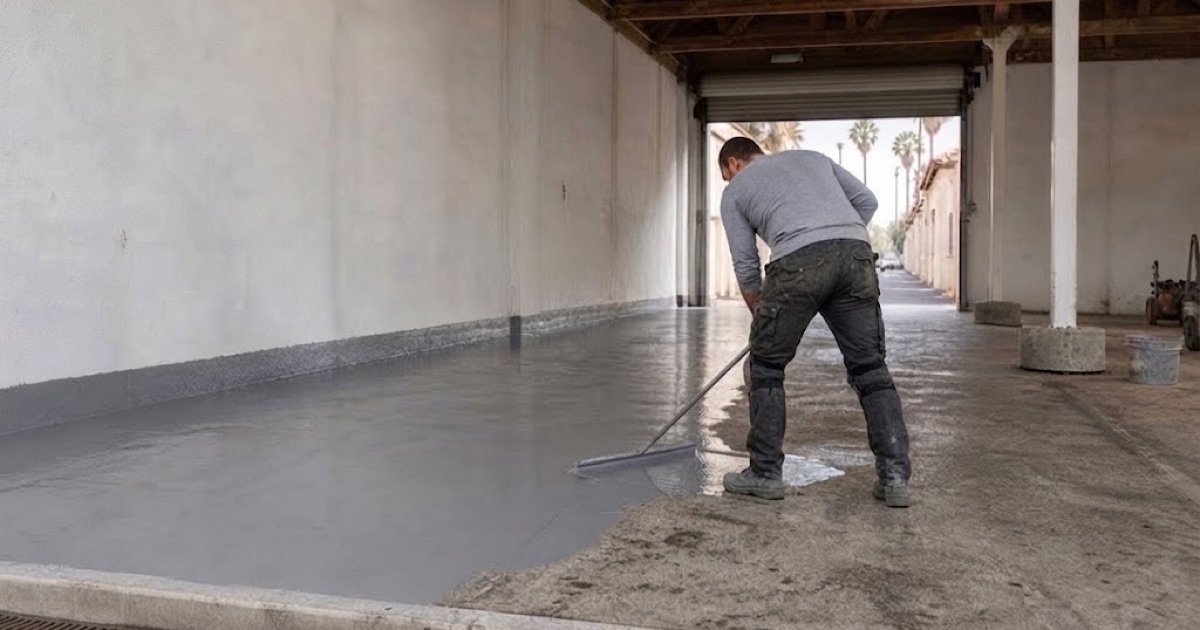
We open a mechanical profile with diamond grinding to a named ICRI concrete surface profile and never with acid etching. Where an old film has to come off across a wide area, or where saturation runs deeper than grinding reaches, shot blasting is the more honest tool and we say so at the walkthrough rather than after mobilizing.
Cracks, Joints and the Things Nobody Wants to Find Later
Older concrete moves, and it has usually already cracked somewhere. We measure crack, joint and spall repair up front and price it as a line the customer can see, because the alternative is a change order raised on day two when the floor is already open and the customer has no leverage.
Control joints get a decision rather than a coat of resin. Depending on what crosses them and how much they move, we fill them with a semi-rigid joint filler, honor them through the finished surface, or bridge them, and spall repair mortar goes in at edges and pop-outs before any primer touches the floor.
Looking for epoxy flooring closer to San Dimas? See Epoxy Flooring Services in San Dimas.
Floors for Exposition Halls and Event Buildings
Turnaround Between Shows
The Fairplex grounds run as a year-round exposition venue with numbered Expo Hall buildings, and the Wally Parks NHRA Motorsports Museum sits inside Gate 1 at 1101 West McKinley Avenue as part of that same address system. A hall between two bookings is not an empty building waiting for a contractor; it is a revenue window with a load-in truck already scheduled against it.
That makes the calendar the specification. We work back from the next load-in, and where the gap is short the answer is a polyaspartic or polyurea topcoat that returns the floor to forklift traffic in hours rather than a system that needs a long weekend it does not have.
The motorsport calendar constrains it further. The quarter-mile dragstrip on the same grounds at 2780 Fairplex Drive has hosted the NHRA Winternationals since 1961 and the season finale since 2021, so work in the adjacent buildings routes around two national event weekends plus the test sessions that bracket them.
Barns, Show Rings and Wash-Down Areas
An exposition barn is not a private stable, and it fails in its own way. It sits mostly empty, then fills for a week with animals, bedding, feed and public foot traffic, then gets hosed out and stripped back down, which is a cycle of intense loading and aggressive cleaning rather than steady daily wear.
Urethane cement handles that cycle where a garage-grade epoxy would not, because it tolerates hot water washdown, ammonia and the disinfectants used between shows without softening. Cove base carried up the wall junction matters here too, since a floor that is hosed rather than swept needs a sealed corner instead of a raw one.
Slip Resistance Where the Public Walks
An event floor is a public assembly surface, and a glossy finish that photographs well can be genuinely unsafe once a drink is spilled on it under crowd density. We specify grip as a measured property, expressed as a dynamic coefficient of friction under ANSI A326.3, rather than as an assurance that a floor is non-slip.
Texture is then set by room rather than by building. A concourse wants enough grip to stay safe wet, a wash-down area wants a heavy aggregate broadcast, and an exhibitor hall wants a surface that can still be swept clean at three in the morning between one show and the next.
Institutional and Clinical Floors
Hospital and Teaching-Clinic Spaces
Pomona Valley Hospital Medical Center is a 427-bed acute care hospital with a trauma center, a cancer center, a heart and vascular center and a neonatal intensive care unit, and Western University of Health Sciences runs teaching clinics at 309 East 2nd Street across osteopathic medicine, dental medicine, veterinary medicine, pharmacy, optometry and several therapy programs. Floors in those buildings answer to infection control before they answer to appearance.
That means a seamless surface with no seam for anything to live in, cove base turned up at every wall so the mop reaches the junction, and chemical resistance chosen against the actual disinfectant schedule the department runs rather than against a general durability claim.
Campus Shops, Labs and the Break Windows
Cal Poly Pomona’s main campus sits partly inside the city limits, and its academic calendar creates genuine summer and winter windows for shop, lab and residence floors that simply do not exist while classes are running. We plan those jobs months ahead because the window closes on a fixed date whether or not the floor is finished.
Specialized rooms carry their own requirement. Where electronics work demands it, static dissipative flooring installed and verified against ANSI/ESD S20.20 is a measurable system rather than a marketing word, and it has to be grounded and tested rather than simply applied.
Dust, Odor and Containment in an Occupied Building
Grinding concrete releases respirable crystalline silica, which is a regulated hazard for our crew and an unacceptable one to let drift into a ward or a clinic corridor. Containment and extraction run on our equipment as standard, and in clinical buildings we add sealed barriers and negotiate air handling with facilities before a machine is switched on.
Odor gets the same treatment. Some fast-cure chemistries, MMA resin in particular, carry a smell that travels much further than the work area, so material selection in an occupied hospital wing is partly a question of what the building can tolerate at two in the morning.
Garage Floor Coating on a Pomona Budget
Alley Garages and Getting Equipment to the Slab
The prewar neighborhoods near downtown commonly have a detached garage at the back of the lot, reached by a long narrow driveway or from the alley rather than from the street. A box truck, a planetary grinder and a dust extraction rig all have to reach that slab with a hose run that still works at distance.
Street space compounds it near the Arts Colony off 3rd Street, where the 1930s Fox Theater and the two blocks of Antique Row along 2nd Street keep the curb busy. We confirm the approach, the parking and the power at the walkthrough, because a crew that cannot stage properly loses the morning.
Who Is Actually Buying the Floor
Pomona is 54.0% owner-occupied and 46.0% renter-occupied, so a large share of the garage floors we quote here belong to a landlord or a property manager rather than to the person who parks on them. That customer is weighing turnover cost and how the unit shows, and the honest recommendation is usually a durable plain or lightly flaked system rather than the most elaborate one available.
With a median household income of $79,479, price sensitivity in this city is real and worth respecting. Where an existing coating is sound but tired, recoating over a properly prepared surface costs a fraction of a full removal and rebuild, and we will say when that is the better call even though it is the smaller invoice.
When a homeowner does want the decorative version, the flake blend gets chosen from a full sample board laid on their own slab in their own light. Chips look different under a showroom lamp than they do in a garage with the door up, and choosing from a brochure is how people end up with a floor they did not expect.
Heat, Cure Times and the Legal Product Line
We read slab temperature and dew point on the morning of the pour. The same product that gives a crew about sixty minutes of working time on a 55-degree slab gives them roughly twenty at 95, and an uninsulated Pomona garage in August sits at the wrong end of that, so batches shrink and the crew works to the pot life the slab is actually allowing.
Every job leaves with a written cure schedule that separates foot traffic, furniture and vehicle return instead of quoting one number for all three. Driving onto a floor that is walkable but not fully cured is the fastest route to hot tire pickup, where a warm tire lifts the coating off the slab in patches.
Product category is a legal question here as well as a technical one. Under South Coast Air Quality Management District Rule 1113, floor coatings are capped at 50 grams per liter of volatile organic compounds and industrial maintenance coatings at 100, and subsection (c)(6) prohibits applying or soliciting industrial maintenance coatings for residential use, which is why we quote homes and commercial buildings from separate lines. Permits for the work those coatings accompany run through the City of Pomona Building and Safety Division within Development Services.
- 20+ Years Experience
- Licensed & Insured
- Free On-Site Estimates