
Upland Epoxy Floors installs epoxy flooring in Norco for properties where the garage is not the most demanding slab on the lot. Roughly 6,000 residential properties here sit inside the Equestrian Historic District, against 6,451 single-family detached homes citywide, which means very nearly every house we quote also has a barn, a stable, a wash rack or a shop building behind it.
That changes the job. A barn floor and a garage floor are not the same specification with a different address, and a contractor who treats them as one will get the barn wrong. Standing water, ammonia, hoof impact and animals walking on a wet surface are conditions a garage-grade system was never designed to meet.
So most of this page is about the outbuildings, and the garage is covered last rather than first. That is the opposite order from almost everywhere else we work, and here it is the honest one.
Barn, Stable and Tack Room Floors
Stall Floors and What They Actually Take
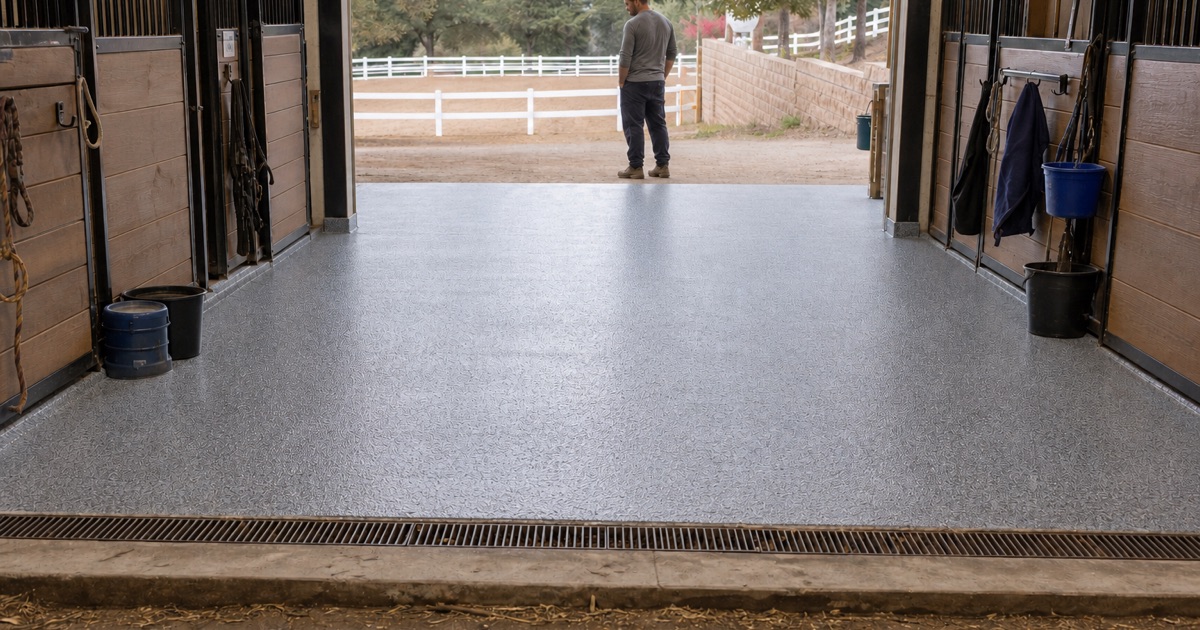
A stall floor is under constant attack from three directions at once. Urine and manure produce ammonia that degrades a coating chemically, bedding and hooves abrade it mechanically, and the whole surface spends much of its life damp rather than dry. A standard garage-grade epoxy meets none of those conditions well.
What works is a heavier, chemically resistant system placed thicker than a residential floor, with aggregate worked in for grip. Urethane cement earns its place in these rooms specifically, because it tolerates the washdown and chemical attack that thins and softens lighter resinous flooring over a season or two.
Tack and Feed Rooms
Tack and feed rooms are the straightforward part of an equestrian property, and they are often the best place to start. They stay comparatively dry, they see foot traffic rather than hooves, and they benefit from a sealed, cleanable floor that keeps dust down and stops grain and shavings working into bare concrete.
They are also where a coated floor pays back fastest in a way owners notice. Sweeping a sealed floor takes a fraction of the time that sweeping raw, porous concrete does, and feed rooms in particular stay far easier to keep clean when there is nothing for spilled grain to lodge in.
Why a Garage Specification Does Not Transfer
The temptation is to price a barn by the square foot at garage rates, and it produces a floor that fails early. The differences are not cosmetic: a different resin family, a heavier build, a mandatory aggregate broadcast, and detailing at the wall junction that a garage never needs.
There is a regulatory wrinkle here too, and it is worth stating plainly rather than working around. Air district rules set a lower volatile organic compound limit for floor coatings than for industrial maintenance coatings, and they do not permit industrial maintenance products to be applied for residential use. A barn on an animal-keeping residential parcel is a residential property, whatever the wear it takes, so the product options are narrower than the conditions might suggest.
Looking for garage floor epoxy closer to West Covina? See Garage Floor Epoxy Services in West Covina.
Wash Racks, Drainage and Standing Water
Water That Never Fully Dries
A wash rack is the wettest slab on the property and often the one in worst condition. Water sits, evaporates and is replaced daily, which drives moisture into the concrete from above while ground moisture works upward from below. Coating a slab in that condition without reading it first is how a wash rack floor delaminates within a year.
We test the slab before quoting rather than after. Relative humidity read from inside the concrete with in-situ probes to the ASTM F2170 method tells us whether a coating can bond at all, and if the answer is no, a mitigation layer goes in beneath the buildup rather than a heavier topcoat over the problem.
Falls, Drains and Where the Water Goes
A coating does not fix drainage, it records it. If the slab holds water in a low spot now, a new floor will hold it in exactly the same place, only with a smoother surface for it to sit on. Where falls are wrong we can build them up during the repair stage, but that has to be scoped deliberately rather than discovered.
Edges and drains are where these floors fail first. The coating has to be terminated properly into the drain and carried up at the perimeter rather than stopping at a raw edge, because a wash rack floor is under water pressure at exactly the joints a dry floor never tests.
Ammonia, Waste and Cleaning Chemistry
The chemical exposure in an equestrian building is genuinely aggressive and it is continuous rather than occasional. Ammonia from waste, the disinfectants used to manage it, and the fly sprays and hoof products that end up on the floor all attack a coating in different ways.
Specification therefore follows an actual list rather than a general durability claim. We ask what gets used in the building and how often it is washed down, because a floor chosen against that list will outlast one chosen because it looked hard-wearing in a brochure.
Slip Resistance Where Animals Walk
A Horse on a Wet Smooth Floor
This is the part of the job with real consequences. A smooth, glossy coating that is perfectly safe in a garage becomes genuinely dangerous once a shod hoof meets it wet, and a horse that loses its footing indoors can injure itself, the handler, or both.
So any floor an animal moves across is specified for grip first and appearance second. That is not a preference we are expressing, it is the order the conditions impose, and we would rather lose a job than put a slick floor into a stable aisle.
Aggregate Broadcast and Texture
Grip comes from what is broadcast into the coating rather than from the resin underneath it. A heavy aggregate broadcast produces genuine mechanical texture that stays effective when the surface is wet, which is the state these floors are in for much of their working life.
Slip resistance is also measurable rather than a matter of opinion. It is expressed as a dynamic coefficient of friction under ANSI A326.3, and specifying a number gives you something concrete to hold a floor to instead of an assurance that it will be non-slip.
Balancing Grip Against Cleanability
The obvious move is to make the floor as aggressive as possible, and it is a mistake. A surface textured beyond what the animals need becomes hard to muck out and hard to hose clean, and the debris that lodges in it is exactly the material you are trying to remove daily.
The balance point differs by room, so we set it that way. A stall and a wash rack want serious texture, an aisle wants enough to be safe underfoot, and a tack room wants very little. Treating the whole building as one specification gets at least one of those rooms wrong.
Garages and Shops on Animal-Keeping Lots
Fifty-Year-Old Garage Slabs
The houses here are not new. Two-thirds of Norco’s housing predates 1980 and the 1970s alone account for roughly a third of it, with only 154 units built since 2010, so the standard garage slab we grind is between forty-five and seventy years old.
Slabs of that age come with settlement cracks, no vapor retarder underneath, and decades of absorbed oil. Moisture testing belongs in the scope as a matter of course rather than as an upsell, and crack and spall repair gets priced up front so it is not discovered halfway through the job.
Getting Equipment Back to the Barn
Access on these parcels cuts both ways. The lots are deep and the driveways are long, so there is usually plenty of room to work, but the barn is frequently set well back from the street across decomposed granite or dirt rather than paving.
That matters because a planetary grinder and a vacuum rig are heavy and they need a hose run back to the machine. We confirm the run distance and the surface before quoting rather than arriving with equipment that cannot reach the building it was hired for.
Dust, Odor and Animals Nearby
Grinding concrete releases respirable crystalline silica, which is a regulated hazard for the crew and a genuine concern for animals stabled nearby. Containment and extraction run as standard on our equipment, and on a property with horses in adjacent stalls that containment is doing double duty.
Odor deserves the same care. Horses are sensitive to solvent smell in a way that makes a low-odor system worth more than the price difference, and we plan the sequence so the most odorous stage does not coincide with animals being closest to the work.
Staging Around Trails and Turnout
In parts of the city the street edge is a horse trail rather than a sidewalk, and the trail network runs through more than 400 acres of parkland. A grinder, a dust rig and a material trailer cannot simply be left across a trail easement while the crew works.
We agree staging with the owner in advance, including where vehicles sit and which corridors stay clear, because animals move through those routes during the same hours we are working. It is a small piece of planning that avoids the only genuinely avoidable problem on a job like this.
- 20+ Years Experience
- Licensed & Insured
- Free On-Site Estimates