
Upland Epoxy Floors installs epoxy flooring in Montclair, and after 20 years working this valley we quote jobs here differently than we quote them anywhere else, because the concrete is older. Of 10,974 housing units, 30.9 percent were built before 1960 and 51.1 percent before 1970, with the 1950s alone accounting for 26.0 percent of the stock.
On the commercial side the demand is retail and food service rather than heavy industry. A store fitting out between tenants and a restaurant kitchen that has to reopen for lunch service impose the same constraint from opposite directions: a hard, short shutdown, and a floor that has to be walkable and cleanable the moment the doors are unlocked again.
Both halves of that work turn on the same thing, which is preparation rather than product. The resin going down is the cheap, fast, predictable part of a floor. What decides whether it lasts is what we find when we open the slab, and on concrete this old we would rather find it during the quote.
Retail and Food-Service Floors
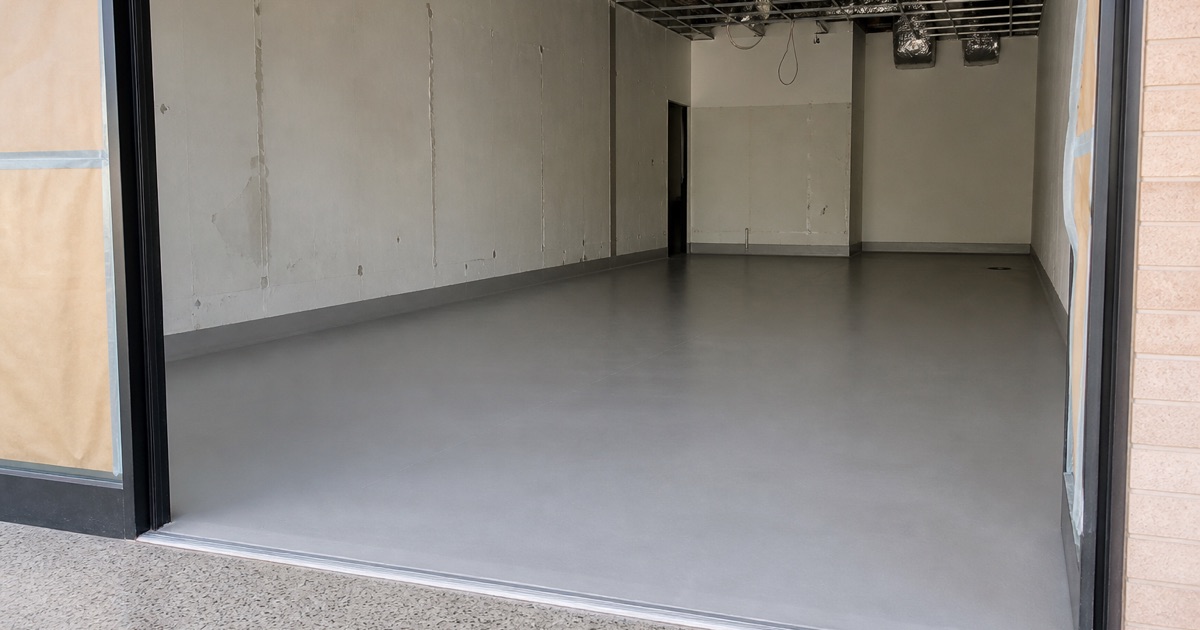
Behind the Line in a Commercial Kitchen
A kitchen floor lives under hot water, grease, food acids and whatever the closing crew uses to cut through all three. That combination softens a general-purpose coating faster than foot traffic ever wears one out, and a floor that has gone soft under a fryer station stops being cleanable long before it stops being visible.
For those rooms we specify urethane cement rather than a straight epoxy build. It handles thermal shock from steam cleaning and boil-overs and it holds up against caustic degreasers, and it takes an aggressive quartz aggregate broadcast so the surface still has grip when a line cook is standing in a wet spot.
The Junction Where a Kitchen Floor Actually Fails
Kitchen floors do not fail in the middle of the room. They fail at the base of the wall, at the equipment plinths and around the drain, wherever the coating stops at a raw edge and grease-laden water can work its way underneath and start lifting it.
An integral cove base solves that by carrying the floor up the wall in one continuous surface with no seam at the bottom to hold debris. It also makes a health inspection go faster, because a coved junction can be hosed and squeegeed rather than scrubbed at with a brush, which is the reason food-service floors have been detailed that way for decades.
Grip on a Sales Floor
Customer-facing space asks for something different. A sales floor wants a hard, bright, cleanable surface that reads as finished rather than industrial, but it still has to be safe under a wet shoe on a rainy afternoon when the entry mats have given up.
We treat slip resistance as a number rather than an adjective: the dynamic coefficient of friction measured under ANSI A326.3. Setting a target on paper lets us tune the texture to the room, which matters because a surface aggressive enough for a dish pit is far too aggressive for a space that gets dust-mopped nightly.
Looking for garage floor epoxy closer to Rancho Cucamonga? See Garage Floor Epoxy in Rancho Cucamonga.
Tenant Improvements and Turnover Between Leases
What the Last Tenant Left on the Slab
A vacated retail unit almost never presents bare concrete. There is tile mastic, carpet adhesive, self-leveling compound, sometimes two generations of coating over one another, and a grid of anchor holes where fixtures and racking were bolted down.
All of that has to come off mechanically before anything new goes on. We diamond grind to a named ICRI concrete surface profile and never acid etch, because an etch does nothing to adhesive residue and leaves an inconsistent bite where it does work. The honest consequence is that removal, not coating, is the long pole in a fit-out schedule.
Sequencing Against the Other Trades
The floor is the trade most easily crushed by the ones around it. Coat too early and the electricians drop conduit on it, the fixture crew rolls pallet jacks over a surface that has not reached full hardness, and the finished job gets blamed for damage it did not cause.
So we ask to be sequenced deliberately and we hand over a written cure schedule that separates foot traffic, fixture and casework return, and rolling loads instead of quoting one number. On a shutdown measured in days those intervals are the schedule, and a general contractor who has them in writing can plan around them rather than guess.
Downtime Is the Real Line Item
For a retail tenant, the coating is rarely the expensive part of the job. The expensive part is the days the space is dark, and a floor that has to be re-done because the slab was never tested costs the tenant a second closure on top of the first.
That is why we price crack repair, joint treatment and spall repair mortar up front rather than discovering them halfway through. A number that goes up midweek is not just an unpleasant surprise on an old commercial slab, it is a schedule slipping while the store stays closed.
Building for a Corridor That Is Still Being Built
The North Montclair Downtown Specific Plan sets out roughly 150 acres of mixed-use, transit-oriented development between the TransCenter and the Montclair Place regional shopping center, master planned with Moule & Polyzoides Architects and Urbanists. The city also carries a Montclair Place District Specific Plan and a designated Transit-Oriented District over the same part of town.
That pipeline is planned rather than delivered — only 39 of the city’s housing units were built in 2020 or later — and the rail extension to the Montclair TransCenter is still under construction, with a completion date of 2028. We mention it because ground-up commercial shells and their tenant fit-outs are a different scope from recoating, and it is worth scoping early.
Slabs That Are Fifty to Seventy Years Old
What Age Does to a Garage Floor
The typical residential slab we grind in this city was poured somewhere between the Truman and Johnson administrations. Concrete that old has usually settled unevenly, cracked at the control joints, spalled along the door line and absorbed decades of oil deep enough that it darkens the moment a grinder passes over it.
None of that rules out a good floor, but it does rule out a fixed price per square foot quoted from a phone photograph. We look at the slab, price the repair work as its own line, and decide joint by joint whether each one gets filled, honored through the finish or bridged — because coating straight over a joint that is still moving simply reprints the crack.
Moisture Under Pre-1960 Concrete
Slabs from the 1950s in this region were commonly poured without a vapor retarder beneath them, which means ground moisture rises through the concrete continuously and has nowhere to go once a coating seals the top. That is delamination waiting for a date, and it is the single failure that nearly every coating warranty in the trade excludes.
So we set in-situ relative humidity probes into the slab, read them to the ASTM F2170 method, and the number is written down before we order material. Where a slab reads high, the answer is a moisture mitigation system beneath the buildup rather than a heavier topcoat over the problem, and where it reads fine, the customer has that in writing too.
Single Bays and Rooms That Used to Be Garages
Mid-century tract garages in this part of the valley are frequently single-car, and a good number of them stopped being garages years ago. A converted bay is a living-space floor question rather than a parking-slab question, and it changes both the finish and the tolerance for dust during preparation.
We would rather establish which one we are looking at before quoting. A single bay is a small floor and an honest minimum-charge conversation, while a conversion often wants a lower-profile finish, a different edge detail at the new wall, and a much more careful conversation about how the room will be used.
Working on an Older Lot, and Working for an Owner
Staging Where There Is No Room to Stage
Lots platted in the 1950s came with narrow driveways and tight side setbacks, and there is rarely a spot on the property to park a truck and a trailer-mounted dust-extraction rig. In practice the crew works off the street and runs hose and cord in from the curb.
That has to be checked before the day, not discovered on it. We confirm curb access and where the rig can sit, and we confirm the hose distance, because extraction loses pull over a long run and dust that escapes the vacuum ends up in a house rather than in a filter.
What a Property Owner Is Actually Buying
Nearly half the occupied units here are rentals — 45.2 percent of 10,652 — so a large share of the residential calls we take come from owners and managers rather than from the person who will park on the floor. Their brief is different, and it is refreshingly blunt: the floor has to survive tenants and it has to be ready for the next one quickly.
For that customer we lean toward a full vinyl flake broadcast to refusal under a polyaspartic topcoat. The flake hides the patchwork an old slab requires, the texture holds up to abuse, and the topcoat resists hot tire pickup, which is the complaint that generates the callback on a rental garage more than anything else.
One Legal Line the Same Owner Crosses
An owner who holds a retail unit and a rental house often assumes one coating covers both, and it does not. This whole area sits under the South Coast Air Quality Management District, whose Rule 1113 caps floor coatings at 50 grams per liter of volatile organic compounds and industrial maintenance coatings at 100, with subsection (c)(6) prohibiting application, or even solicitation, of an industrial maintenance coating for residential use.
We therefore quote commercial and residential work off separate product lines, which is a legal boundary rather than a preference. It also means the answer to “use whatever you put in my shop” is no, and we would rather explain that at the estimate than have it come up later.
Heat, Pot Life and the Hour We Start
An old, dark, sun-exposed slab gains temperature early. The same product that gives a crew roughly 60 minutes of working time at 55 degrees gives about 20 minutes at 95, and a west-facing garage door standing open in July can move a slab a long way across that range before the second coat goes down.
We read slab temperature and dew point on the morning of the pour rather than working from a forecast, and that reading sets batch sizes and the start time. One crew handles the job from grinding through topcoat, so nobody is inheriting a surface they did not prepare and cannot vouch for.
- 20+ Years Experience
- Licensed & Insured
- Free On-Site Estimates