
Upland Epoxy Floors installs epoxy flooring in La Verne, and the honest starting point in this city is that the job is often not a garage at all. Mobile homes make up 13.7 percent of the 12,020 housing units here, 1,644 of them, which is the largest manufactured-housing share anywhere in our service area.
That works out to roughly one household in seven whose parking surface is a carport pad, a patio or an entry slab rather than an enclosed bay with a door on it. An open slab is an exterior floor, and an exterior floor is a genuinely different specification from a garage — not a garage floor priced slightly cheaper because there are no walls.
The remainder of the stock is mixed rather than uniform. Some 62.0 percent of housing was built before 1980, the 1970s alone account for 32.3 percent, and 69.2 percent of homes are owner-occupied, so in the course of a single week here we quote covered slabs, uncovered slabs and a fair number that we end up recommending against coating.
Carports, Patios and Manufactured-Home Slabs
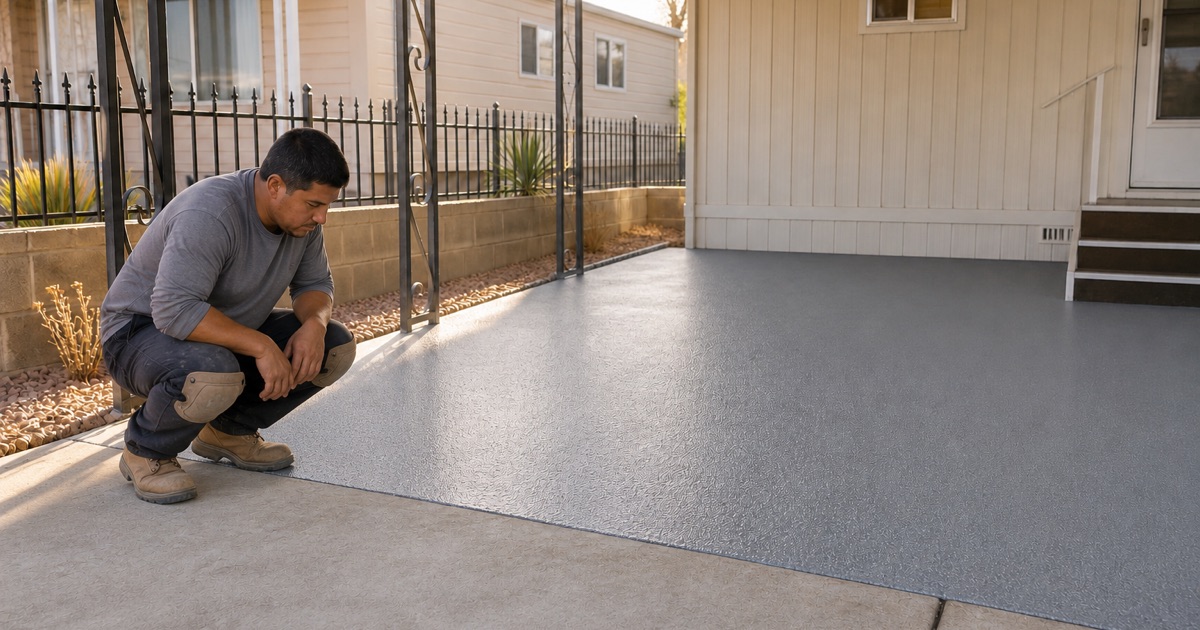
An Uncovered Slab Is Not a Garage Floor
The moment a slab has no roof over it, three things change at once. It gets rained on, it gets direct sun for hours a day, and it cycles through a much wider temperature range than any floor inside a building, expanding and contracting under a coating that has to move with it.
So the buildup changes with it. We choose a system with more flexibility and less brittleness than a straight interior epoxy build, we detail the edges so water runs off the slab rather than sitting against a termination, and we look hard at where the water currently goes, because a coating records existing drainage rather than repairing it.
Sunlight Is What Kills an Exterior Coating
Epoxy is a superb body coat and a poor final surface outdoors. Ultraviolet light breaks it down at the top layer, first as ambering and chalking and then as a dull, powdery surface that no amount of cleaning brings back, and that happens on a schedule measured in seasons rather than years.
The fix is not a thicker coat of the same thing, it is a different chemistry on top. An exterior-rated aliphatic topcoat, typically a polyaspartic or polyurethane, carries the color stability and the epoxy underneath supplies the build and the adhesion. Anyone quoting a bare epoxy for an open carport is selling you a floor that will look wrong by next summer.
Wet Concrete Under a Roofless Slab
Grip matters more outdoors than in, because these slabs are wet several times a year and people cross them carrying groceries. Slip resistance is measurable as a dynamic coefficient of friction under ANSI A326.3, and specifying a target gives us something to build to rather than a vague promise that the surface will not be slick.
Texture on an exterior slab is worth paying for anyway, since it also masks the surface irregularity these pads tend to have. A modest aggregate broadcast, worked to a consistent coverage rather than dumped, gives grip when the slab is wet and hides an uneven trowel finish that a high-gloss coating would otherwise advertise.
Working Inside a Manufactured-Home Community
Park lots are close together, the utility runs are shallow and often visible, and the neighbors are within a few feet of wherever the grinder sits. Dust containment and a tidy setup are not a courtesy here, they are what makes the job possible at all on a Tuesday morning.
There is also a permission question that does not arise on a single-family lot. The pad frequently belongs to the park rather than to the homeowner, so before we quote anything permanent we want to know who owns the surface and whether park management has to sign off, and we would rather ask that early than finish a floor somebody was not entitled to change.
Looking for commercial epoxy flooring closer to Ontario? See Ontario Commercial Epoxy Flooring.
When the Right Answer Is Not to Coat It
Slabs That Are Not Candidates
Some surfaces should not take a coating, and saying so at the estimate costs us a job and saves the customer a failure. A slab that has heaved or settled into separate planes, one broken into sections by a root, or one that is spalling across a wide area is a repair or replacement question before it is a finish question.
Asphalt is a straight no, and so is a thin topping or a decorative overlay of unknown make-up bonded to something we cannot identify. Coating any of those means bonding a hard, rigid film to a surface that will not hold it, and the delamination that follows takes the topping with it.
Reading a Slab We Did Not Pour
Every quote here starts with the substrate rather than the product. We look for previous coatings and sealers, oil that has soaked deep enough to keep bleeding back, patching compounds someone applied over a crack, and whether the concrete rings solid or hollow when it is sounded near the edges.
Where the answer is uncertain we grind a test area and see what the concrete actually gives us. It takes an hour, it settles the argument, and it is a much better way to find a problem than discovering it with a crew, a trailer and 30 gallons of resin already on site.
Renting, Owning and Who Gets to Decide
Nearly a third of occupied homes in the city, 30.8 percent, are rentals, and a coating is a permanent alteration to somebody’s property. A tenant who wants a better garage floor needs the owner in the conversation, and we ask about it directly rather than assuming.
That is a practical point rather than a legal lecture. Written permission before the grinder comes out protects the tenant who paid for the work, the owner who has to live with it afterward, and us, and it has never once made a job take longer than an unanswered question later did.
Garages Across a Mixed Housing Stock
The 1970s Tract Bay
The single largest slice of housing here went up in the 1970s, and that generation of garage is a predictable, well-behaved floor to work on: a flat pour, standard bay dimensions, control joints where you expect them and, in most cases, a vapor retarder underneath. It grinds evenly and it takes a coating well.
What it usually needs is honest repair rather than heroics. Fifty years of settlement leaves cracking at the door line and joints that have opened, and we price crack repair, spall repair mortar and joint treatment up front so the number quoted at the kitchen table is the number at the end of the week.
Testing Anyway, Because the Warranty Depends on It
Moisture is less likely to sink a floor on this stock than on genuinely old concrete, but likelihood is not evidence. Under-slab moisture is the one failure almost every coating warranty in this trade excludes, so we set in-situ relative humidity probes into the slab and read them to the ASTM F2170 method before any material is ordered.
The reading gets written down either way. If it comes back clean, that is documentation the homeowner keeps; if it comes back high, the response is a moisture mitigation system beneath the buildup rather than a heavier topcoat over the top of it, and the customer finds that out at the quote rather than a year in.
Joints, Preparation and Who Is Holding the Grinder
Each control joint gets a decision instead of a coat of resin poured across it. Depending on whether it is still moving we fill it, honor it through the finished surface, or bridge it, because a coating run straight over a live joint reprints that crack in the new floor within a season.
Preparation is mechanical, always. We diamond grind to a named ICRI concrete surface profile rather than acid etching, extraction runs on the machine because grinding liberates respirable crystalline silica, and the same crew carries the job from the first pass to the final topcoat with no subcontracted surface prep in the middle.
Scheduling, Heat and What Is Legal to Apply
A Four-Day Counter
Most coating work is a finish rather than a permitted alteration, but when a job crosses into something the city has to see — enclosing a carport, rebuilding a section of slab, adding drainage — the calendar here is tighter than people expect. The Building and Safety Division inside the Community Development Department issues permits Monday through Thursday, 8:00am to 1:00pm, and runs inspections Monday through Thursday from 8:00am to 10:00am.
A two-hour daily inspection window on a four-day week is not much room, so anything requiring one is planned around it from the start. We would rather build the schedule around those hours at the quote than have a finished floor waiting on a Friday that does not exist.
Slab Temperature Sets the Working Time
Pot life is governed by the concrete, not by the thermometer on the porch. The same product gives a crew roughly 60 minutes of working time on a 55-degree slab and about 20 minutes at 95, and an uninsulated detached garage or an open carport in full sun sits at the wrong end of that range for much of the year.
We read slab temperature and dew point on the morning of the pour and size the batches to what the day will actually allow. On an exterior pad that frequently means starting early and finishing the broadcast before the sun comes around, rather than fighting a resin that is setting in the bucket.
The Product Category Is a Legal Line
This area falls under the South Coast Air Quality Management District, whose Rule 1113 caps floor coatings at 50 grams per liter of volatile organic compounds and industrial maintenance coatings at 100. Subsection (c)(6) prohibits applying, or soliciting the application of, an industrial maintenance coating for residential use.
A carport pad, a patio and a home garage are all residential surfaces, so that higher-VOC shelf is not available to us on any of them regardless of how much abuse the slab takes. We quote residential and commercial work from separate product lines because the rule makes that a legal boundary, and within the residential limits there is still plenty of good material to build a floor that lasts.
- 20+ Years Experience
- Licensed & Insured
- Free On-Site Estimates