
Upland Epoxy Floors installs epoxy flooring in La Palma, and the garages here are the most consistent set of slabs we work on anywhere. Fully 75.6% of the city’s 5,206 housing units went up in just two decades, 38.1% of them in the 1960s and 37.5% in the 1970s, and 81.1% were finished before 1980 with barely one percent predating 1950.
Two decades of tract building on 1.8 square miles produces something unusual: garage after garage of the same vintage, footprint and construction on a fully built-out grid. Single-family detached houses make up 66.2% of the stock and another 7.1% are attached, so the standard two-car bay is close to the default building type here.
The other thing to say plainly is how we get here. The drive is around twenty-eight miles, and we keep no yard, office or standing crew in this city, which is better said at the start than quietly assumed. What we do instead is book whole days here, and the scheduling section below explains how.
Garages Built Within Fifteen Years of Each Other
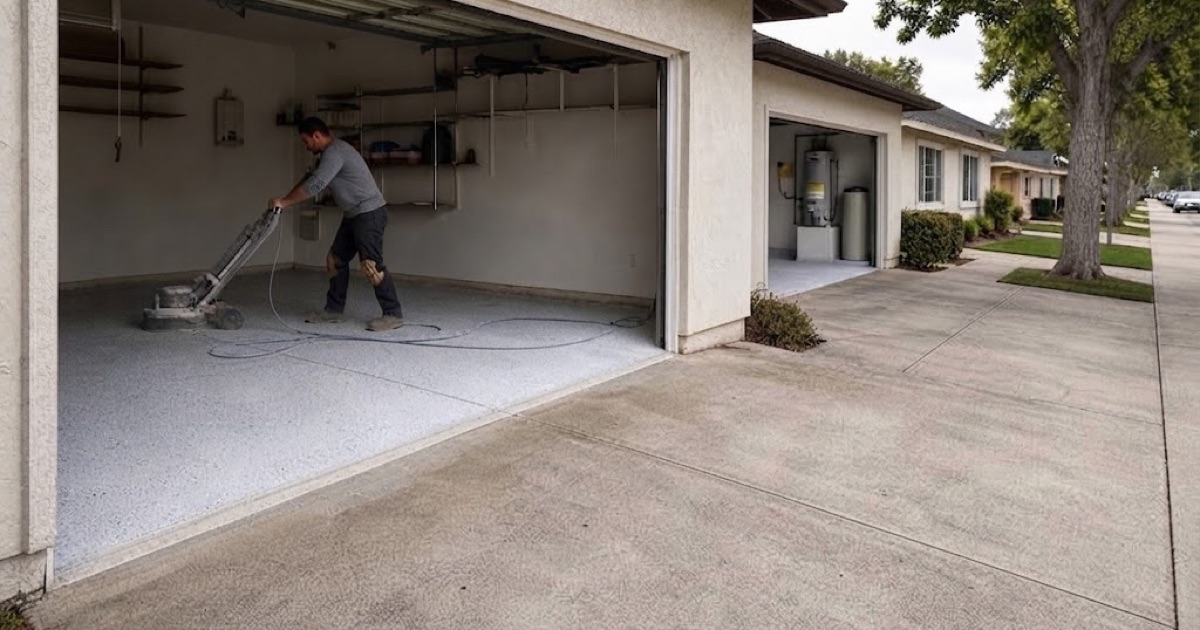
One Cohort, One Set of Details
When three quarters of a city’s housing comes out of a fifteen-year window, the floors share their problems as well as their dimensions. The bays are sized for the cars of that period, the aprons and driveways were poured to the same practice, and the slab thicknesses and control joint layouts repeat from street to street.
That consistency is worth real money on a quote. We are not guessing at square footage from a photograph or padding the material order against an unknown, which means the number we give is closer to the number the job costs, and the flake and resin quantities that come off the truck are the quantities the floor actually takes.
What We Can Settle Before Leaving
Familiarity with a cohort lets a lot of the thinking happen before anyone drives out. The likely bay dimensions, the door width, the position of the water heater platform and the apron condition are all predictable enough on this stock to sketch a scope and a material list against, and to price with reasonable confidence.
What it does not do is excuse skipping the measurement. Every house still gets its own dimensions, its own slab reading and its own repair list, because prediction is a way of arriving prepared rather than a substitute for looking. The difference shows up as a shorter visit, not an absent one.
Where the Cohort Still Diverges
Fifty and sixty years of individual ownership pulls identical houses apart. One bay carries a coating somebody rolled on in the 1990s that is lifting at the edges, the next has a converted corner and a drain that was never in the plan, and a third has an addition poured against the original slab.
Old coatings in particular decide the scope. Where a previous layer is genuinely sound, abrading it and building over it beats taking the slab back to bare concrete; where it is already releasing, no topcoat saves it. We check that with a bond test, because getting it wrong costs the whole floor.
Looking for epoxy flooring closer to Commerce? See Epoxy Flooring in Commerce.
How a Day Here Actually Gets Booked
We Book Days, Not Single Garages
A twenty-eight-mile run each way does not pay for one two-car bay, and quoting as if it did would either overprice the customer or underdeliver on the date. So the practical unit of work in this city is a day with two or three addresses on it, or a cluster of jobs within a few streets of one another.
That is why the lead time here is measured in weeks rather than days. We are waiting for a workable day to assemble rather than for a crew to become free, and a customer who understands that up front gets an accurate date instead of an optimistic one that slips twice.
Neighbors on the Same Street
The uniformity makes coordinated work genuinely easy. Two or three houses on the same block with near-identical bays can be surveyed in one visit, quoted from one set of assumptions and run consecutively, and the mobilization that would otherwise be spread across one job is spread across three.
We are happy to be introduced down a street for that reason, and it is not a discount gimmick. Fewer trips mean fewer hours of traffic charged into the work, and the finished floors on a block come from one crew and one material batch rather than from three different months.
Sequencing More Than One Floor in a Day
Running several floors in a day is a question of pacing, not of hurrying. Pot life follows slab temperature rather than the clock: material that stays workable for close to an hour on a 55-degree floor is spent in about twenty minutes at 95, so each address gets its own slab temperature and dew point read before anything is mixed.
An attached garage with the door shut on a summer afternoon sits well above the outside air, which is what catches out a crew working from a forecast. We open the doors and let a bay come down, mix smaller when the slab is warm, and take the addresses in the order the temperatures allow.
What a Tract Slab From This Era Needs
Moisture: Lower Risk Here, Still Measured
These are relatively modern pours by the standards of the older housing elsewhere in the region, so the odds of a slab that simply cannot take a coating are lower than on prewar or early postwar concrete. That is a reason to expect a straightforward job, not a reason to skip the test.
We still measure, either by relative humidity probes set into the slab under ASTM F2170 or by calcium chloride under ASTM F1869, and the reading goes into the file before material is ordered. Moisture is the exclusion written into almost every coating warranty, and finding it afterward costs a floor rather than a day.
The Preparation Is Still the Whole Job
Acid etching is popular because it is quick and needs no machinery. It also produces an inconsistent key, leaves residue that has to be neutralized and rinsed, and does nothing at all about the oil that has soaked into a garage slab across five decades of parking on it.
We cut the profile mechanically with diamond tooling to a named ICRI concrete surface profile, which gives the primer somewhere to lock into and exposes contamination instead of sealing it under a film. One crew takes the floor from that first pass to the final topcoat, with no part of the preparation handed to somebody else.
Hot Tire Pickup and Honest Film Build
Hot tire pickup is the failure most people in this city have already seen, usually on a coating a previous owner rolled on themselves. Tires come home from the freeway hot enough to soften a thin or incompletely cured film, and as they cool they grip the coating more firmly than the coating grips the concrete, lifting a patch away.
The defenses are film thickness and cure, not brand loyalty. A measured mil build with vinyl flake broadcast to refusal and a topcoat over it has the mass to shed that heat, and the cure schedule we hand over separates foot traffic, furniture and vehicle return so the first car back is not parked on a floor still hardening.
Choosing a Finish for an Identical Bay
There is a temptation on a uniform street to pick a blend from a neighbor’s finished garage, and here that is a fair starting point in a way it would not be on a mismatched street. It is still not the same floor: flake reads differently under one ceiling fixture with the door down than with the door up.
So the choice gets made on the customer’s own slab. We lay a full sample board on the concrete it will actually live on, at the size and blend proposed, and look at it in the light that bay genuinely has rather than in a showroom or off a printed chip.
Orange County Context, and the Rest of the City
A Different County, the Same Air District
La Palma sits in northern Orange County rather than in the county most of our work is in, and that changes county-level process, the school districts serving the city and the wider institutional context around a job. It is worth knowing which county a property is in before anybody starts making assumptions about it.
What it does not change is what may legally go on the floor. The South Coast Air Quality Management District covers all of Orange County too, so Rule 1113 applies identically: a floor coating capped at 50 grams of volatile organic compounds per liter and an industrial maintenance coating at 100, with subsection (c)(6) putting the heavier category out of reach for residential work.
Permits Through a Contracted Division
Building and Safety here is not staffed in-house. The City of La Palma contracts those services to Bureau Veritas North America, Inc. through its Community Development Department, permits issue digitally through the city’s OpenGov portal, and the counter sits at City Hall on Walker Street.
The city has adopted the 2025 California Building Standards Code, and where a floor forms part of a wider scope rather than a straight recoat, that is the route the question takes. We do not guess at what a scope needs, and we do not call a permit unnecessary because it would be convenient.
Shared Parking and Who Can Authorize It
Not every unit here is a house with its own driveway. Around one in eight units sits in a building of fifty or more, and the parking under and around those buildings is common property rather than anybody’s private bay.
That makes the floor an association or property management decision with an approval cycle attached, so we qualify it at the first call. A resident can absolutely start the conversation, but the scope, the phasing and the schedule all have to be built for a board and its calendar rather than for one owner’s weekend.
The One Building Here That Is Not Housing
La Palma Intercommunity Hospital on Walker Street, an acute-care community hospital run by Prime Healthcare Services since 2006, is the substantial non-residential floor stock in the city, and it is a different kind of work altogether. Infection control governs the job: containment, negative air relative to occupied areas, and a barrier that is verified rather than assumed.
Product selection and timing follow from that rather than from durability alone. Low-odor systems, night or phased working, and a sequence agreed with facilities around occupied departments are the constraints that matter, and they are settled before anything is scheduled rather than negotiated once a corridor is already closed.
- 20+ Years Experience
- Licensed & Insured
- Free On-Site Estimates