
Upland Epoxy Floors has spent more than twenty years on warehouse floor coating in Jurupa Valley, and the buildings that bring us out here are not all kept at the same temperature. The Mira Loma industrial complex holds temperature-controlled distribution space alongside ordinary dry storage, and a room held below freezing all year is a different product and a different detail set from the dry dock apron two buildings down.
Cold storage is the part of this market that gets quoted wrong most often. A refrigerated slab moves, it gets washed down, and it never really gets a dry spell between shifts, so a straight epoxy specification that would give a decade of service in an ambient building can let go of a freezer floor inside a single season.
The rest of our work in this city looks nothing like that. This is a 2011 merger of seven formerly unincorporated communities, and more than half of its 29,248 housing units went in before 1980, so one week can put us on a recent power-troweled industrial placement and on concrete poured before anybody was putting a vapor retarder under it. Those two slabs want opposite preparation, and the sections below cover both.
Cold Storage and Refrigerated Distribution Floors
Reading a Slab That Will Not Get a Chance to Dry
Moisture is the first number we take and the one that decides whether everything after it is real. We drill in-situ relative humidity probes to the ASTM F2170 method, let them equilibrate, and write the reading down before a single pail is ordered, because moisture failure is the one condition almost every coating warranty carves out of its own coverage.
A temperature-controlled room raises the stakes on that reading, because the slab will not sit and breathe once the doors close again. ASTM F710 governs how the surface gets assessed, and where numbers come back high a moisture mitigation system goes in beneath the buildup rather than a heavier topcoat over the problem.
Coving, Drains and the Washdown Detail
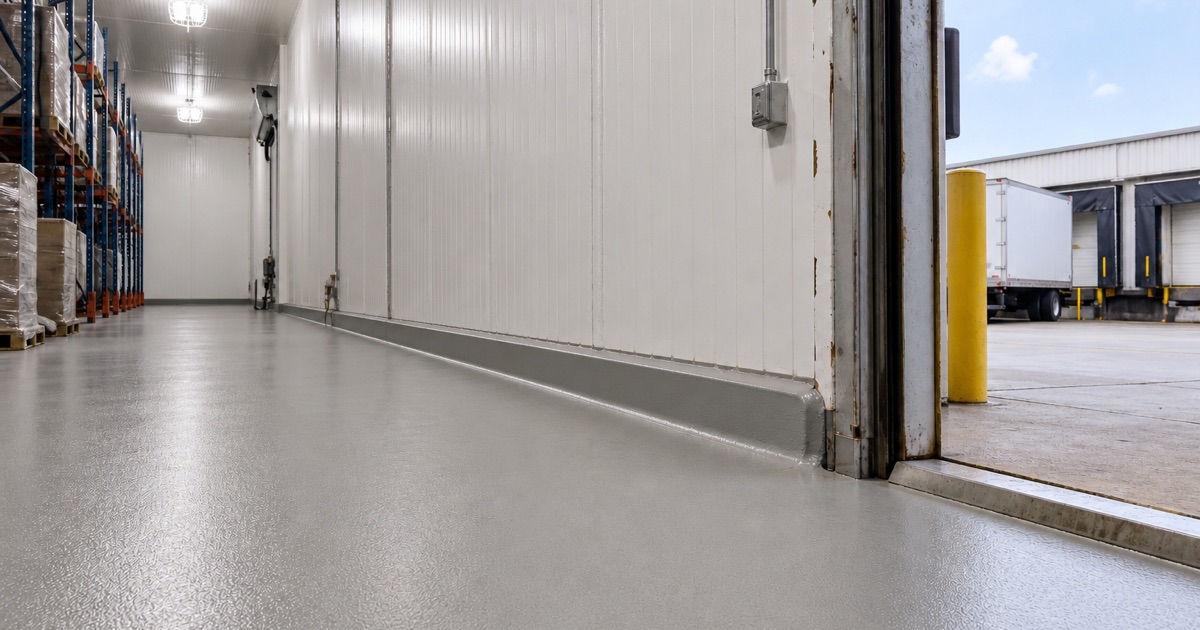
A cold room is cleaned with water and pressure, and water finds the places a floor stops. Terminating a coating at a raw wall junction gives it an edge to creep under, so an integral cove base is formed and carried up the wall as part of the same monolithic surface rather than added afterward as a separate strip.
Drains and thresholds get the same attention. The coating is carried into the drain body and closed off there, falls are read before quoting because a new surface records existing drainage rather than correcting it, and the threshold where a cooler meets a warmer dock earns its own line in the estimate.
Handing a Room Back to a Running Cold Chain
These buildings do not switch off for us. Product has to be pulled or consolidated, the room has to come up to a temperature where a resin will cure at all, the work has to happen, and the room has to come back down before it is loaded again. That sequence gets agreed with the operations side before the first machine is unloaded, not negotiated at the door.
What we hand back with it is a written cure schedule that separates foot traffic, racking and equipment, and loaded pallet jack or lift truck return, instead of one figure that quietly means the longest of the three. A crew can walk a floor well before it will take a steel wheel through a turn, and a facility manager needs both of those dates to book against.
Looking for epoxy flooring closer to Azusa? See Azusa Epoxy Flooring.
Thermal Cycling and Why Standard Epoxy Fails It
What Repeated Movement Does at the Bond Line
Concrete and a resin film do not expand and contract at the same rate, and a floor that runs at freezer temperature and then takes hot washdown water is working that difference over and over. The damage does not show up as wear in the middle of the room; it shows up as delamination starting at edges, joints and drain surrounds where the film has something to peel from.
That is a mechanical failure rather than a chemical one, which is why a general durability claim tells you nothing useful about a cold room. A thin, rigid, high-gloss film is close to the worst answer available here, and it is exactly what an ambient specification hands you if nobody flags the temperature.
Where Urethane Cement Earns Its Cost
Urethane cement is the system built for this. It is placed considerably heavier than a roller-applied epoxy, it moves far closer to the rate the slab underneath it moves, and it tolerates thermal shock and aggressive cleaning chemistry in a way that a standard epoxy buildup was never formulated to.
It also costs more per square foot, and we say so at the quoting stage rather than burying it. In a dry ambient building we quote 100% solids epoxy and stand behind it, and on an unusually tight window an MMA resin that cures at low temperature is worth pricing. The deciding factor is the room’s temperature history, not the budget.
Profile, Mil Build and Preparation That Holds
A heavier system needs a deeper anchor than a thin one, so the mechanical profile is opened with diamond grinding to a named ICRI concrete surface profile and never with acid etching. On wide open areas shot blasting covers ground faster and leaves a deeper, more consistent texture for the buildup to key into.
Mil build then has to actually be achieved rather than assumed, and aggregate broadcast to refusal is what gives a washdown floor grip that survives the cleaning that removes it from lesser surfaces. One crew runs the job from the first pass of the grinder to the last pass of the topcoat, with no subcontracted surface preparation, because prep is where the outcome is decided.
Dry Warehouse Floors and Somebody Else’s Calendar
Opening a Slab That Is Too Tight to Bond To
The distribution buildings on this side of the city are recent placements, power-troweled and burnished to a closed, dense surface that sheds a liquid instead of absorbing it. New concrete is not easier to coat than old concrete, it is harder in a specific way, and the answer is aggressive grinding rather than a primer chosen to compensate.
Joints and cracks get decided rather than covered. Saw-cut control joints are filled with a semi-rigid joint filler, honored through the new surface or bridged depending on the movement they carry and the wheels crossing them, and spall repair mortar at the dock edge is measured and priced up front instead of discovered on the second shift.
Racking Permits and the Install Sequence
The coating window in a warehouse here is usually defined by somebody else’s schedule. Pallet racking permits and tenant improvement work run through the City of Jurupa Valley Building & Safety Department, with intake and processing handled through Accela, and the inspection dates on that work set the shape of ours.
So we confirm the racking and equipment install sequence before committing to a cure date. Coating a bay the week before anchor holes get drilled through it means somebody is drilling into a new floor, and resequencing after the fact costs more than asking the question at the estimate.
Pot Life on a Hot Inland Slab
We read slab temperature and dew point on the morning of the pour rather than off a forecast written the week before. The same product that gives a crew roughly sixty minutes of working time on a 55-degree slab gives them closer to twenty at 95 degrees, and that gap decides how the whole day is run.
On a large open floor that is a crew-size question, not a start-time question. Batch sizes come down, more mixers run in parallel, and the gauge rake and notched squeegee team is paced to the working time the slab is actually giving rather than the figure printed on the data sheet.
Staging Where the Trucks Are
The Mira Loma industrial streets and Etiwanda Avenue carry constant big-rig traffic moving between the Costco, Walmart, FedEx and UPS facilities and the freeways. A planetary grinder, a dust extraction rig and a material pallet cannot be dropped wherever there happens to be curb, and that flow has to be planned around rather than discovered.
Street parking for a crew vehicle near a dock apron is not a safe assumption either. We confirm which door the equipment goes through, where the truck sits while it is unloaded and what power is available, before the number is written rather than at the guard shack on the morning of the job.
One City, Seven Communities, Two Building Eras
Why the Address Decides the Quote
Incorporation came on July 1, 2011, when Rubidoux, Glen Avon, Mira Loma, Pedley, Sunnyslope, Indian Hills and Sky Country were merged into one municipality. They did not become one place in the process, and a day’s route can run from tight 1950s lots to a 2010s industrial placement to acreage where the outbuildings matter more than the houses.
That is why we quote an address rather than a city. The industrial complex itself only exists because a mid-1980s Costco warehouse started converting dairies and pastureland into distribution space, so a building’s age here tells you which era of construction you are standing on before anyone reads a tape measure.
Old Concrete on the Older Side of the City
Roughly 6,300 units citywide, 21.5% of the stock, went in before 1960, and 987 date to 1939 or earlier. Concrete of that vintage was commonly placed without a vapor retarder underneath it, so moisture vapor emission testing belongs in the scope as a standard line item on that side of the city, whether by in-situ relative humidity to ASTM F2170 or calcium chloride to ASTM F1869.
Old slabs want patience where new ones want aggression. Settlement cracks get routed out and filled rather than skimmed, spalled edges get rebuilt, and that repair is priced before the work starts. A single citywide preparation method would be wrong at one end of this city or the other.
Two Product Lines and Where Rule 1113 Draws the Line
Jurupa Valley sits inside the South Coast Air Quality Management District, and SCAQMD Rule 1113 caps floor coatings at 50 grams per liter of volatile organic compounds while permitting industrial maintenance coatings up to 100. Subsection (c)(6) then forbids applying or soliciting industrial maintenance coatings for residential use, which makes the category a legal boundary rather than a matter of preference.
We therefore quote commercial and residential work from separate product lines, and in a city split this evenly between distribution floors and older housing that line gets tested constantly. What decides it is the use of the building, not how hard the floor happens to get worked.
- 20+ Years Experience
- Licensed & Insured
- Free On-Site Estimates