
Upland Epoxy Floors quotes epoxy flooring in Grand Terrace against a market that is genuinely small, and we would rather say so than pretend otherwise. The city’s own business profile counts 2,719 jobs inside the city limits, so the commercial floors we coat here belong to a supermarket, a couple of pharmacies, an auto parts store, a bank branch, a fast-casual kitchen and a short list of distributors and light manufacturers.
That changes the shape of a commercial job more than it changes the chemistry. A floor of that size does not get phased over six weekends; it gets done in a night or a weekend, and the cost of mobilizing a crew and a dust extraction rig is a bigger share of the total than it would be on a hundred thousand square feet. Getting the scope right in advance is what keeps a small job from becoming an expensive one.
The residential side is narrow in a different way. Only 59.6% of the 5,069 housing units here are single-family detached, ownership sits at 64.4%, and 7.4% of the stock is mobile homes, so a real share of this city has no private garage slab at all and the apartment and condominium buildings become part of the addressable work rather than a footnote to it.
Floors for Small Shops and Supply Businesses
Distributor and Supply-House Floors
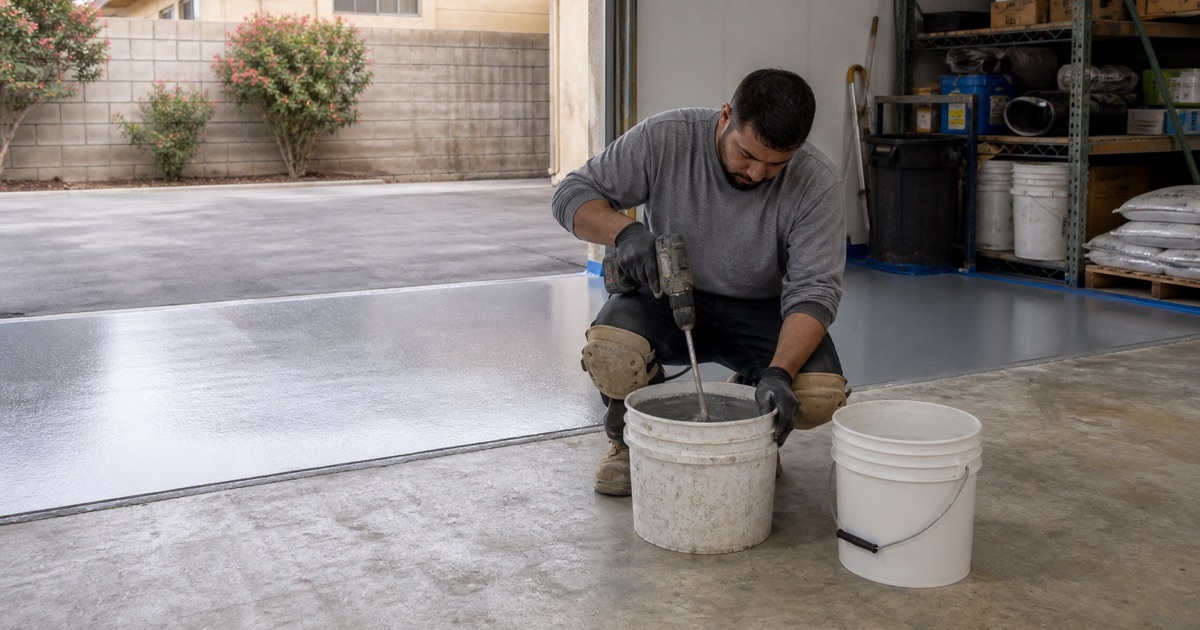
The distributors here run tight buildings rather than high-cube ones. Names like Essco Wholesale Electrical and Superior Pool Products describe an operation with a will-call counter at the front, racking down the middle and a roll-up door at the back, and the floor takes pallet jack wheels, dropped stock and forklift point loads across a footprint measured in thousands of square feet, not hundreds of thousands.
That compresses everything into fewer moves. There is usually one aisle wide enough to work in, one door the equipment can come through, and no second building to move stock into, so the sequence has to be agreed with whoever runs the counter before a machine arrives rather than improvised around them on the day.
Grocery, Pharmacy and Restaurant Back-of-House
Back-of-house floors in a market, a pharmacy or a kitchen get washed rather than swept, and that single fact drives the detailing. The coating has to be carried up the wall as an integral cove base so there is no raw junction for water to work under, and it has to be closed off properly into floor drains rather than stopped short of them.
Slip resistance in those rooms is a measured property, not an adjective. It is expressed as a dynamic coefficient of friction under ANSI A326.3, and setting a number gives an operator something to hold the finished surface against, while the aggregate broadcast still has to stay fine enough that a nightly mop actually lifts what lands on it.
What Keeps a Small Commercial Floor Affordable
On a floor this size the variable that moves the price is not the resin, it is the number of trips. Every extra mobilization brings the truck, the grinder, the vacuum and the crew back for a day that produces a fraction of a day’s coverage, so we would rather measure carefully once and order to a complete list than discover a shortfall at ten at night.
Repair is the other place small jobs go wrong. Crack, joint and spall repair gets measured and priced before the work starts rather than found halfway through, because on a two-thousand-square-foot floor an unexpected day of concrete repair is not a rounding error in the estimate — it is a visible percentage of it.
Looking for epoxy flooring closer to Sierra Madre? See Epoxy Flooring Services in Sierra Madre.
Working Around a Business That Cannot Close
Coating in Sections While the Doors Stay Open
A small operator cannot take a week off, and does not have a second warehouse to trade out of. So these floors get divided into working sections: one area is cleared, isolated, ground, coated and cured while stock and staff move to the other side, and the coating is terminated at a clean temporary edge that the next section ties back into.
That means the scope has to be written as sections with dates rather than as one square-foot number. We agree which area comes first, what has to be moved out of it and where it goes, because the part of this job that actually disrupts a business is the shifting of inventory, not the grinding.
Getting the Floor Back Overnight
Every section gets a written cure schedule that separates foot traffic, restocking and racking, and loaded wheel or vehicle return, instead of one figure that quietly means the longest of the three. Staff can walk a floor well before it will survive a loaded pallet jack turning on it, and an owner needs both dates to plan the reopening.
The chemistry then follows the window rather than the other way around. Where a room has to trade in the morning, a polyaspartic or polyurea topcoat over an epoxy build buys back hours that a straight 100% solids epoxy system cannot give; where a full weekend is available, the epoxy system is the cheaper answer and just as durable.
Dust, Fumes and a Customer on the Other Side of the Wall
Grinding concrete releases respirable crystalline silica, which is a regulated hazard for the crew and a nuisance for everyone else in the building. Containment and extraction run on our equipment as standard, and in a small tenancy where the stockroom shares a wall with a sales floor that containment is doing more work than it would in an empty shell.
Odor is the complaint that reaches an owner first. We sequence the most odorous stage into the part of the window furthest from trading hours and confirm what can be done about ventilation before quoting, because a floor that is technically finished on time but leaves a smell in a food or pharmacy space has not really been handed back.
Apartment, Condominium and Common-Area Floors
Parking Structures, Podium Decks and Stairwells
Roughly 1,470 of this city’s units sit in multifamily structures, including 499 in buildings of fifty units or more, which makes property management a bigger share of the addressable work here than the resident count suggests. Those buildings carry floors that a single homeowner never has: resident parking levels, podium decks, exterior stairs and landings.
Each of those is a different exposure. A parking level takes tire traffic and dripped fluids, a podium deck takes weather and movement, and a stair landing has to be slip-resistant while wet without becoming something a mop cannot clean, so quoting them as one line at one rate produces at least one surface that is wrong.
Laundry Rooms, Trash Rooms and Circulation Space
The small shared rooms are where a coated floor pays back fastest in a building like this. A laundry room floor takes standing water and detergent, a trash enclosure takes leakage and constant cleaning, and both are far easier to keep presentable sealed than as bare porous concrete that stains and holds odor.
These are also the rooms that let a manager test a contractor cheaply. A single laundry room is a small enough scope to complete inside one visit, and it produces a floor that the same maintenance staff will look at every day for years, which is a fairer trial than any brochure.
Which Product Line the Rules Allow in a Residential Building
SCAQMD Rule 1113 caps floor coatings at 50 grams per liter of volatile organic compounds and industrial maintenance coatings at 100, and subsection (c)(6) prohibits applying or soliciting industrial maintenance coatings for residential use. That subsection is not abstract in a city with this much apartment stock.
An apartment parking structure feels commercial because a management company signs the contract, but it serves a residential building, and the product decision has to be made deliberately rather than by whichever line the invoice comes from. We quote residential and commercial work off separate product lines for that reason, and we will say which one a given floor falls under before it is ordered.
The Garages This City Actually Has
One Slab Cohort, Two Decades Wide
More than half the housing here, 54.7%, went up in the 1970s and 1980s, which produces the most repeatable residential job we see in this city: an attached two-car garage on a slab somewhere between thirty-five and fifty-five years old. Control-joint cracking, a settlement crack or two and decades of absorbed oil come with it as standard.
Because the cohort is so tight, the estimate is unusually predictable and we would rather be honest about the exceptions than the average. Fewer than 430 units predate 1960 and only 581 have gone in since 2000, so a floor here is almost never new concrete and almost never pre-war concrete either.
Taking Off What Somebody Already Put Down
On a slab of that age the real scope is frequently removal. A one-part garage paint or a hardware store kit from a decade ago will be sitting there in patches, bonded well in some places and lifting in others, and a new system laid over it inherits every weak spot underneath it.
That comes off mechanically before anything else happens. The profile is opened with diamond grinding to a named ICRI concrete surface profile rather than acid etching, and one crew carries the job from that first pass through to the topcoat with no subcontracted preparation, because the removal and the bond are the same decision made twice.
Older Slabs and the Moisture Question
The roughly 1,430 units that predate 1970 are where moisture stops being a formality. Concrete of that era was frequently placed with no vapor retarder beneath it, and ground moisture will move up through a slab indefinitely regardless of how good the coating over it is.
So the reading gets taken and written down before material is ordered, using in-situ relative humidity probes to the ASTM F2170 method or calcium chloride to ASTM F1869, with ASTM F710 governing how the surface is assessed. Where the number comes back high, a moisture mitigation system goes in under the buildup instead of a heavier topcoat over the problem.
Heat, Pot Life and a Narrow Counter Window
Slab temperature and dew point are read on the morning of the pour rather than taken from a forecast. The same product that gives a crew roughly sixty minutes of working time on a 55-degree slab gives them closer to twenty at 95 degrees, so a summer garage means an early start, smaller batches and a crew paced to what the slab is giving.
The administrative side has its own clock. Building and Safety sits within Planning and Development Services at 22795 Barton Road, and while the counter is open through the day the permit window itself runs only from one in the afternoon until half past four, so anything needing a same-day permit interaction gets scheduled into that window rather than around it.
- 20+ Years Experience
- Licensed & Insured
- Free On-Site Estimates