
Upland Epoxy Floors has been specifying and installing industrial epoxy flooring in Fontana for more than twenty years, and the work here is not a heavier version of a light commercial floor. It is a process surface that has to keep working while heat, wheels and chemistry all attack it from different directions on the same shift.
The scale of that is set by what the city is built around. California Steel Industries runs a 430-acre plant here with roughly 115 acres under roof, in operation since 1984 on the former Kaiser Steel site, and a metals operation of that kind sets the expectation for what a floor in this city is asked to do.
So the specification questions we ask on the way in are different from the ones a decorative job starts with. We want to know the temperature the floor sees, the reagents that reach it, the wheels that cross it and the hours it is allowed to be out of service, because those four answers decide the resin family long before anyone talks about appearance.
What a Manufacturing Floor Is Actually Absorbing
Point Loading and Impact
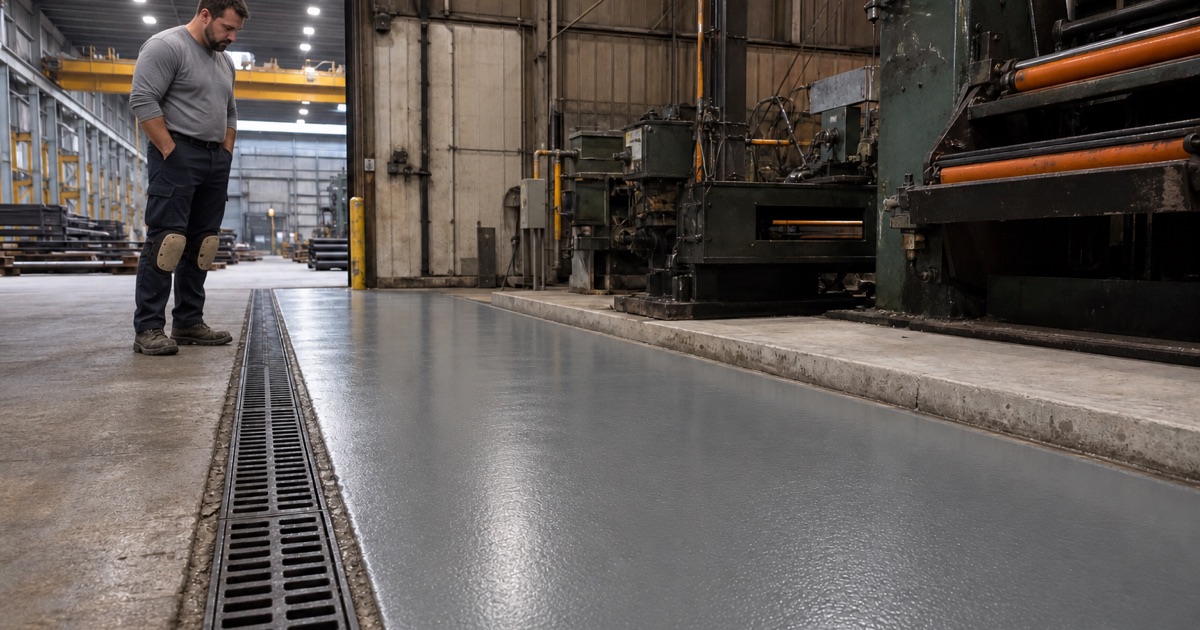
A plant floor rarely fails across its whole area. It fails where a hard, small contact patch concentrates load into one spot: the steel wheels of a die cart, a jack stand under a machine base, the leg of a stillage dropped rather than set down. Those loads are carried by the compressive strength of what is on the slab, not by the toughness of the resin binding it.
Impact behaves differently again. A thin roller-applied film has nowhere to put the energy from a dropped part and simply shatters, while a trowel-applied system loaded with quartz aggregate is thick enough to spread that energy into the slab beneath it. When a floor is going to be struck rather than merely driven on, the build has to be measured in fractions of an inch rather than in mils.
Thermal Shock and Where Urethane Cement Belongs
Thermal shock is the exposure most often left off a specification and it is the one that pulls coatings off in sheets. Hot process water, steam cleaning or a wash-down over a floor that has been running warm all day makes the concrete and the coating move at different rates, and the bond line is where that difference gets resolved.
Urethane cement exists for exactly this. Its rate of thermal movement sits far closer to concrete’s than a filled epoxy’s does, so it survives cycling that would debond a rigid system, and it will go down over a slab that still holds more moisture than an epoxy would tolerate. It costs more per square foot and in a hot, wet bay it is the cheaper decision.
Chemical Exposure Matched to a Real List
Chemical resistance is not a durability adjective, it is a resin-by-reagent question with a different answer for every plant. Cutting fluid, hydraulic oil, coolant, pickling and cleaning acids and caustic wash chemicals each attack a coating by their own mechanism, and a system that shrugs off one of them can soften under another within a season.
So we ask for the actual list, and then for concentration, temperature and dwell time, because those three change the answer more than the chemical name does. A floor that handles an occasional splash and gets rinsed will fail where the same fluid pools against a drain for hours, which is why the specification often varies by zone inside one building.
Looking for epoxy flooring closer to Eastvale? See Epoxy Flooring in Eastvale.
Two Very Different Kinds of Slab in One City
New Concrete Too Tight to Bond To
The distribution corridor along Slover Avenue between Interstate 15 and Interstate 10 is dense with recent high-cube product, including the Slover Gateway Commerce Center and buildings running 36-foot clear heights with dozens of dock-high doors. Those slabs were placed for flatness and power-troweled hard, and the resulting surface is closed and low in porosity.
An acid etch does almost nothing to a face like that, which is one reason we never use one. The profile gets opened mechanically with diamond grinding to a named ICRI concrete surface profile, chosen for the system going on top, because the coating can only key into a texture that has physically been cut into the concrete.
Older Slabs and What Is Underneath Them
The other half of the city’s inventory is the opposite problem. Fontana stayed essentially rural until the war years brought a steel mill, and a meaningful share of the building fabric here dates from that era, with 12.9% of the city’s housing stock alone predating 1960. Slabs of that age were routinely poured with no vapor retarder under them.
That makes moisture testing a precondition rather than an upsell. We take in-situ relative humidity readings to the ASTM F2170 method, or a calcium chloride moisture vapor emission rate to ASTM F1869 where that suits the slab better, and the number goes in writing before material is ordered, because moisture failure is the one thing nearly every coating warranty excludes.
Joints, Cracks and Spalled Arrises
In a building that has been running for years, the joints have already taken their beating. Wheel loads chip the arrises on either side of a saw cut until the edges crumble, and coating over that condition just produces a smooth surface with the same broken concrete a fraction of an inch below it.
Those edges get rebuilt with spall repair mortar and the joints get treated deliberately, filled with a semi-rigid filler that supports the edge, honored through the new floor, or bridged, depending on whether the joint still moves. All of that is priced up front rather than discovered by the crew halfway through the grind.
High-Cube Distribution Floors
Sequencing Against a Dock Schedule
Distribution tenants here run around the clock, so the constraint on a warehouse floor is almost never access. Streets are wide, yards are built for 53-foot trailers and a grinder and dust rig go in easily; what is difficult is finding a window when a given bay is empty and the racks over it can be worked around.
We ask about dock doors and trailer stalls before committing to any schedule, and then break the building into bays or aisle runs that can be prepared, coated and released independently. Where the operation genuinely cannot open a gap, a full weekend shutdown is usually the only honest answer and it is better said early than discovered late.
Where a Warehouse Floor Actually Wears
Wear inside these buildings is nothing like uniform. It concentrates at the dock apron where wheels land loaded, in the turn aisles at the ends of racking where tires scrub sideways, and around battery charging areas, while the slab under a rack bay may go years without anything touching it at all.
Specifying one system across all of that overspends in the quiet areas and underspecifies where it counts. We build heavier through the traffic lanes and turns, treat charging areas as a chemical zone in their own right, and let the storage footprint carry a lighter system, which is usually how the budget gets to cover the whole building.
Striping, Color Coding and Grip
Aisle markings, keep-clear zones at electrical panels and pedestrian walkways all last longer built into the floor than applied as tape over it, since tape lifts the first time a pallet jack turns on it. Color coding placed within the coating system also survives the scrubber, which is what removes most painted lines within a year.
Grip belongs in the same conversation, particularly at dock edges and anywhere a floor is washed. It is measurable as a dynamic coefficient of friction under ANSI A326.3, which gives a number to hold the floor to, and the level gets set against how the area is cleaned so a textured surface does not become a place that traps what it is meant to shed.
Getting It Right on the Day
Slab Temperature, Dew Point and Pot Life
Ambient air temperature is the wrong number to work from and it is the one most crews check. We read slab temperature and dew point on the morning of the pour, because the same product can run a 60-minute pot life at 55 degrees and about 20 minutes at 95, and this valley reaches the top of that range for months at a stretch.
That reading dictates batch size, crew size and start time rather than just being noted. Mixing more than can be pulled out with a gauge rake and backrolled before it goes off is how a floor gets ridges and thin spots, so in summer the batches shrink, the crew grows and the day starts early.
Silica and People Who Are Still Working
Diamond grinding releases respirable crystalline silica, which is a regulated hazard and not a housekeeping issue. Extraction and containment run as standard on our equipment, and in an occupied plant that containment is also what allows other trades and the tenant’s own staff to keep working two bays over instead of clearing the building.
Sequencing carries the rest of it. We agree the boundary of the work area, where the dust rig sits and how the route out for spoil crosses the operating floor, and we plan the noisiest and most odorous stages against the shifts rather than against our own convenience. That planning is what makes phased work in a running plant realistic.
Product Class and the Line the Air District Draws
The air district sets two separate ceilings in Rule 1113: floor coatings are held to 50 grams per liter of volatile organic compounds, while industrial maintenance coatings are allowed 100. That second category is legitimately available for a plant, a warehouse or a workshop, and it is part of why a heavy industrial floor can be built from products a house is not permitted to receive.
The same rule closes that door in the other direction, because subsection (c)(6) prohibits applying or soliciting industrial maintenance coatings for residential use. A contractor quoting a distribution floor on Monday and a private garage on Saturday is working across a legal boundary, not a preference, which is why we quote the two from separate product lines entirely.
A Cure Schedule With More Than One Number
Return to service is where a plant manager and a coating contractor most often misunderstand each other. We issue a written cure schedule that separates foot traffic, equipment and material placement and full chemical service, because those are days apart on the same floor and quoting a single figure guarantees somebody loads it too early.
The chemistry can be chosen against that schedule too. A polyaspartic or polyurea topcoat returns to service faster than a straight epoxy and buys back hours in a building that cannot afford them, and one crew stays on the floor from grind to topcoat, with no subcontracted surface preparation, so nobody inherits somebody else’s profile.
- 20+ Years Experience
- Licensed & Insured
- Free On-Site Estimates