
Upland Epoxy Floors installs epoxy flooring in Eastvale on the youngest concrete anywhere in our service area, and after twenty years of grinding floors we can say that changes the job in both directions rather than simply making it easier.
The numbers behind that are unusually clean. Of the city’s 18,484 housing units, 17,129 of them were built in 2000 or later, the years from 2000 to 2009 alone account for 11,827, and only 418 units in the entire city predate 1980. Practically every slab we are asked to coat here was placed inside one narrow window.
That uniformity is a genuine advantage and it is also the thing most often misread. A slab poured this century arrives without the accumulated damage an older one carries, but it brings its own two problems: a surface finished far too tightly to bond to, and a moisture story nobody should assume they already know.
What a Post-2000 Slab Does and Does Not Give You
Concrete Without Decades of History
The absences matter first. There is no deep oil saturation from forty years of somebody’s home mechanic work, no stack of previous patches in materials nobody recorded, and rarely the wide settlement cracking that comes from ground moving under a slab across half a century. What cracking exists is usually shrinkage, and it is usually shallow.
That shows up directly in the estimate. We still price crack, joint and spall repair up front rather than finding it mid-job, but on a house of this vintage the repair line is genuinely small most of the time, and we would rather tell an owner that than build a padded allowance into a number they are comparing against someone else’s.
A Surface Finished Too Tightly to Bond To
Production housing gets its garage slabs finished hard and fast, and a power trowel run over concrete for flatness and speed leaves a burnished face with very little open pore structure. Nothing about that is a defect. It is simply a surface a liquid coating can sit on top of without ever keying into anything.
Which is why preparation here is an argument about profile rather than about repair. We cut a mechanical texture with diamond grinding, to a named ICRI concrete surface profile chosen for the system going down on it, and we do not use acid. An etch on a slab this tight rinses the face and leaves it very nearly as closed as it was.
Shrinkage Cracks and the Joints Around Them
Young slabs still have joints, and the saw cuts in a tract garage floor are doing a job whether or not anyone notices them. A joint that is still moving and gets coated straight across will reappear as a crack through the finish, which reads to an owner as a failed floor rather than as concrete behaving exactly as designed.
So joints get a decision instead of a coat of resin. Depending on what the cut is doing, it is filled with a semi-rigid filler, honored through the new surface as a deliberate line, or bridged where the movement has clearly stopped, and that call is made on site with the slab open rather than assumed from the plan.
Moisture Does Not Care How New the Slab Is
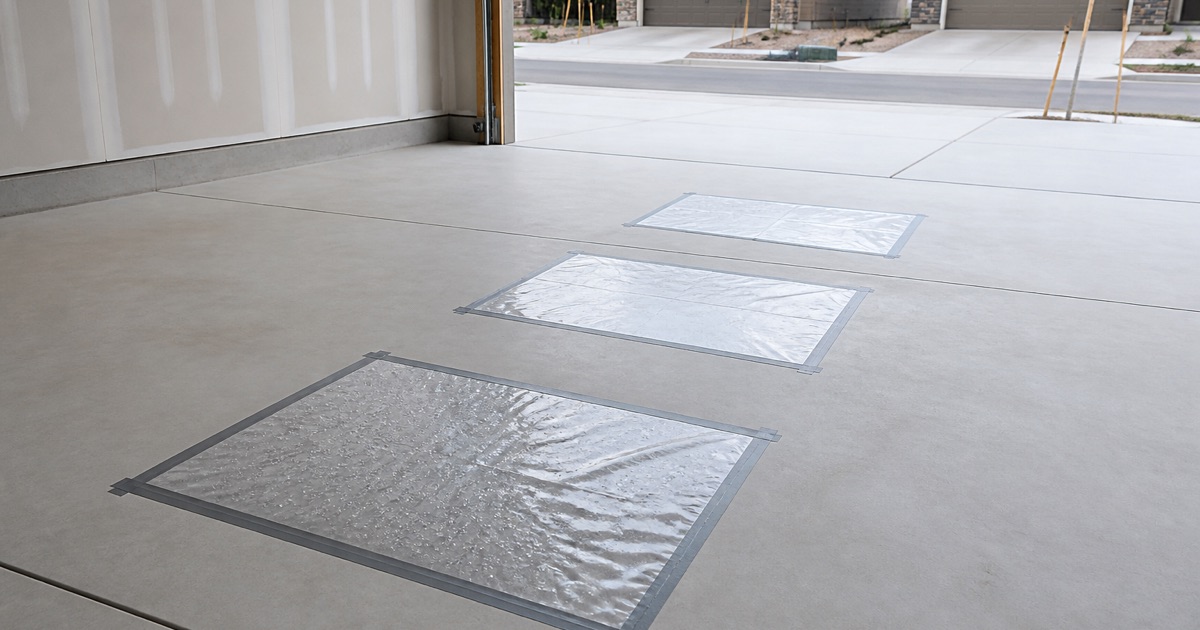
This is the assumption worth dismantling. A young slab can carry a serious moisture problem: an under-slab vapor retarder can be torn during construction and never noticed, a slab placed over saturated subgrade holds that water for a very long time, and irrigation on three sides of an attached garage keeps feeding the edges of it for years afterward.
So we test rather than infer. In-situ relative humidity probes to the ASTM F2170 method give a reading from inside the concrete, ASTM F710 sets what a slab has to satisfy before it receives a resinous floor, and the number is written down before any material is ordered, since moisture failure is the exclusion in nearly every coating warranty in the industry.
Looking for epoxy flooring closer to Diamond Bar? See Epoxy Flooring Services in Diamond Bar.
Garages in a City Built All at Once
Attached Bays, Almost Without Exception
Single-family detached houses make up 87.7% of Eastvale’s units, 16,211 of them, and there are only 140 units in the whole city inside buildings of fifty or more. The attached two- or three-car garage is effectively the default here, and attached is the operative word, because that floor shares a wall and a doorway with the kitchen.
That proximity drives how we work. Diamond grinding releases respirable crystalline silica, so extraction and containment run as standard and the interior door gets sealed rather than closed, and the product category is chosen partly on odor because the household is on the other side of it, not across a yard.
The Real Scope Is Often Removing Somebody’s Kit
The condition we meet most often is not bare concrete at all. It is a fifteen- to twenty-five-year-old floor carrying a one-part hardware store coating that was rolled over an etched slab, now peeling at the perimeter and lifted in two neat rectangles where the tires sit, which is hot tire pickup doing what it always does to a film that never bonded.
Taking that off is the job, and it grinds slower than clean concrete does. We scope removal and preparation as separate items so the price reflects what is actually being done, because a quote built for bare slab and then met with a half-failed coating is where most disputes on a garage floor begin.
Identical Plans, Identical Floors
Houses that went up together to the same elevation have the same garage: the same bay width, the same fall toward the door, the same slab finish from the same crew in the same season. Once we have surveyed one, we know most of what the next one on that street will present before we open the door.
Finish selection is the part that still has to be done individually. We lay a full sample board on your own slab, in the light that garage actually has, because the same flake blend reads differently under a single fixture with the roll-up door shut than it does with the door open and the afternoon sun on it.
Working Inside a Master-Planned City
Architectural Review, Gate Codes and Posted Hours
Eastvale is organized almost entirely into master-planned, HOA-managed neighborhoods, so anything visible from the street can involve an architectural committee. Driveway aprons, entries, patios and RV pads are the pieces most likely to need that review, and the approval is part of the schedule rather than a formality bolted on at the end.
The daily rules matter just as much. Posted work-hour windows, guest parking limits and gate codes for a crew truck and a material delivery all shape a start time, and we confirm them in advance. Physical access is otherwise as easy as it gets: wide modern streets, deep driveways and a garage door opening straight onto them.
Slab Temperature Rather Than the Forecast
Pot life is governed by the temperature of the concrete, not the number on a phone. The same product that gives roughly sixty minutes of working time at 55 degrees gives about twenty at 95, and a west-facing tract garage that has been closed all morning in July sits at the short end of that range regardless of how new the floor is.
We read slab temperature and dew point on the day and let the reading set the plan. Batch sizes come down, the crew goes up, and the start time moves earlier, because material that begins to set while it is still being pulled out with a gauge rake produces ridges and thin spots that no topcoat hides.
Three Dates, Not One Cure Time
Owners load a garage back long before they park in it, which is why a single cure number is such a reliable source of disappointment. Our cure schedule is written down with foot traffic, furniture and stored items, and vehicle return each carrying its own date, so nobody has to guess which one they are allowed to do on a Thursday.
The chemistry can be picked to shorten those dates where it matters. A polyaspartic or polyurea topcoat returns to service faster than a straight epoxy build, and one crew stays on the floor from the first grinding pass to the last topcoat, so the profile that was cut is the profile the coating actually goes onto.
Product Class, Permits and Commercial Work
The Subsection That Governs Almost Every Job Here
Rule 1113, written by the South Coast Air Quality Management District, holds a floor coating to 50 grams per liter of volatile organic compounds and allows an industrial maintenance product twice that, then closes the gap with subsection (c)(6), which prohibits applying or soliciting industrial maintenance coatings for residential use. In a city this overwhelmingly residential, that clause decides what may be quoted at all.
It means a high-solids industrial product cannot legally be sold into a private garage here, whatever a supplier might suggest. We pick the coating category against the limit before anyone picks a color, and we keep residential and commercial quoting on separate product lines because the rule draws that boundary for us.
Where the Paperwork Goes
Eastvale incorporated in 2010 and runs its own counter, so this is not a place where a question has to travel to a county office. Building Safety sits within the Community Development Department at 12363 Limonite Ave, Suite 910, and applications are submitted through the city’s own permit portal.
We do not offer opinions about what a given scope requires. Coating an existing slab and converting a space are different undertakings with different paperwork, and where a floor forms part of a larger project the answer comes from the city rather than from a flooring contractor guessing on a driveway.
Commercial Floors on Equally Young Concrete
The commercial side of this city sits on concrete just as new. Eastvale Gateway on Limonite Avenue carries roughly seventy-two retail and dining tenants, The Station at Goodman Commerce Center opened in 2018 anchored by Costco Wholesale on Hamner Avenue, and Goodman Commerce Center at Hamner and Goodman Way includes a 38,209 square foot building permitted for an indoor trampoline park.
Those floors present the same tight, recently troweled surface and the same profile question, but almost nothing else carries over from a garage. Cart and foot traffic patterns, cleaning chemistry, slip performance in an entry that gets mopped nightly and the tenant’s own trading hours all change the specification, and the schedule gets built around opening times rather than around a household.
- 20+ Years Experience
- Licensed & Insured
- Free On-Site Estimates