
Upland Epoxy Floors installs epoxy flooring in Covina for two kinds of building that could hardly be less alike. One is a working acute-care hospital founded in 1922, older than almost every neighborhood standing around it. The other is the post-war tract garage, which is what 57.1 percent of this city’s housing came with when it went up across the 1950s and 1960s.
Those jobs are separated by far more than square footage. A clinical floor is specified so that nothing can lodge in it and nothing survives a wipe-down, and it is installed under containment while patients are still in the building. A garage floor is specified for hot tire pickup, appearance, and a slab that has been quietly absorbing oil since the grove was cleared.
So we run them as two operations with two product lists, two schedules and, as it happens, two legally distinct categories of coating. This page follows that split. The clinical work comes first because it sets the harder requirements, and the residential slab comes afterward because there is a great deal more of it.
Floors in Medical and Clinical Spaces
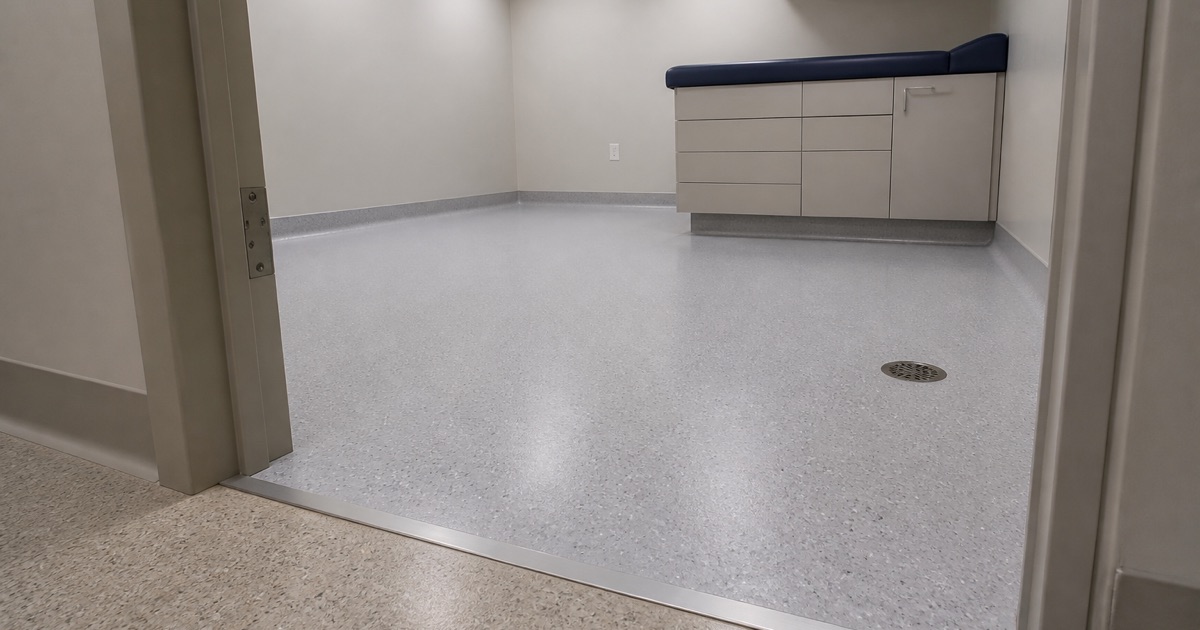
Working Inside a Building That Never Closes
Emanate Health Inter-Community Hospital stands at 210 West San Bernardino Road and is one of three hospitals in the Emanate Health system. Floor work in a building of that kind is not scheduled around our crew. It is scheduled around the department, which means a window that opens when clinical use stops and shuts again when it resumes, usually overnight or across a weekend.
That forces the sequence to be written backward from the reopening rather than forward from the start. Containment, negative pressure and temporary partition are priced as part of the job rather than raised as extras, and where a room genuinely has to be usable by morning we say so at the quote and specify an MMA resin system that can be walked on in hours rather than days.
Cleaning Chemistry, Not Foot Traffic
A clinical floor rarely wears out from being walked on. It fails from what gets poured onto it: quaternary disinfectants, bleach dilutions, alcohol, spilled fluids and whatever else the housekeeping cart is carrying this quarter. A general-purpose coating softens under that routine long before a cart wheel ever abrades through it.
We therefore specify these rooms against the facility’s actual cleaning list rather than against a durability adjective. That usually points to a heavier mil build in 100% solids epoxy for chemical resistance, and in a sterile processing or food service area where the floor is steam cleaned it points to urethane cement, which tolerates thermal shock that would craze a thinner resinous floor.
Grip That Still Works Under a Wet Mop
Corridors, treatment rooms and anywhere a mop bucket crosses several times a day need slip resistance measured wet rather than dry. That is a number rather than an assurance, expressed as a dynamic coefficient of friction tested to ANSI A326.3, and putting it in the specification gives a facilities team something they can hold the finished floor to.
Texture and cleanability pull against each other, so we set the aggregate room by room instead of building to one recipe. A soiled utility room earns a genuine quartz aggregate broadcast, a patient corridor wants just enough tooth to be safe under a wet shoe, and an office wants almost none, because texture a room does not need is texture that holds soil.
Looking for epoxy flooring closer to Bloomington? See Bloomington Epoxy Flooring.
Seamless Surfaces and How They Get Cleaned
The Junction Between Floor and Wall
Ask where a clinical floor fails and the answer is almost never the middle of the room. It is the perimeter, where a coating stops at a raw edge against the wall base and leaves a hairline seam that mopping pushes soil into and never pulls back out.
The answer is an integral cove base, where the floor turns up the wall as one continuous surface with a radius at the bottom, so there is no square corner for material to collect in and no separate trim to lift. That detail is also the difference between a room housekeeping can genuinely flush and a room that only looks washable.
Drains, Thresholds and Everything That Penetrates
Every hole through a floor is somewhere a seal can end badly. Floor drains, equipment anchors, conduit stubs and the threshold at a doorway each get detailed individually and terminated into the substrate, rather than trimmed to a tidy line and left for the first washdown to find.
Control joints get a decision rather than a coat of resin. Depending on what the joint is doing we fill it, honor it through the finish or bridge it, because a coating run blind across a live joint reproduces that crack on the surface within a year, and in a clinical room a reappearing crack is a cleanability defect rather than a cosmetic complaint.
A Cure Schedule Somebody Can Actually Plan Around
A hand-back date means very little on its own. Foot traffic, the return of carts and casework, and the point at which a room can be wet cleaned arrive on three different days, and quoting one cure figure to cover all three is how a new floor picks up its first damage inside a week.
So the cure schedule is issued in writing, staged, alongside the slab temperature reading that produced it. Cure is temperature dependent, and a schedule written for a mild week does not survive a hot one, which matters far more in a mechanical room under an August roof than in a conditioned corridor.
Covina Garages From the Orange-Grove Tracts
The Original Two-Bay Is Tighter Than You Remember
More than half of this city was built inside two decades, on ground that had been orange grove a generation before. In 1907 the town claimed to be the third-largest shipping point of oranges in the world, and what the tracts that replaced the groves left behind is a very consistent garage: a two-bay laid out for mid-century cars, meaningfully narrower than a modern one.
Two practical things follow from that. The finished coated area tends to come out smaller than the owner pictured, so we measure and quote from the real interior instead of a nominal two-car number. And there is less room to run a planetary grinder along the walls, which pushes more of the perimeter onto hand-held edging equipment and adds hours to the preparation day.
Concrete With Sixty Years of History In It
Only 5.4 percent of Covina’s 16,978 housing units have been built since 2000, so almost every residential slab we open here is sixty years old or older. It comes with soaked-in oil, hairline shrinkage cracking, a spalled edge at the door line and, very often, an earlier owner’s patch that was never meant to be seen.
All of it is opened mechanically, diamond grinding to a named ICRI concrete surface profile rather than acid etching, with extraction running on the machine because grinding liberates respirable crystalline silica and a narrow bay gives nobody room to stand clear of it. Crack repair, spall repair mortar and joint treatment are priced in the quote rather than discovered once the grinder is already running.
Reading the Slab Before Any Material Is Ordered
Slabs of this vintage predate any consistent practice of laying a vapor retarder underneath them, and ground moisture moves up through bare concrete continuously rather than seasonally. Moisture is also the one failure that nearly every coating warranty in this trade excludes, which makes measuring it the cheapest insurance available on the job.
We set in-situ relative humidity probes into the slab, read them to the ASTM F2170 method and write the number down before anything is ordered. Where the reading comes back high, the answer is a moisture mitigation system underneath the buildup, not a heavier topcoat laid over the top of the problem.
Estimating Where Nearly Everything Was Built at Once
The era consistency that limits the finished area turns into an advantage everywhere else. Because so much of the housing stock shares two decades, garage width, door opening and slab thickness vary far less across this city than in places built out over a century, so an estimate here holds its shape before anyone lifts a door.
It also means the failure patterns repeat, which makes the walkthrough quicker and the pricing steadier. We still test and measure each slab on its own terms, but we arrive knowing roughly what the concrete underneath is likely to be, and that is not something we can honestly say on a street where the houses span a hundred years.
Access, Ownership and the Product That Is Legal Here
Carports, Open Bays and Slabs Somebody Else Owns
Detached houses are 52.7 percent of the housing here, but 14.7 percent of units sit in structures of twenty or more, and that parking is frequently a carport or open bay rather than an enclosed garage. An exposed slab takes direct sun, wind-blown grit and rain running in at the edge, so it gets a UV-stable polyaspartic or polyurea topcoat rather than an epoxy left as the wearing surface, which chalks and shifts color outdoors.
Ownership changes the conversation as much as exposure does. With 41.2 percent of occupied units rented, a real share of the inquiries we take need a property owner’s decision rather than the occupant’s, and where the scope reaches past the finish into the building itself, permits are issued by the City of Covina’s own Building Division rather than at a county counter.
Getting a Truck and a Vacuum Close to the Work
Access is the quiet variable in a commercial quote. The older buildings of the historic downtown, around the theater refurbished in 2008 and the Metrolink station, sit on narrow street frontage with very little loading room, so a box truck and a dust-extraction rig cannot be parked at the door the way they can at a strip-center address on a wide arterial.
Daily-trading retail is the mirror image of that problem. The IKEA store on South Barranca Avenue, the big-box units and the thirty-screen multiplex opened in 1997 all open every morning, so stockroom and service-corridor floors are sectioned and worked between close and open, in smaller bays, with a hard hand-back at dawn and a topcoat chosen for return-to-service speed.
Pot Life, Slab Temperature and Two Legal Categories
Inland heat moves the chemistry more than most customers expect it to. The same product that gives a crew roughly 60 minutes of working time on a 55-degree slab gives them about 20 minutes at 95, and a west-facing post-war garage with an uninsulated metal door runs well above ambient right through the afternoon.
So slab temperature and dew point are read on the morning of the pour rather than taken from a forecast written days earlier. That reading sets batch size, how many people are on the gauge rake and the notched squeegee, and now and then whether the pour starts at six in the morning instead of nine.
The other constraint on the material is legal rather than physical. Under SCAQMD Rule 1113 a floor coating is capped at 50 grams per liter of volatile organic compounds while an industrial maintenance coating may reach 100, and subsection (c)(6) prohibits applying, or soliciting the application of, an industrial maintenance coating for residential use. That is precisely why a hospital corridor and a garage a few blocks away are quoted from separate product lines.
- 20+ Years Experience
- Licensed & Insured
- Free On-Site Estimates