
Upland Epoxy Floors installs epoxy flooring in Commerce, and nearly all of it goes down in warehouses, plants and distribution buildings rather than in garages. The city covers about 6.6 square miles that were laid out for industry from 1887 onward, holds only 3,381 housing units, and had 12,378 residents at the 2020 census against a working population many times larger.
The rail complex is the reason. BNSF’s Hobart Intermodal Facility sits inside the city on 243 acres and is the largest rail intermodal facility in North America, with roughly 52,000 feet of production track, 30 cranes and up to 1.5 million lifts handled in a year, and the warehousing built to feed and empty it runs on the same continuous clock.
So this page is about industrial floors, and it says so up front rather than burying it. The run out here is close to thirty miles, which is a poor trade against one detached garage and a sensible one against a cross-dock, a plant floor or a fleet maintenance bay. The residential tail is real and it is covered further down, but on terms that reflect the distance instead of pretending it away.
Floors Beside a Yard That Never Closes
There Is No Quiet Week to Wait For
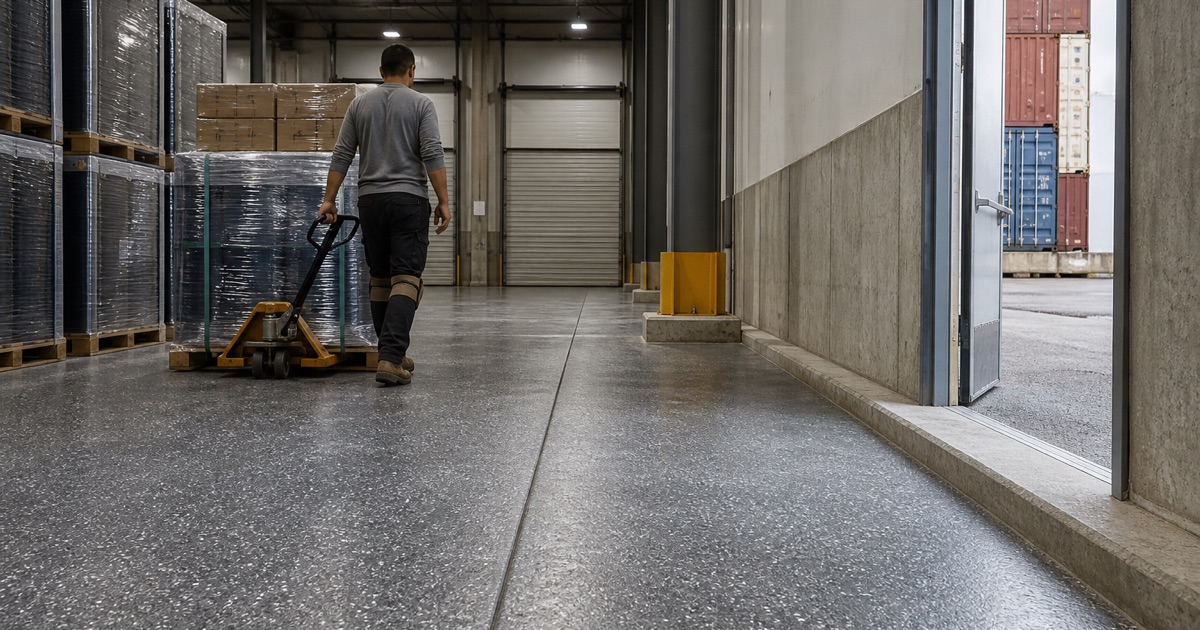
A building tied to the intermodal chain has no natural gap in it. Trailers arrive and leave through the night, and a 3PL bay, a transload building or a cross-dock apron carries freight on a schedule set by trains rather than by office hours, which means the coating program has to be designed around production instead of hoping for a lull.
That leaves two honest options and we quote both. Either a shutdown window is bought deliberately, or the floor is taken in phases: rope off a defined section, grind it, build it, cure it and hand it back before the next shift wants it, then move the barrier and do it again.
Phasing Inside a Live Building
Phasing is mostly a discipline about edges and dust. Every phase needs a clean termination line that the next phase can key into invisibly, and it needs containment good enough that the grinder on our side of the barrier does not put respirable crystalline silica into the air on the working side of it.
The material choice follows the window rather than the other way round. Where a bay has to be back under wheels quickly, a polyaspartic or polyurea build returns to service far sooner than a straight epoxy of the same thickness, and paying for that chemistry is usually cheaper than paying for the hours a slower floor would cost the operation.
Handback Times That Do Not Move
The city also has large public-facing floors, with the Citadel Outlets on the site of a former tire factory and the Commerce Casino among the biggest. Work in those buildings happens between closing and opening, and the floor is either walkable and open at the stated hour or the client has a problem that no amount of explaining fixes.
We do not answer that with a single cure number. The written schedule separates foot traffic from racking and equipment and from vehicle return, because those thresholds land at different hours, and a supervisor deciding what to let back in at six in the morning needs the specific one rather than an average.
Looking for epoxy flooring closer to Artesia? See Epoxy Flooring Services in Artesia.
Point Loading, Impact and the Ways These Floors Break
Load Concentrated Into a Very Small Contact Patch
A loaded forklift puts several tons through wheels with a contact area smaller than a hand, and a fully racked pallet transfers its whole weight through four feet. That is a different loading regime from a parked car, and it is why a thin decorative film that would last a decade in a garage fails inside a season in a warehouse aisle.
The answer is build and bond rather than brand. A properly measured mil build over an epoxy primer keyed into an opened profile spreads that concentrated load into the slab instead of shearing at the interface, and quartz aggregate worked into the body of the system adds compressive strength where wheels track the same line every day.
What Dropped Freight Does to a Coating
Impact is the other half of the same problem. A dropped case, a pallet set down hard by a tired operator or a steel cage dragged off a dock plate all punch or gouge rather than abrade, and the damage concentrates at exactly the places a floor is weakest: leading edges, dock lips and the arris of every joint.
Repairs therefore get scoped honestly at the survey. Spalled edges get rebuilt with a repair mortar and re-profiled before anything is coated over them, and cracks and cold joints are priced as line items at that stage rather than raised as a surprise once the machines are running and the building is committed.
Joints Under Constant Wheel Traffic
Joints are where warehouse floors actually die, and they die from the edges inward. A wheel crossing an unsupported joint edge thousands of times a week chips the concrete arris away, the gap widens, the coating breaks back along it, and what started as a hairline becomes a repair the length of the aisle.
So joints get a semi-rigid filler installed full depth and shaved flush, which supports both edges and lets a wheel roll across the gap rather than drop into it. Coating straight over a working joint and hoping the film bridges it is the shortcut that produces a split line down an otherwise sound floor.
Plants, Washdown and the Product Class Question
Food Manufacturing Wants a Different System Entirely
Food production is a genuine vertical inside the city, with operations including Mission Foods, Unified Grocers, Kimlan Foods and Wine Warehouse. Those floors get hot water, caustic cleaners and high-pressure washdown on a sanitation shift, and thermal shock alone will lift a system that was never chosen for it.
That is where urethane cement belongs. It expands and contracts closely enough to the concrete underneath that a bucket of near-boiling water does not shear it off, it shrugs off caustics and food acids that soften lighter resin systems, and it can be laid heavy enough to be reground and recoated years later instead of stripped out.
Specifying Against a Real List of Chemicals
Chemical resistance is not a general virtue a floor either has or lacks. It is resistance to particular substances at particular concentrations and temperatures, so we ask what is actually used in the building — cleaning chemistry, process fluids, hydraulic oil, whatever goes down the drain on a bad day — before naming a system.
That list also decides how the floor gets looked after later. A system matched to what the building really handles can be maintained on a schedule, scrubbed and patched at the dock edges as it wears, rather than surrendered wholesale the first time something aggressive goes over it in quantity.
Two Markets Sitting a Block Apart
Two markets sit within a block of each other here, and they are not permitted the same tin. South Coast Air Quality Management District Rule 1113 allows floor coatings 50 grams of volatile organic compounds per liter against 100 for industrial maintenance coatings, and subsection (c)(6) keeps the industrial category off residential work altogether.
One crew therefore carries two product lines and does not cross them. A homeowner who has watched a plant floor go down at their workplace sometimes asks for that exact system on their own slab, and the answer is no for a legal reason rather than a commercial one.
The Small Residential Tail and the Old Concrete Under It
What the Distance Means for a House Here
We do coat houses in Commerce, but not on the footing a customer ten minutes from our shop gets, and saying so plainly is fairer than discovering it later. A single-garage job is a long haul each way for a few hours of work, so it is quoted as a planned job with a date agreed well in advance rather than as something we can drop in on.
The industrial work is what makes the corridor viable at all, and it is what we build the calendar around. Residential enquiries get a straight answer about lead time and about the travel built into the price, which is a better outcome than a cheap-sounding number and a crew that never quite gets there.
Concrete From the 1940s and 1950s
The housing stock is genuinely old. Just over a quarter of the units went up in the 1940s and another quarter in the 1950s, giving 57.1% built before 1960 and 72.9% before 1980, with nothing recorded as built after 2009 anywhere in the city. Detached houses account for 64.5% of it.
Slabs of that age carry no vapor retarder underneath, decades of soaked-in oil and at least one generation of patching. Moisture gets measured rather than assumed, whether by calcium chloride to ASTM F1869 or with relative humidity probes set into the slab, and the reading decides whether a mitigation layer belongs under the buildup before anything else is ordered.
Slab Temperature Inside a Steel Box
Pot life belongs to the slab rather than to the pail. An hour of working time on 55-degree concrete becomes about twenty minutes on 95-degree concrete with the identical product, and a metal-skinned warehouse with the dock doors open runs a slab surface well above the outside air.
We read slab temperature and dew point on the day and cut the batch size to suit, which on a hot floor means mixing less at a time and putting more people on the spread. A gauge rake and a notched squeegee move at a fixed speed, and material that goes off in the bucket is material nobody gets to place.
The Counter, the Code and the Drive In
Permits and inspections come from the City of Commerce Building and Safety Division within the Department of Economic Development and Planning at 2535 Commerce Way, and from January 1, 2026 plans are checked against the 2025 California Building, Electrical, Green, Mechanical, Plumbing and Residential Codes.
The other thing to plan is the approach. Sites here have yard space and dock aprons, so unloading a grinder and an extraction rig is the easy part, but the city sits where the I-5, the I-710 and the SR-60 converge with drayage traffic running through all of it, and a crew that leaves at the wrong hour loses the morning to the freeway rather than to the floor.
- 20+ Years Experience
- Licensed & Insured
- Free On-Site Estimates