
Upland Epoxy Floors has been installing epoxy flooring in Claremont for more than 20 years, and the work splits cleanly between two customers who have almost nothing in common. One is institutional: the Claremont Colleges consortium of seven schools carries effectively the whole of the city’s commercial floor demand. The other is a homeowner in a housing stock where 75.1 percent of the 12,530 units went up before 1980.
Those two jobs are not the same product applied to different addresses. A teaching lab or a servery floor is specified for chemical resistance, a sealed junction at the wall and a measured grip underfoot, while a garage floor behind a house is specified for hot tires, appearance and a slab that may be older than the practice of putting a vapor retarder under one.
They also run on different clocks. Institutional floors happen inside two narrow windows a year and residential work fills everything between them, so we quote and staff the two streams separately rather than pretending one crew calendar covers both.
Floors Inside Campus and Institutional Buildings
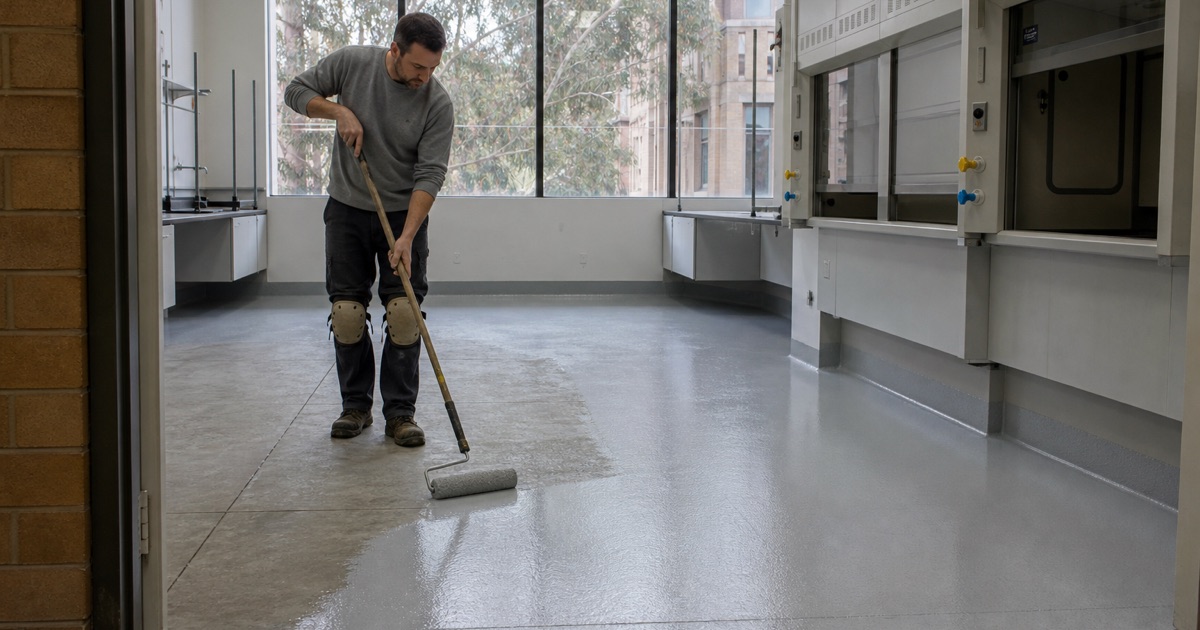
What a Teaching Lab Floor Actually Has to Take
A lab floor fails from chemistry, not from traffic. Solvents, acids and the reagents that get mopped up after a spill will soften a general-purpose coating over a couple of terms, and once the resin is soft, the abrasion from cart wheels and stools finishes it. We specify these rooms against a written list of what is used in them rather than against a general durability claim.
That usually points to a heavier mil build in 100% solids epoxy, and in a wet or steam-cleaned room such as a kitchen or a washup area it points to urethane cement instead, which tolerates thermal shock and caustic cleaners that thin an ordinary resinous floor. Where a room takes MMA resin because it has to be back in service overnight, we say so up front, because that product is a different install and a different smell.
The Wall Junction, the Drain and the Cove
The place an institutional floor leaks is never the middle. It is the perimeter, where a coating stops at a raw edge and liquid gets underneath it, and the drain, where the coating is terminated badly and then sits under standing water every time the room is washed.
So the coving is part of the specification, not a finishing touch. An integral cove base carries the floor up the wall as one continuous surface with no seam at the bottom to trap spilled material, which is also the difference between a room that can genuinely be hosed down and a room that merely looks like it can.
Grip in a Room the Public Walks Through
Corridors, entries and any room where a mop bucket goes through daily need slip resistance that survives being wet, and that is a measurable property rather than a claim on a brochure. It is expressed as a dynamic coefficient of friction under ANSI A326.3, and putting a number in the specification gives a facilities manager something to hold the floor to.
Grip and cleanability pull against each other, though, so we set the texture room by room. A lab or a wash-down area earns an aggressive quartz aggregate broadcast, a corridor wants enough texture to be safe under a wet shoe, and an office or a display space wants very little of it at all.
Rooms Full of Electronics
Some departmental spaces are built around equipment rather than benches, and in a room where boards are assembled or instruments are calibrated, a floor that holds a static charge is a liability rather than a nuisance. Static dissipative flooring is a defined system, not a coating with an additive stirred into it.
It relies on a grounded conductive layer under the wearing surface and is verified by testing to ANSI/ESD S20.20 after installation. We would rather scope that properly at the drawing stage than be asked to add it later, because retrofitting the ground path means taking the finished floor back off.
Looking for epoxy flooring closer to Montclair? See Montclair Epoxy Flooring.
Coating to an Academic Calendar
Two Windows, Not Twelve Months
Campus floor work is governed by the term rather than by anyone’s convenience. Realistically a lab, a kitchen or a corridor can be taken out of service over summer break or during the winter interim, which compresses an entire year of institutional flooring into two blocks and makes both of them crowded.
That has a practical consequence for anyone planning a building: the survey has to happen months before the window, not inside it. We prefer to test slabs, price repairs and order material while the room is still in use, so the first day of the shutdown is a grind day rather than an assessment day.
Building a Sequence Around a Reopening Date
A shutdown has a hard end. Students and staff come back on a published date, and a floor that is still gassing off or still soft on that morning is not a scheduling inconvenience, it is a closed room.
So the schedule is written backward from the reopening and includes the cure, not just the install. We hand over a written cure schedule that separates foot traffic from the return of casework, carts and heavy equipment, because those three do not happen on the same day and quoting one number for all of them is how a room gets damaged in its first week.
The Legal Line Between a Campus Product and a Garage Product
This whole area falls under the South Coast Air Quality Management District, and its Rule 1113 caps floor coatings at 50 grams per liter of volatile organic compounds while permitting industrial maintenance coatings up to 100. Subsection (c)(6) prohibits applying, or soliciting the application of, an industrial maintenance coating for residential use.
That is why our residential and commercial quotes come off separate product lines. A material that is entirely legal in an institutional service corridor cannot be carried across town and rolled onto a homeowner’s garage slab, and a contractor who does it anyway is not saving the customer money, just moving a liability onto them.
Garages Behind Claremont’s Older Houses
A Slab at the End of a Long Side Driveway
Detached homes are 67.5 percent of the housing here and mobile homes barely register at 0.1 percent, and in the older neighborhoods that detached house usually comes with a detached garage set well behind it. The approach is a single narrow side driveway with the house on one side and a fence on the other.
That geometry decides the day. A planetary grinder and a dust-extraction rig often cannot be wheeled straight to the slab, there may be nowhere on the property to put a box truck, and the vacuum has to run a long hose to reach the building. We walk the route before quoting so the crew is not solving it at seven in the morning.
Concrete Poured Before Anyone Put Plastic Under It
Roughly 8.8 percent of the city’s housing dates to 1939 or earlier, and slabs from that era predate the practice of laying a vapor retarder beneath them. Ground moisture moves up through the concrete continuously, and a coating placed over it without checking first is a coating that will delaminate rather than wear out.
So we set in-situ relative humidity probes into the slab, read them to the ASTM F2170 method and write the number down before any material is ordered. Moisture is the one failure nearly every coating warranty in this trade excludes, and where a reading comes back high the fix is a moisture mitigation system underneath the buildup rather than a thicker topcoat on top of it.
Emptying a Garage That Has Been Filling for Decades
In the neighborhoods north of Base Line Road, up against the Claremont Hills Wilderness Park, garages tend to be dense storage first and parking second. Every shelf, cabinet and stack has to come off the slab and out of the building before a grinder starts, and the honest version of that conversation happens at the quote, not the night before.
Old concrete also arrives with its damage already done: settlement cracks, spalled edges at the door line, control joints that have opened. We price crack repair, spall repair mortar and joint treatment up front, and each joint gets a decision to be filled, honored through the finish or bridged, because a coating run straight over a live joint prints that crack back through within the year.
Heat, Preparation and the Finish You Live With
Pot Life on a West-Facing Slab in August
An inland summer moves the chemistry more than most homeowners expect. The same product that gives a crew roughly 60 minutes of working time on a 55-degree slab gives them about 20 minutes at 95, and an uninsulated garage facing west in August is genuinely a different job from that same garage in February.
We read slab temperature and dew point on the morning of the pour rather than trusting the forecast from the week before. That reading decides the batch size, how many people are on the squeegee and the gauge rake, and occasionally whether the pour starts at six in the morning instead of nine.
Profile Comes From a Grinder
We open every slab mechanically, diamond grinding to a named ICRI concrete surface profile, and we do not acid etch. Etching leaves residue in the pores and gives an inconsistent bite, and on a garage floor carrying sixty or seventy years of soaked-in oil it is not a preparation we would put our name to.
Grinding liberates respirable crystalline silica, so extraction runs on the machine as standard and on a tight side driveway that containment is protecting the neighbor as much as the crew. The same crew grinds, primes and topcoats: we do not subcontract surface preparation, because the people who opened the slab should be the ones answering for how it bonded.
Seeing the Blend Where the Floor Will Live
Flake blends are chosen from a full sample board laid on your own concrete, in your own light, because a card held up in a showroom tells you almost nothing. A blend that looks cool gray under fluorescent tubes can read distinctly warm in a garage with its door open onto afternoon sun.
Vinyl flake broadcast to refusal is the workhorse for these garages, and it earns that place honestly: it hides the patch repairs an eighty-year-old slab needs, it gives the floor texture underfoot, and it takes a polyaspartic topcoat that resists hot tire pickup better than an epoxy left bare on top.
- 20+ Years Experience
- Licensed & Insured
- Free On-Site Estimates