
Upland Epoxy Floors installs epoxy flooring in Citrus, where the concrete behind almost every garage door in the community came out of the same decade. Of 2,740 housing units here, 1,789 went up between 1950 and 1959, and 92.0 percent of the stock was standing before 1980.
That uniformity is unusual, and it is genuinely useful. Bay width, slab thickness, the way the joints were cut and the kind of wear seventy years leaves behind repeat from one street to the next, so what a crew learns on one floor carries over to the next one in a way it never does in a mixed-era neighborhood.
It also means there is no such thing here as a fresh slab. Nothing has been built in this community since 2009 and only a sliver of it postdates 2000, so every quote is a quote on old concrete, and most of the work happens before any resin comes out of a pail.
Every Slab Here Was Poured in One Decade
The Advantage of a Single Cohort
In most places a quote starts from nothing, because the house next door might be forty years older or younger than the one in front of us. Here it does not. When two-thirds of the housing went up inside ten years, those garages were built to one prevailing set of dimensions and their slabs were poured to one prevailing practice.
So the estimating is steadier and the surprises are fewer. We still test and measure each floor on its own, because no two seventy-year-old slabs have lived the same seventy years, but we arrive with the right diamond segments, the right repair materials and a realistic idea of how long the preparation day is going to run.
What a Slab From That Decade Actually Is
A 1950s pour is not a modern pour with more dirt on it. It went down before under-slab vapor retarders were standard practice, which is the most consequential difference for anything bonded to the top of it, and it has been in direct contact with ground moisture every day since.
The surface has changed as well. Decades of parking have driven oil into open pores, hairline shrinkage cracking has had a very long time to develop, and somewhere in that history most of these floors were sealed, painted or patched by somebody whose product nobody wrote down.
A Community of Private Garages
Detached single-family houses are 88.5 percent of the housing units here and mobile homes barely register at 0.7 percent, so nearly every inquiry we take is about one private bay belonging to one household. At 71.4 percent owner-occupied, the person who picks up the phone is usually the person who can say yes.
There is also no city hall in this community. It is unincorporated, so permits and inspections run through Los Angeles County Public Works Building and Safety at its San Gabriel Valley district office rather than a local counter. That rarely touches a floor coating, but it matters the moment a job grows into slab replacement or structural repair.
Looking for warehouse floor coating closer to Jurupa Valley? See Warehouse Floor Coating Services in Jurupa Valley.
Reading the Concrete Before Anything Is Ordered
Moisture Is the Failure Mode Here
When a coating fails on this housing stock, moisture is the likeliest reason by a distance. Vapor rising through a slab with nothing underneath to slow it reaches the back of the coating and pushes, and the result is blistering or outright delamination months after everybody has signed off on the job.
So we measure before we specify anything. In-situ relative humidity probes are set into the slab and read to the ASTM F2170 method, the moisture vapor emission rate can be checked alongside them under ASTM F1869, and whatever comes back goes into the quote in writing, because moisture is the one failure nearly every coating warranty in this trade specifically excludes.
When the Number Comes Back High
A high reading is not a reason to walk away from a floor. It is a reason to add a layer. A moisture mitigation system goes down first, underneath the buildup, as an engineered barrier between the vapor drive below and the finish anybody will ever see.
What it is not is a thicker topcoat. Stacking mils over a wet slab traps the same pressure beneath more material and usually makes the eventual failure bigger rather than smaller, so the mitigation goes at the bottom and the finish is then specified normally on top of it.
What the Old Surface Is Hiding
Before any of that, we need to know what is already on the floor. Old sealers, garage paint, a previous owner’s driveway product and adhesive from a long-gone storage system all look like concrete from standing height and behave nothing like concrete under a grinder.
Oil is the other unknown. Seven decades of parking can drive it deep enough that it bleeds back into fresh resin, so on a heavily stained bay we grind, degrease and read the surface again before committing to a system, rather than finding out about it through the finished floor.
Repair Before Any Coating Goes Down
Cracks, and Which Ones Are Still Working
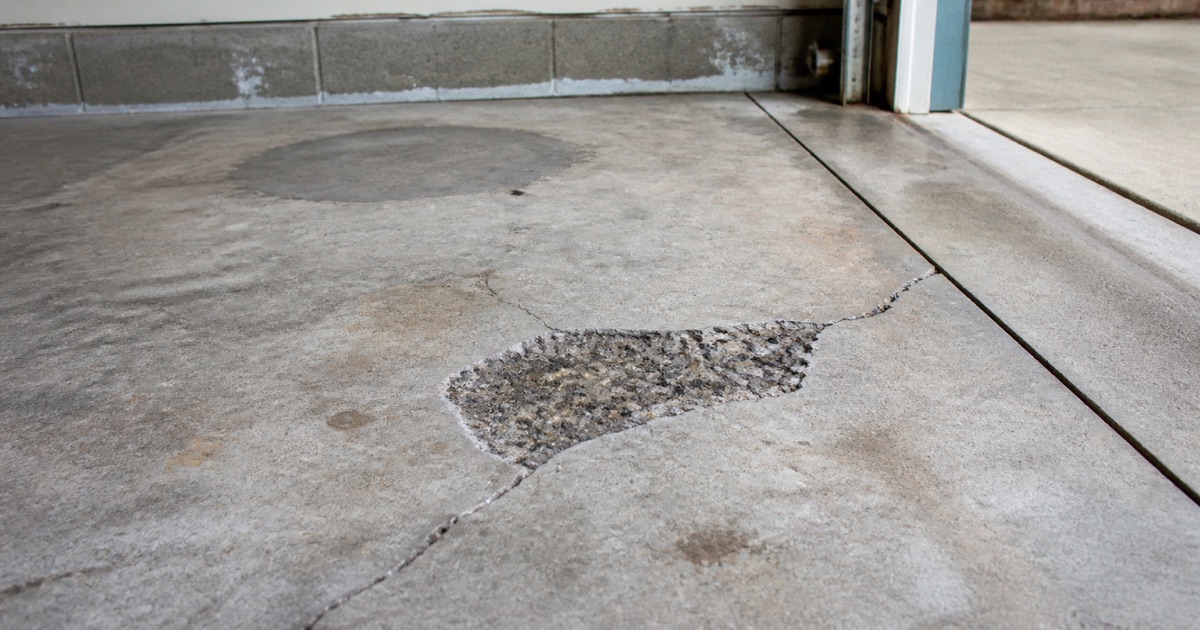
Every slab this old has cracks in it. What matters is whether a crack is dormant shrinkage left over from its first year or a live one that still opens and closes through the seasons, because those two get different treatment and only one of them can be filled and forgotten about.
We chase a crack open with a saw or a grinder instead of skimming across the top of it, fill it with a rigid material that grips both faces, and grind the repair flush with the floor. Done that way it disappears into the finish. Painted over, it comes back as a line within a season or two.
Spalled Edges and Broken Corners
The door line takes the worst punishment on a garage slab of this age. Water runs in under the door, the exposed edge of the concrete breaks down, and what is left is a crumbling lip that will not hold a coating however carefully the rest of the bay is prepared.
Those areas get rebuilt with spall repair mortar back to a sound edge, keyed into solid concrete rather than feathered out over weak material. It is unglamorous work, and it is the difference between a floor that terminates cleanly at the threshold and one that starts failing along the most visible line in the building.
Every Control Joint Gets a Decision
The saw cuts in a slab are there to control where it cracks, and putting a coating over them does not change what they are doing. Running resin straight across a joint and hoping is a reliable way to reproduce that joint on the surface, sharply, inside the first year.
So each one is decided rather than defaulted. Where it has stopped moving it gets a semi-rigid joint filler, where it is still working it is honored through the finish, and where the detail allows it can be bridged. The call is made at the walkthrough and written down, not made by whoever is holding the squeegee.
Repair Priced Up Front, Not Discovered
All of that is quantified before the first machine is unloaded. Crack chasing, spall repair, joint treatment and any grinding needed to take an unknown old coating off the slab are counted at the walkthrough and carried in the quote as their own line items.
That matters more on this housing stock than on newer concrete, because preparation is a much larger share of the total. On a seventy-year-old bay the repair can outweigh the coating in labor, and a number that quietly assumes otherwise is a number that will change halfway through the week.
Grinding, Heat and the Floor You End Up With
A Planetary Grinder in a Narrow Bay
Original bays from this era were laid out around the cars of the time and are noticeably tighter than a modern garage. Two things follow: the finished floor measures smaller than most owners picture, and there is less clearance to run a machine along the walls.
Every slab is opened mechanically all the same, diamond ground to a named ICRI concrete surface profile rather than acid etched, with more of the perimeter than usual finished on hand-held edging equipment. Grinding liberates respirable crystalline silica, so extraction runs on the machine, and in a small enclosed bay that containment is doing real work.
Slab Temperature on the Morning of the Pour
A 1950s garage with nothing insulating the ceiling gets genuinely hot through an inland afternoon, and the slab holds that heat well after the air starts to cool. That is a chemistry problem rather than a comfort one: a product with roughly 60 minutes of working time on a 55-degree slab leaves a crew about 20 minutes at 95.
We read slab temperature and dew point that morning instead of trusting a forecast written days earlier. The reading decides how big each batch is mixed, how many people work the gauge rake and the notched squeegee, and whether the pour needs to start early enough to stay ahead of the afternoon.
A Finish That Suits a Repaired Slab
A floor carrying this much repair underneath it deserves a finish chosen to work with it. Vinyl flake broadcast to refusal is the natural answer here: it breaks up the patchwork an old slab needs, puts texture underfoot, and accepts a polyaspartic topcoat that resists hot tire pickup better than epoxy left bare on the surface.
Blends come off a full sample board laid on your own concrete in your own light, and the job closes with a written cure schedule separating the day you can walk on the floor from the day storage goes back and the day a car does. Everything specified for a private garage here comes off our residential line, which SCAQMD Rule 1113 holds to 50 grams per liter of volatile organic compounds and bars us from substituting an industrial maintenance coating into.
- 20+ Years Experience
- Licensed & Insured
- Free On-Site Estimates