
Upland Epoxy Floors has installed epoxy flooring in Chino for more than twenty years, and the first question we ask on a job here is not what finish somebody wants but what year the concrete was poured. In most cities that question gets a vague answer. In this one it usually gets a precise one, and the answer changes the specification more than anything else on the walkthrough.
That is because the concrete in this city arrived in distinct waves rather than at a steady trickle, and the waves line up with what the land underneath was being used for at the time. A slab poured in 1975 and a slab poured in 2008 sit half a mile apart and behave like two different materials.
So this page is organized around the substrate rather than around a product catalog. What we can put on your floor, what it will cost to prepare, and how long it lasts all follow from the slab you already have.
Why the Year on a Chino Slab Matters
A Gap in the 1990s, Then a Surge
Run the city’s 28,188 housing units by decade and a hole opens up. The 1970s produced 21.2% of the stock and the 1980s another 16.6%, then the 1990s drop to 7.4%, and then the 2000s and 2010s come back at 17.1% and 17.5% respectively. Almost 38.3% of everything here was built since 2000, the highest post-2000 share of any city we serve.
That shape is not a coincidence, and it is not really about housing demand. It is about land becoming available. The Preserve covers roughly 5,435 acres of former and existing farm and dairy property between Kimball Avenue and State Route 71, bounded by Hellman Avenue and Euclid Avenue, announced in 2002 as a master plan and annexed to the city in July 2003.
About half of that ground was designated for development and about half retained as open space, arranged around a community core of roughly 125 acres. The gap in the 1990s is a valley waiting on that land, and the surge that follows is the buildout of it, which is why so many garage slabs in the south of the city carry a date within a few years of each other.
Reading the Slab Instead of Trusting the Decade
The decade tells us what to expect; it does not tell us what is true. So we drill in-situ relative humidity probes and read them to the ASTM F2170 method, or run a calcium chloride test to ASTM F1869 where the floor suits it better, and the number is written down before any material is ordered.
That discipline exists because moisture failure is the one condition almost every coating warranty specifically excludes. A newer slab usually returns a comfortable reading and an older one often does not, but we have been surprised in both directions often enough to stop guessing, and a high result simply moves the job toward a moisture mitigation system under the buildup.
What Used to Be on This Ground
Twenty years ago the dairy preserve in the southeast of the city carried roughly 350,000 cows across a 50-square-mile area, the largest concentration of dairy production in the country. Part of that former county preserve is now Watson Industrial Park, and dairying continues on parcels that were never converted, so this is a landscape in transition rather than one that has finished changing.
For a flooring crew that history is practical rather than sentimental. It means a working barn and a two-year-old garage can be on the same day’s schedule, that the two jobs need different resin families and different preparation, and that a contractor who only knows one of them will get the other wrong.
Looking for epoxy flooring closer to Glendora? See Epoxy Flooring in Glendora.
Garage Floors in the Newer Tracts
What a 2000s or 2010s Slab Gives You
The subdivisions built on the converted ground are the easiest residential work anywhere on our schedule. The slabs were poured under modern practice with a vapor retarder beneath them, the streets are wide, and there is room on the driveway to park a truck and set up a grinder and dust extraction rig without blocking anyone.
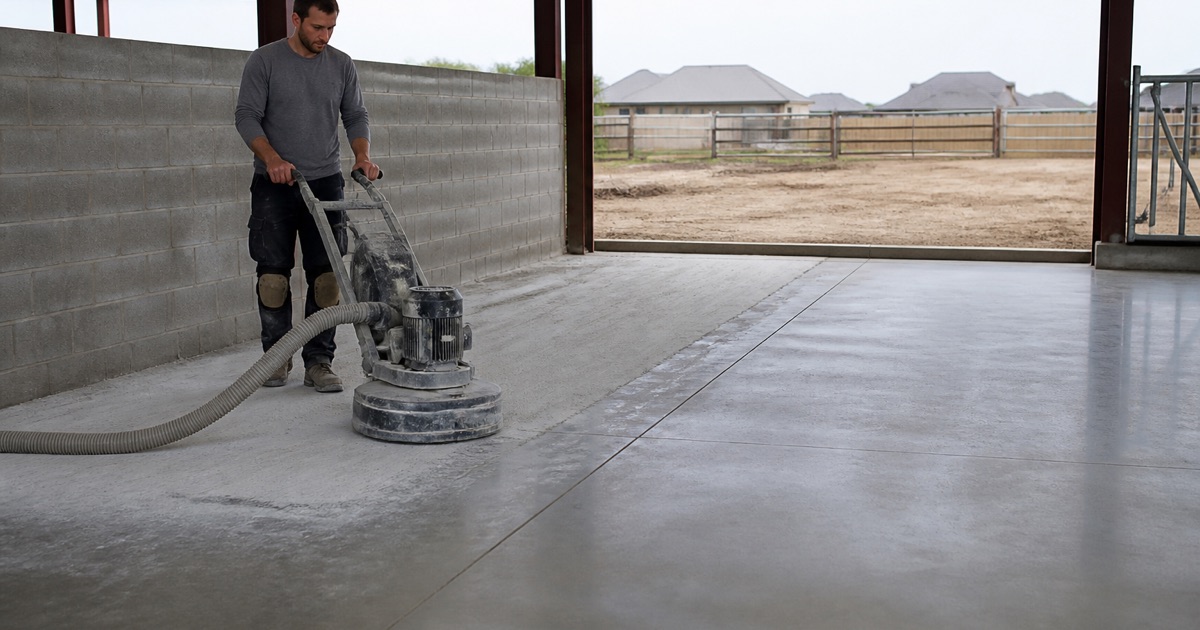
What those floors mostly need is grip on the concrete rather than repair of it. We open a mechanical profile with diamond grinding to a named ICRI concrete surface profile and never with acid etching, which on a clean modern slab gives an epoxy primer a surface it can key into properly and produces a bond that does not depend on luck.
The 1970s and 1980s Core
The older tract neighborhoods are a different piece of work. Combined, those two decades account for well over a third of the housing here, and a garage slab of that vintage has absorbed forty or fifty years of engine oil, brake fluid and whatever leaked out of the last project car parked on it.
Oil that has soaked in has to be ground out rather than cleaned off, and where a previous coating is lifting or was applied over an etched surface, removing it is often the largest single item in the job. Shot blasting is frequently the honest answer on those floors, and we would rather price the removal properly than quote a thin number and discover the truth with the customer’s garage already empty.
Grinding and blasting both release respirable crystalline silica, which is a regulated hazard rather than a nuisance. Containment and extraction run on our machines as standard, which also happens to be why a customer can stay in the house while we work instead of finding gray dust on every surface in it.
Choosing a Finish, and Who Is Choosing It
At 64.0% owner-occupied with 67.6% of units detached single-family, the person signing off on a garage floor in this city is nearly always the person who is going to park on it. That makes for a slower, more specific conversation than a turnover job, and it is worth taking seriously.
We bring a full sample board and lay the blends on the customer’s own slab, in their own light, with the door up. Vinyl flake broadcast to refusal hides slab imperfection and cleans easily, while a quartz aggregate finish gives more texture underfoot, and both look different in a garage than they do anywhere else.
Floors in Barns, Feed Rooms and Working Farm Buildings
What an Agricultural Floor Is Up Against
The buildings on the parcels that still farm face a chemical load a garage never sees. Manure and the ammonia it produces, silage and feed acids, milk residue, and the caustic and acid washes used to clean all of it off attack a coating from several directions, and the floor spends much of its life wet rather than dry.
Standard residential epoxy is the wrong family of product for that room. Urethane cement is what belongs there, laid thick enough to take equipment wheels and formulated to shrug off the washdown, with cove base turned up at the wall junction so a hosed floor drains instead of feeding water into the base of the wall.
Slabs That Were Never Meant to Be Coated
Agricultural buildings routinely hand us a substrate that no coating manufacturer had in mind. The slab may have been power-floated and left, or sealed decades ago with something nobody has a record of, or poured in sections over many years, and in some buildings there is no proper slab beneath the bedding at all.
So these jobs get more testing rather than less. Alongside the moisture reading we check for old sealers and for contamination that has penetrated, because a coating applied over either one will release in sheets, and ASTM F710 exists precisely to set out how a concrete floor should be assessed before anything goes on it.
Where Rule 1113 Bites on a Farm Parcel
Chino falls under the South Coast Air Quality Management District, whose Rule 1113 caps floor coatings at 50 grams per liter of volatile organic compounds and industrial maintenance coatings at 100. Subsection (c)(6) then prohibits applying or soliciting industrial maintenance coatings for residential use, and that is where this gets interesting locally.
An outbuilding on a residentially zoned parcel is a residential property in the eyes of that rule, whatever punishment the floor takes. So the product options for a barn behind a house are narrower than the conditions would suggest, and we quote residential and commercial work from separate lines because the distinction is a legal one rather than a preference.
Scheduling, Repairs and Getting the Floor Back
Slab Temperature and Pot Life
We read slab temperature and dew point on the morning of the pour rather than working from a forecast. The same product that gives a crew about sixty minutes of working time on a 55-degree slab gives them roughly twenty at 95, and this end of the valley reaches that in summer without difficulty.
The response is more hands, not more time. Batch sizes shrink, mixing runs in parallel, and the crew placing material with a gauge rake and notched squeegee is sized to the working time the slab is actually allowing, because a batch that goes off in the bucket is wasted material and a visible line in the finished floor.
Joints, Cracks and Spalls
Control joints get a decision rather than a coat of resin over the top. Depending on the movement they carry and what drives across them, we fill them with a semi-rigid joint filler, honor them through the finished surface, or bridge them, and each choice has a different consequence a year later.
Crack and spall repair is measured and priced at the estimate as a line the customer can see. Older slabs commonly need spall repair mortar at the door threshold where water and tire wear have chewed the edge, and finding that out in advance is much cheaper for everybody than raising it mid-job.
Cure Windows, Permits and One Crew
Every floor leaves with a written cure schedule giving separate times for foot traffic, for shelving and stored items, and for driving a vehicle back on. Those three are genuinely different, and the gap between the first and the last is where hot tire pickup happens, when a warm tire lifts a coating off a slab that was walkable but not ready for weight.
Where permitted work sits alongside the coating, the authority is the City of Chino Building Division within the Development Services Department. The coating itself normally falls outside that process, but the construction it is scheduled around often does not, and we sequence our work against the inspection dates rather than around them.
One crew handles the job from the first pass of the grinder to the last pass of the topcoat, with no subcontracted surface preparation. Preparation is the stage that decides whether a floor bonds, and it is not a stage we are willing to hand to somebody whose name is not on the warranty.
- 20+ Years Experience
- Licensed & Insured
- Free On-Site Estimates