
Upland Epoxy Floors installs epoxy flooring in Charter Oak, and after more than twenty years of coating slabs across the San Gabriel Valley we have learned something specific about this pocket of it: the person who calls about a garage floor here is frequently not the person who will end up parking on it. The call comes from an owner, and the deadline comes from a lease.
That follows from the housing stock rather than from anything about the people living in it. Single-family detached homes account for only 52.1% of Charter Oak’s units, mobile homes make up another 9.5%, and 12.4% of everything here sits in buildings of fifty units or more, so the private two-car garage is far less common than a population approaching ten thousand would suggest.
The work therefore splits differently here than it does a few miles in any direction. We coat single narrow bays behind rented houses, laundry and utility rooms at multifamily addresses, and patio slabs that have to hold up under residents who had no say in what went down. Almost all of it is bought by somebody running numbers rather than decorating a home they live in.
Floors That Change Hands Between Tenancies
The Vacancy Window Sets the Schedule
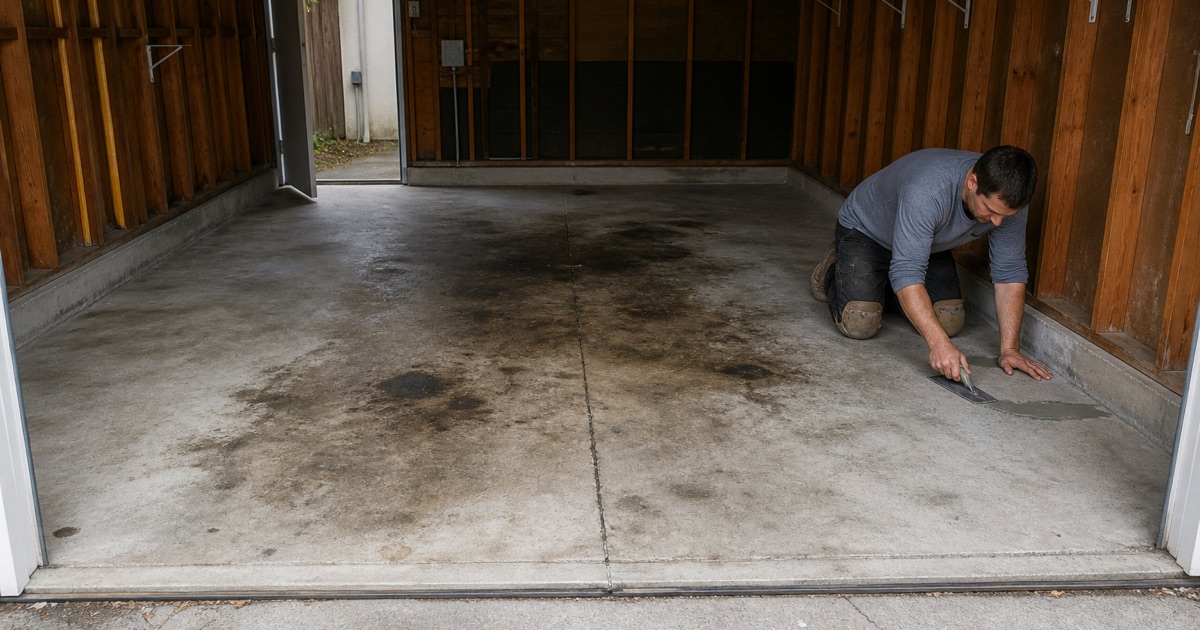
A turnover is measured in days, and every one of those days is rent nobody is collecting. We build the calendar backwards from the move-in date rather than forwards from the day the keys come back, because a floor that is finished but not yet ready to be loaded is still a vacant unit.
That is the reason we issue a written cure schedule separating foot traffic, furniture and vehicle return instead of quoting one number and letting the owner guess. A tenant’s movers are walking on that slab long before any car sits on it, and a polyaspartic or polyurea topcoat that returns to service faster than a straight epoxy often earns its premium back in recovered days.
Reading the Slab Before the Unit Is Empty
Moisture is the single condition that can wreck a turnover, so we measure it with in-situ relative humidity probes to the ASTM F2170 method and write the reading down before any material gets ordered. Those probes need time to equilibrate inside the concrete, so the test wants to happen when notice is given, not on the morning a crew is standing in the driveway.
The reasoning there is scheduling as much as chemistry. If the reading calls for a moisture mitigation system underneath the buildup, that is a different scope, a different material order and a different number of working days, and finding it out on the second morning of a five-day window is how one garage floor turns into a month of lost rent on the unit.
Repair Scope Priced Before the Grinder Runs
Crack, joint and spall repair gets priced up front rather than discovered halfway through the job, which matters more to an owner than to almost anyone else. Somebody weighing two vacant units against one budget needs to know which slab carries extra repair mortar before committing, and that is not a figure to deliver mid-grind.
Not every floor has to start over, either. Where an existing coating is still bonded and sound, abrading it and running a fresh topcoat costs less and finishes sooner than stripping back to bare concrete; where it is already lifting at the edges, no topcoat rescues it, and we would rather say so before the invoice.
Looking for industrial epoxy flooring closer to Fontana? See Fontana Industrial Epoxy Flooring.
What a Rented Garage Has to Survive
Hot Tire Pickup and Vehicles Nobody Vetted
Hot tire pickup is the failure an owner sees most often and understands least. A warm tire parked on a thin or under-cured film softens the resin and lifts it away in a patch the exact shape of the contact area, and it is overwhelmingly a preparation and mil build problem rather than proof the wrong brand was bought.
A rental also hosts vehicles nobody screened. The next tenant may bring a work truck that drips, a project car on stands, brake fluid, battery acid or a knocked-over can of solvent, and none of that appears on an application. We specify chemical resistance against the roughest use the unit is plausibly going to see, not against the tidy household currently holding the keys.
Storage First, Parking Second
In plenty of these bays the car never comes inside at all. The space holds boxes, bicycles, a washer and dryer, a chest freezer and whatever the last three tenants decided not to take with them, which loads a slab in concentrated points and drags steel appliance feet across it in ways a parked vehicle never does.
That argues for texture and camouflage at the same time. Vinyl flake broadcast to refusal builds a thicker, more forgiving surface and breaks up the visual field, so scuffs, chips and the ghost of an old patch stop being the first thing a prospective tenant fixes on during a showing.
Cost Per Door Rather Than Cost Per Job
An owner is not really buying a floor, they are buying a number of tenancies. Spread across four or five turnovers, a properly built coating tends to cost less per year than repainting a slab every time somebody moves out, and it quietly deletes a recurring line from every make-ready list that follows.
The thing that destroys that arithmetic is delamination, and delamination is nearly always a preparation failure rather than a product one. We open a mechanical profile with diamond grinding to a named ICRI concrete surface profile instead of acid etching, and one crew carries the floor from grind to topcoat with no subcontracted surface preparation handed off in the middle.
Seventy-Year-Old Concrete in Narrow Bays
What a 1950s Slab Brings With It
The concrete under all of this is old. Fully 73.2% of Charter Oak’s 3,170 housing units were built before 1980, the 1950s alone account for 32.2% of them and the 1980s add another 21.0%, so the ordinary garage slab we grind in this area has been in service for something close to seventy years.
Slabs of that vintage were generally placed without a vapor retarder beneath them, which is exactly why the moisture reading matters more here than the condition of whatever coating is sitting on top. Add settlement cracking, seven decades of absorbed oil and at least one previous owner’s idea of a patch, and the preparation stage rather than the topcoat is what carries the job.
Bays Sized for a 1950s Car
Original single bays from that period are narrow by current standards, and a modern vehicle fills one almost wall to wall. Doors open into studs, the edges take abuse the center never sees, and the perimeter detail becomes the place a coating either holds or starts to peel.
Access is the other half of the same problem. A planetary grinder and a dust extractor are heavy machines that need a hose run back to the rig, and a short driveway with a tenant’s cars already on it changes where a truck can sit, so we confirm the approach and the run distance while quoting rather than on the morning of.
Joints, Patches and Whatever Came Before
Joints get treated deliberately, filled, honored or bridged according to what they are doing, rather than coated straight across and hoped over. A control joint that is simply buried telegraphs through and then cracks the coating along its own line, which reads as a defective floor even when everything else was done correctly.
Old repairs deserve the same suspicion. A slab patched once or twice across seventy years may carry material that will not accept a coating at all, so we grind those areas and check the bond rather than assuming somebody else’s fix counts as a sound substrate.
Permits, Product Class and Who Actually Signs
There Is No Local Building Counter
Charter Oak is an unincorporated community rather than a city, so there is no city hall here and no local building department to carry a question into. Permits and inspections for this area are handled by Los Angeles County Public Works, Building and Safety, whose San Gabriel Valley district office sits at 125 S. Baldwin Ave. in Arcadia, roughly fifteen miles west of the neighborhood.
The institutions that actually carry the name locally are Charter Oak Unified School District and campuses like Charter Oak High School, not a municipal government, which catches out owners who assume a counter is nearby. We do not guess at what a scope requires; where a floor forms part of a conversion or a tenant improvement, the answer comes from the county.
Residential and Commercial Are Separate Product Lines
Rule 1113 from the South Coast Air Quality Management District caps floor coatings at 50 grams per liter of volatile organic compounds and industrial maintenance coatings at 100, and subsection (c)(6) bars industrial maintenance coatings from being applied or solicited for residential use. A garage behind a rented house is residential no matter how hard the tenant in it happens to be.
So residential and commercial work gets quoted from separate product lines, and that is a legal line rather than a preference we invented. An owner holding a rented single-family house on one street and a multi-tenant building on another will get two quotes at two different rates, and hearing why up front beats hearing it once the numbers look inconsistent.
The Tenant Asks and the Owner Decides
At 40.9% renter-occupied against 59.1% owner-occupied, a real share of the interest reaching us from this area comes from tenants who want a better garage floor and have no authority to buy one. We take those conversations seriously, because the tenant is the one who actually knows the slab, but the first practical question is who signs rather than which color.
From there we put the scope in writing so it can be forwarded intact. The owner then reads the same document the tenant did, with the preparation, the mil build, the repair line items and the cure schedule all in one place, which is what keeps a floor from being coated on a verbal maybe and argued over once the bill lands.
Approving a Finish From Somewhere Else
Flake blends never look the same on a sample chip as they do on a floor. We lay a full sample board on the actual slab in its own light, because a single fluorescent tube overhead and an open roll-up door render one identical blend as two visibly different floors.
That step normally happens with the buyer standing on the slab, and here the buyer is regularly somewhere else entirely. We still lay the board on the real floor and work from what it does there rather than from a catalog page, since an owner approving a finish at a distance has even less margin for a surprise at handover.
- 20+ Years Experience
- Licensed & Insured
- Free On-Site Estimates