
Upland Epoxy Floors installs epoxy flooring in Bloomington, and on most of the properties we quote here the slab that needs the work is not attached to the house. Freestanding shops, detached garages and separate outbuildings sit behind ranch homes on large parcels, and coating a building set well back from the street is a different day’s work from coating a two-car bay off a kitchen wall.
The other side of the work is the logistics floors already standing and operating inside the community boundary. Distribution buildings on Slover Avenue and Cedar Avenue run to hundreds of thousands of square feet apiece, and a floor inside one of those is scheduled around a live shipping operation rather than around our preferred sequence.
Both halves sit on concrete that has to be read rather than assumed. 52.1% of the 6,771 housing units here were built before 1980 and 41.7% before 1970, and there is no city building counter to answer to either, because this is unincorporated territory and the rules come from the County.
Detached Shops and Outbuildings on Large Lots
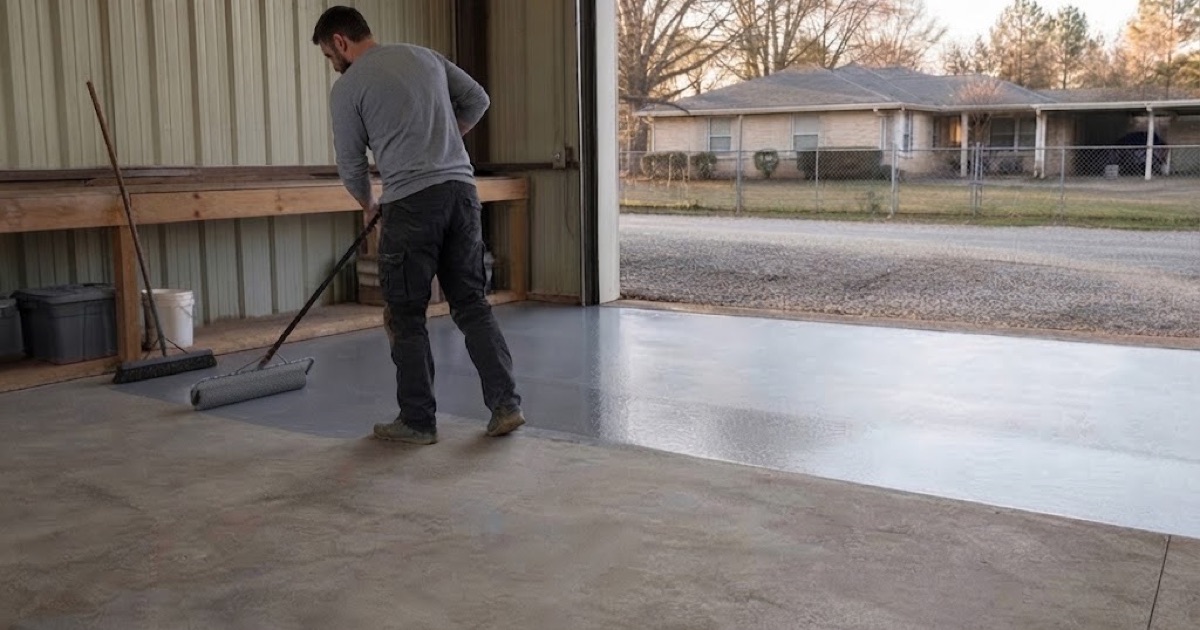
A Slab That Is Nowhere Near the House
77.8% of housing here is single-family detached on a semi-rural, large-lot pattern, and the useful consequence for this trade is how often the target building stands on its own. A separate shop or outbuilding has its own doors, its own floor and frequently its own electrical situation, and none of that can be assumed from a photograph.
So we walk the run before quoting. A planetary grinder and a dust extraction rig need power that will actually carry them and a hose run back to the machine, and where the building sits a long way from the truck the material has to be carried the same distance in the same heat. That is a real line in the estimate rather than a detail to sort out on the morning.
Dirt, Dust and the Approach to the Door
Unpaved and partly paved driveways and yard areas are common on the bigger parcels, and fine dirt is the enemy of a bond. A prepared slab that has been ground clean can be contaminated by one trip across a dry yard, and the contamination is invisible until the coating lifts in patches months later.
The containment plan therefore covers the approach, not just the room. We control what comes through the door, keep the material path clean, and vacuum immediately before priming rather than at the end of the previous day, because on a property like this the gap between preparation and coating is where the risk lives.
What a Working Shop Floor Actually Sees
A shop building on a parcel like this is not a showroom, and specifying it as one wastes money. It takes dropped tools, jack stands, welding spatter, dragged steel and whatever gets spilled while a project is in the middle of it, so impact and abrasion matter more than gloss and the mil build has to be there to absorb them.
Chemical resistance gets specified against a real list rather than a general durability claim. Motor oil, solvents, degreasers and battery acid each attack a coating differently, and asking what actually gets used in the building produces a better system choice than any adjective on a data sheet. With owner-occupancy at 69.3% and a median home value of $469,200, what people here want from a floor is that it lasts and stops shedding dust, not that it photographs well.
Looking for epoxy flooring closer to Citrus? See Epoxy Flooring in Citrus.
Old Concrete and What It Needs Before Anything Else
Reading a Pre-1970 Slab
More than four units in ten here predate 1970, and slab-on-grade concrete of that era in this valley was frequently placed with nothing underneath it to stop ground moisture moving up. That moisture does not care how good the coating over it is, and it is the single condition almost every coating warranty carves out of its own coverage.
So the reading gets taken and written down before any material is ordered, with in-situ relative humidity probes to the ASTM F2170 method or calcium chloride to ASTM F1869, and ASTM F710 governing how the surface itself is assessed. Where the number comes back high, a moisture mitigation system goes in beneath the buildup instead of a heavier topcoat over the problem.
Repair That Gets Priced Before It Gets Discovered
Concrete of this age comes with settlement cracks, spalled edges at door thresholds and control joints that have opened up. None of that disappears under a coating; a crack telegraphs through a new floor within a season, and a spalled threshold takes the edge of the coating with it the first time something heavy crosses it.
Crack, joint and spall repair is measured and priced up front rather than found halfway through the job. Joints get treated deliberately as well, filled with a semi-rigid joint filler, honored through the new surface or bridged depending on the movement they carry, instead of being coated straight over and left to reappear.
Open Pads and Uncovered Slabs
Roughly one unit in twelve here is a mobile home, which usually means a carport or an open pad rather than an enclosed garage, and an uncovered slab is a genuinely different specification. It has to cure in open air, it takes direct sun for the rest of its life, and a system chosen for a closed garage will chalk and fade on it.
That is a product conversation before it is a price conversation. Ultraviolet stability moves the choice toward an aliphatic polyaspartic or polyurea topcoat rather than an epoxy left exposed, and the working day has to be planned around when the slab is in shade rather than when the crew would prefer to start.
County Rules, Product Categories and the Working Day
There Is No City Building Counter Here
Bloomington is an unincorporated census-designated place with no city government of its own, so the authority is the San Bernardino County Land Use Services Department. Building permits for work in unincorporated territory come from its Building and Safety Division, and the Planning Division is what administers the Bloomington Community Plan.
A coating on its own generally sits outside the permit process, but the work it is scheduled around often does not. A new shop building, a slab pour, an electrical upgrade or a conversion all run through the County, and we sequence our grind and our cure dates against those inspections rather than against our own calendar.
Two Buildings on One Parcel, Two Product Categories
SCAQMD Rule 1113 caps floor coatings at 50 grams per liter of volatile organic compounds and industrial maintenance coatings at 100, and subsection (c)(6) prohibits applying or soliciting an industrial maintenance coating for residential use. On a parcel that carries both a house garage and a working shop, that line is not academic.
The two structures are not automatically the same specification, and we say which category each falls into before anything is ordered. Our residential and commercial work is quoted from separate product lines for exactly this reason, so nobody ends up with a product on a floor it is not permitted to be on because the invoice came from the same crew.
Slab Temperature and the Length of the Working Day
Slab temperature and dew point are read on the morning of the pour rather than taken from a forecast written the week before. The same product that gives a crew roughly sixty minutes of working time on a 55-degree slab gives them closer to twenty at 95 degrees, and this is valley floor with nothing to moderate a summer afternoon.
That is a batching problem more than a start-time problem. Mixes get smaller and more frequent, more people run mixers, and the gauge rake and notched squeegee team is paced to the working time the slab is actually giving rather than the number printed on the technical sheet.
Warehouse Floors in the Buildings That Are Standing
Coating Around a Live Shipping Operation
Industrial space is roughly 53% of the commercial floor area available in this community, and the operators are running rather than fitting out. A 677,383 square foot distribution building on Cedar Avenue completed in 2018, and the pair of third-party logistics buildings on Slover Avenue that together exceed 1.26 million square feet, are floors we work around rather than floors we take possession of.
So these jobs get divided into zones against a handback time. A zone is cleared, isolated, prepared, coated and cured while the racking aisles either side of it stay usable, and the sequence is agreed with the operations side before the first machine comes off the truck. More mobilizations, smaller bites, and a date we hand back on.
Forklift Traffic, Joints and Point Loads
A warehouse floor fails at its joints and its dock edges long before it fails in the open field. Saw-cut control joints under a loaded forklift wheel need a semi-rigid filler that supports the joint arris rather than a flexible sealant that lets it spall, and dock aprons need spall repair mortar measured in the estimate rather than negotiated at two in the morning.
The topcoat has to be rated for wheeled point loading, which a residential-grade finish is not. A written cure schedule then separates foot traffic, racking and equipment, and loaded lift truck return, because a crew can walk a zone long before it will survive a steel wheel turning under a full pallet.
Opening a Power-Troweled Industrial Slab
An industrial floor is hard-troweled and burnished to a closed, dense surface that sheds a liquid rather than absorbing it, so preparation is not a formality. The profile is opened with diamond grinding to a named ICRI concrete surface profile and never with acid etching, and on wide open areas shot blasting covers ground faster and leaves a deeper, more consistent texture.
That stage is also the loudest and dirtiest part of the job, and grinding concrete releases respirable crystalline silica. Containment and extraction run on our equipment as standard, which matters more in an occupied building where product is racked nearby and people are picking it while we work.
We Quote the Buildings That Exist
We are careful about which floors we say we can work on here. The Bloomington Business Park Specific Plan covering roughly 213 acres was approved by the San Bernardino County Board of Supervisors in 2022, construction was halted by a San Bernardino County Superior Court judge in 2024 over deficiencies in the county’s environmental review, and litigation over it is still live. Those buildings are not standing.
The warehouse work described above is in the buildings already up and operating, and that is the only kind we price. 117 homes and small ranches on that footprint were demolished, and we are not going to dress any of that up as an opportunity — a contractor quoting floors in buildings that do not exist is not someone to take a schedule from.
- 20+ Years Experience
- Licensed & Insured
- Free On-Site Estimates