
Upland Epoxy Floors installs epoxy flooring in Azusa for buildings rather than for bays, more often than in any other city we serve. Only 47.6 percent of the 15,580 housing units here are single-family detached, the lowest share in our whole service area, so the floor somebody wants coated is frequently one that several hundred people share.
That changes who we talk to and how the work is organized. A shared floor is authorized by a board, an owner or a management company, it cannot be closed for a week, and it has to be handed back in sections with the building still occupied around it.
It changes the specification as well. Corridors, parking decks, trash rooms and laundry rooms each fail in their own way, and none of them fails the way a private garage does, so this page starts with the shared floors and gets to the garage at the end.
Floors in Apartment and Multifamily Buildings
The Least Garage-Bearing City We Work In
Alongside that 47.6 percent detached figure sit 14.9 percent attached townhomes and 17.5 percent of units in buildings of five or more, with 7.6 percent in structures holding fifty units or more. Mobile homes account for another 4.2 percent, which have no slab of their own to coat at all.
Add it up and more than half the households in this city have no private garage. The residential flooring question here is usually a shared one, and the person who first raises it is often a resident reporting a problem rather than the person with the authority to fix it.
Parking Decks, Tuck-Under Bays and Ramps
Shared parking wears in a way a private garage never does. One household’s floor sees one car twice a day. A residential deck sees dozens of vehicles turning on the same drive lane, dragging street grit in on their tires, and loading hardest exactly where they start and stop at the ramp.
So drive lanes, ramps and stalls get specified separately instead of one system being rolled flat across a whole level. Ramps in particular need grip that has been measured rather than promised, as a dynamic coefficient of friction tested wet to ANSI A326.3, because a slope a car climbs is also a slope somebody walks down with their arms full.
Newer Concrete Around the Stations
Roughly 9.1 percent of the housing stock here went up between 2010 and 2019, much of it near the city’s two Metro A Line stations. That is younger concrete than we meet anywhere else, and mostly it is good news: flatter slabs, better finishing, none of the accumulated oil that comes with seventy years of parking.
Young concrete has its own trap, though, which is that it may still be releasing the water it was mixed with. That is why new slabs get in-situ relative humidity probes read to the ASTM F2170 method just as old ones do, with the substrate assessed and prepared to ASTM F710 before any primer is opened.
Looking for epoxy flooring closer to Norco? See Epoxy Flooring in Norco.
Common Areas, Corridors and Service Rooms
Corridors and Lobbies Under Rolling Traffic
A residential corridor absorbs a kind of punishment nobody budgets for: luggage wheels, delivery carts, strollers, dog claws and a mop most mornings. It is light, constant and abrasive, which is a genuinely different problem from a floor that takes something heavy once a week.
Those spaces want a hard, closed surface with the topcoat chosen for abrasion resistance rather than for maximum film thickness, plus enough tooth underfoot to stay safe right after cleaning. We set that texture to the room, because a corridor made as aggressive as a wash-down bay is a corridor the staff can never get clean again.
Trash Rooms and Service Corridors
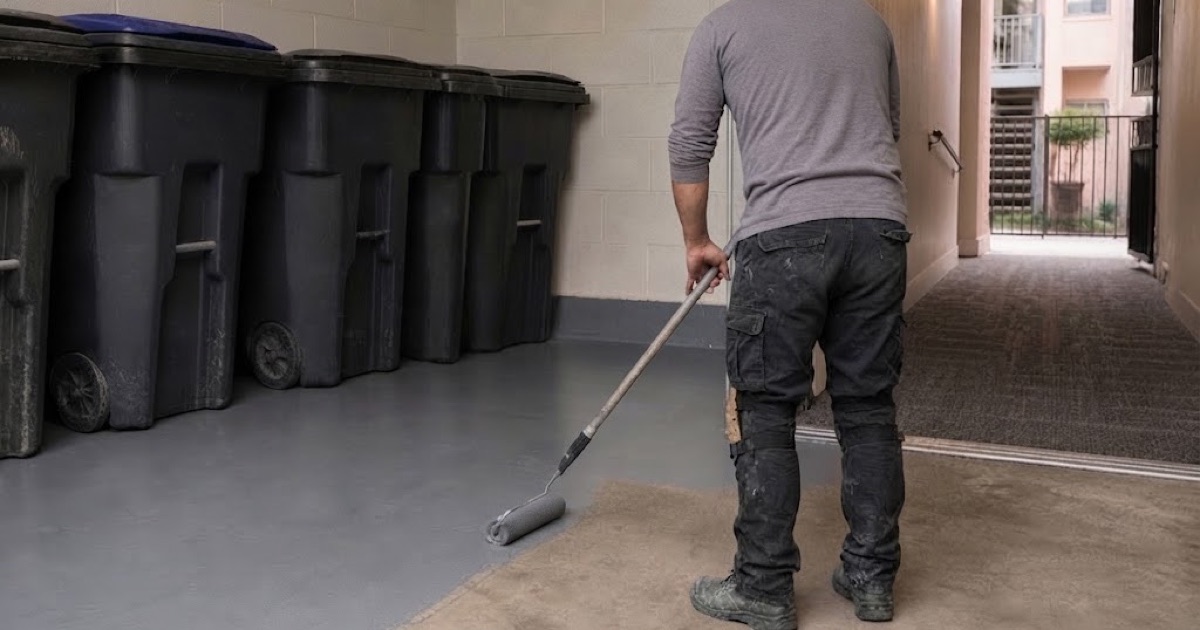
The trash room is the floor that fails first in almost every multifamily building. It is wet more often than dry, it takes whatever leaks out of the bags, it gets hosed rather than mopped, and it is precisely where a coating that stops at a raw edge lets liquid travel underneath the film.
So it gets an integral cove base carrying the floor up the wall as one continuous surface, chemical resistance specified against the products the building actually cleans with, and where the room is hosed hot or steam cleaned, urethane cement instead of a lighter resinous buildup that would soften under the thermal shock.
Laundry and Utility Rooms
Shared laundry rooms and water heater closets are small floors with outsized consequences. There are drains in them, there is standing water the day a machine overflows, and there is nearly always a threshold into a corridor with carpet or plank waiting on the other side of it.
The detailing therefore gets far more attention than the square footage would suggest. The coating turns up at the perimeter, terminates properly into the drain rather than stopping short of it, and finishes at a clean edge at the threshold instead of dying underneath a transition strip that somebody will lift in five years.
A Floor On-Site Staff Can Maintain
Whoever cleans these floors is usually one maintenance technician with a cart, not a specialist contractor. A system that only holds up under a particular cleaning regime is a system that will not hold up in a building like this, so maintainability is part of the selection rather than an afterthought.
We hand over what the floor is and what it tolerates in writing: which cleaners are safe on it, which will dull or attack the surface, and roughly when the topcoat will want refreshing. A recoat done at the right moment costs a fraction of taking a failed floor back to bare concrete and starting again.
Who Decides, and How an Occupied Building Gets Worked
Boards, Managers and Owners Who Live Elsewhere
With 44.8 percent of occupied units rented, hardly any of this work is authorized by the person standing on the floor. The decision belongs to an owner, an association board or a property manager, and it frequently has to survive a meeting before anybody schedules anything.
So we write the quote for that audience: a scope specific enough to be read aloud, priced line by line so it stands up next to two other bids, with the repair work identified rather than buried in a lump sum. Where a scope grows past coating into structural or drainage work, the permits for it come from the City of Azusa Building Division on East Foothill Boulevard.
Sections, Not Shutdowns
An occupied building cannot give up its parking, its trash room or its only corridor for a week. The work therefore gets phased: a level divided into sections, a fixed number of stalls out of service at any one time, and each section returned before the next one opens.
That schedule is built around residents rather than around our crew, which means notices on doors, avoiding the hours when everyone arrives home, and choosing low-odor products because people are asleep two floors above the work. The cure schedule goes out in writing and in stages, so a manager knows which day foot traffic returns and which later day vehicles do.
Two Product Lines Inside One City
This city carries a real industrial base and a large multifamily base at once, and that puts a legal line straight through our material list. SCAQMD Rule 1113 holds a floor coating to 50 grams per liter of volatile organic compounds, while an industrial maintenance coating is permitted up to 100.
Subsection (c)(6) then bars applying, or soliciting the application of, an industrial maintenance coating for residential use, and parking, corridors and trash rooms serving apartments are residential use however large the building is. Keeping those categories apart is an everyday discipline here, which is why residential and commercial work is quoted off separate product lines.
Industrial Floors, Site Access and the Private Garage Exception
Aerospace, Food Production and Campus Buildings
The major employers here need floors a garage product cannot deliver. A defense and aerospace plant may call for static dissipative flooring, which is a grounded system verified by testing to ANSI/ESD S20.20 rather than an additive stirred into a topcoat, and the job comes with escorted access and clearance before anyone unloads a grinder.
Food production sets the opposite problem: floors washed down hot, exposed to caustic cleaning agents daily, and needing a measured slip rating while they are still wet. The university on Foothill Boulevard, the largest employer in the city, adds shop, kitchen and service floors that realistically get done between terms rather than on request.
Quarry Dust and Getting a Rig to the Work
At the northwestern edge of the city, Vulcan Materials works the Azusa Rock quarry, which holds over 100 million tons of granite aggregate, is mined by blasting and moves its material out on a conveyor running roughly two miles. Airborne mineral dust and grit is a live site condition on that side of town.
A curing floor left open to it collects it permanently, so on those jobs the door seal and the containment earn their place as much as the coating does. Aggregate traffic also loads the canyon-mouth routes with heavy trucks, which is why arrival times get agreed rather than assumed on a morning delivery.
The Private Garage That Does Exist
Detached houses may be a minority here, but 47.6 percent of 15,580 units is still thousands of private garages, and most of them are old. Two-thirds of the city’s housing predates 1980, and the 1950s remains the single largest decade at 21.9 percent of everything standing.
Those bays get the full old-slab treatment. Moisture is read and the number written down before material is ordered, the surface is opened by diamond grinding to a named ICRI concrete surface profile rather than acid etching, crack and spall repair is priced up front, and the flake blend is picked off a sample board laid on your own concrete.
Heat then sets the pace on the day itself. At this end of the valley a west-facing bay or an uninsulated industrial unit runs well above the air temperature all afternoon, and a product allowing 60 minutes of working time on a 55-degree slab allows roughly 20 at 95, so slab temperature and dew point are read that morning and batch size follows the reading.
- 20+ Years Experience
- Licensed & Insured
- Free On-Site Estimates