
Upland Epoxy Floors installs epoxy flooring in Artesia, and the work that brings us out here most often is a commercial kitchen rather than a garage. A kitchen floor is one of the few resinous systems where every property that matters — heat tolerance, chemical resistance, grip, cleanability — is fixed by what happens in the room rather than by what the owner likes the look of.
Those kitchens are concentrated. The city covers 1.62 square miles, and the commercial corridor on Pioneer Boulevard between 183rd and 188th Streets holds the largest Indian commercial enclave in Southern California, a district the city itself calls the International and Cultural Shopping District. Roughly 120 South Asian businesses were operating there by 1997, and by 2004 the corridor was generating about a quarter of the city’s sales tax receipts.
What that means for us is a lot of small independent tenancies packed into a few blocks, each with a working kitchen behind the dining room, each running six or seven days a week. The floor in those rooms takes more punishment in a year than a residential slab takes in twenty, and it is inspected by somebody whose job is to notice.
Kitchen Floors in the Pioneer Boulevard District
Small Tenancies, Short Chains of Command
Most of the restaurants here are independent and most of them lease. The person who knows the floor is failing is usually the operator, and the person whose signature a permanent coating actually needs is usually the property owner, so the first useful question is who holds the lease and what it says about improvements.
We put the scope in writing early for that reason, with preparation, system, coving, drainage detail and the closure window all in one document that can be forwarded intact. A landlord reading the same page the tenant read is a much shorter conversation than a landlord hearing about a floor after it has been ground.
What an Inspector Is Actually Looking At
There is a persistent myth in this trade that a floor can be bought with a federal stamp on it. No agency runs an approval list for flooring products, and any contractor telling a restaurant owner otherwise is selling something they have invented.
What an inspector actually judges is the floor in front of them: whether the surface is smooth, non-absorbent and in good repair, whether it is cleanable all the way into the corners, and whether there are cracks, gaps or lifted edges holding soil. That is a performance question about the installed floor, which is why the specification and the workmanship matter more than the label on the pail.
Grip While the Floor Is Wet and Greasy
A kitchen floor is wet, hot and greasy for most of its working life, and a smooth resin surface that feels secure at eight in the morning is a different floor at nine at night. Texture has to be built into the system deliberately, usually by broadcasting aggregate into the body of it rather than by relying on the topcoat alone.
Slip resistance is measurable rather than a matter of opinion. Under ANSI A326.3 it is reported as a dynamic coefficient of friction, and asking for a figure gives an operator something the finished floor can be tested against long after the crew has packed up.
Looking for epoxy flooring closer to San Antonio Heights? See Epoxy Flooring in San Antonio Heights.
What a Working Kitchen Does to Concrete
Boiling Water, Fryer Oil and Thermal Shock
The specific killer in a kitchen is temperature swing rather than wear. A pot of near-boiling water tipped onto a cool slab makes the coating expand while the concrete beneath it does not, and a system without the thermal movement to absorb that difference debonds in sheets from the edges of the wet spot outward.
That is what urethane cement is for. Its thermal expansion is close enough to the concrete’s that a washdown does not shear it away, it resists the food acids and caustic degreasers that soften lighter resin systems, and it can be placed heavy enough to take trolley wheels, dropped pans and a nightly scrub without going soft.
The Junction Where Kitchen Floors Actually Fail
Almost every failed kitchen floor we are called to look at failed at the wall, not in the middle. A coating that stops at a right-angle junction leaves a seam running the length of the room that fills with grease and food waste, and no mop, brush or pressure washer gets properly into it.
An integral cove base solves it by carrying the same material up the wall in a curve, so there is no line to clean into and nothing to catch. The same detail belongs around equipment plinths, under the line and behind the dish station, because those are exactly the places nobody can reach once the kitchen is reassembled.
Drains, Falls and Standing Water
A coating records the drainage it is laid over, it does not correct it. If water pools by the prep sink now, a resurfaced floor will pool in the identical spot, only on a slicker surface, so the falls get checked with the floor dry and empty before anyone quotes a system.
Where the falls are wrong they can be rebuilt during the repair stage, and where they are right the coating still has to be terminated properly into the drain body rather than stopped short of it. A kitchen floor is under water pressure at precisely the junctions a dry floor never tests, and a drain edge left raw is a failure with a start date.
Doing It Between One Service and the Next
The Closure Window Is the Whole Job
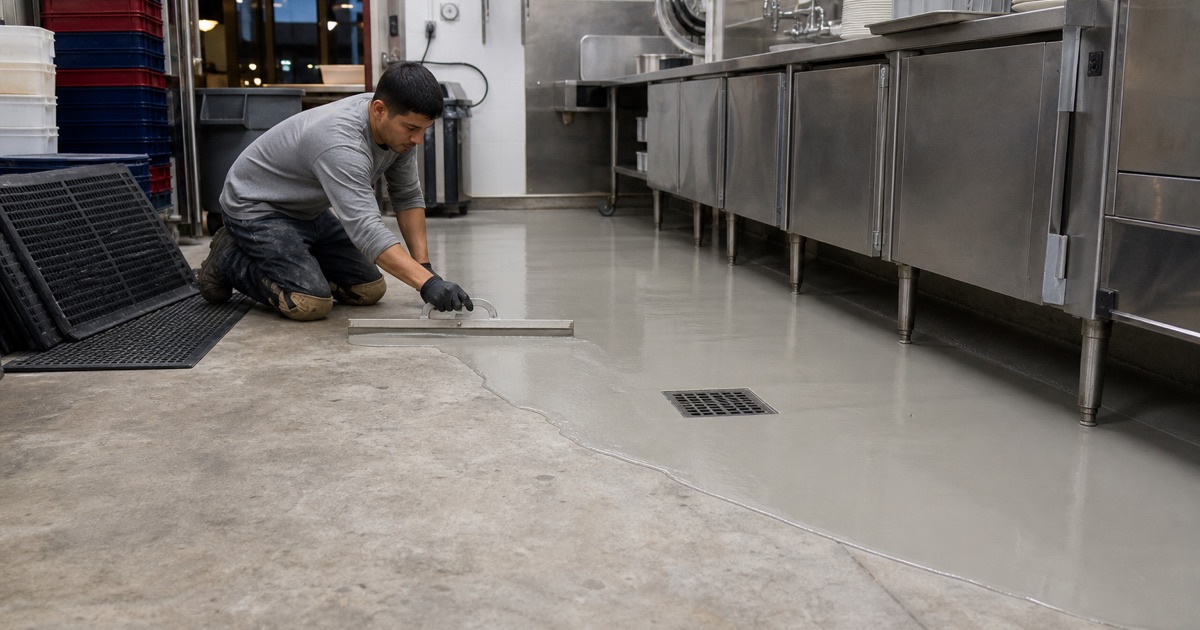
A restaurant closing for a week to have its floor done is not a plan anybody accepts, so the realistic scope is a single overnight or a closed day, and everything is built backwards from the hour the kitchen has to be usable again. Equipment out, floor stripped, ground, repaired, built and cured inside one window.
That is why the cure schedule we hand over separates the stages instead of quoting one figure. Foot traffic returns first, then the equipment can be walked back in and reconnected, then the floor is ready for a full washdown, and a manager reopening at eleven the next morning needs to know which of those three has actually arrived.
Working Next Door to Other Businesses
These are shared walls and shared alleys, with other kitchens, groceries and shops operating a few feet away. Grinding concrete makes a great deal of dust, respirable crystalline silica among it, and containment plus vacuum extraction run as standard on our machines for our crew’s sake before anybody else’s.
Odor gets planned with the same care, because a neighboring dining room does not want solvent smell drifting in during service. We sequence the most odorous stage early in the closure and keep material staging out of the shared circulation, which is a small piece of coordination that avoids the only genuinely avoidable complaint on a job like this.
One Survey, Because the Drive Is Long
This is the furthest city on our map, near enough thirty miles out, so a return trip for something we could have recorded the first time is a serious cost against a one-night job. The survey has to come back with everything the quote and the material order depend on.
That means slab moisture read properly rather than guessed at, cracks and spalls counted and priced, the drain positions and falls recorded, the equipment layout noted, and the route from the truck to the kitchen door measured. Nothing about a floor should be discovered at two in the morning with a closure clock running.
The Residential Side, and the Rules Around It
Half the Homes Here Are Rented
Artesia is 50.5% renter-occupied across 4,513 occupied units, which is an operational fact rather than a demographic footnote. Roughly half the people who call us about a garage floor cannot authorize a permanent coating on the property without the owner agreeing to it.
We raise that in the first conversation rather than on the morning of the work. It costs nothing to ask, it saves a tenant the disappointment of a quote they cannot act on, and it occasionally turns into a better job when the owner decides to do the whole property properly.
Fifties and Sixties Slabs Down Narrow Driveways
The housing stock is postwar and overwhelmingly detached: 68.0% of units are single-family detached against only 2.9% attached, 76.2% were built before 1980, and the 1960s and 1950s account for roughly a quarter of the stock each. The city grew out of dairy farming, and the lots reflect that era rather than a modern tract layout.
Garages here are typically detached and reached down a side driveway too narrow to back a truck along, and there is frequently nowhere legal to leave a trailer on the street. Access, not the coating, is the real scheduling risk on a house in this city, so we measure the run for hoses and cords before committing to a date.
Old Concrete Under an Old Garage
With more than one in ten units dating to 1949 or earlier, under-slab vapor retarders range from inconsistent to entirely absent. Moisture is therefore a default test rather than an optional extra, measured with in-situ relative humidity probes to the ASTM F2170 method and written into the quote, since moisture is the failure almost every coating warranty excludes.
Decades of soaked-in oil are equally normal in a slab of that age, and how deep it goes only becomes visible once diamond grinding opens the surface to a named ICRI concrete surface profile. That is another reason we grind rather than acid etch, and another reason crack and spall repair gets priced from the survey instead of raised mid-job.
Two Product Lines and a Third-Party Plan Check
The air district treats a restaurant and a house as different jobs with different tins. Rule 1113 allows a floor coating 50 grams of volatile organic compounds per liter and an industrial maintenance coating double that, and subsection (c)(6) forbids offering the heavier category for residential use at all, so the two sides of our work are quoted from separate product lines.
Permitting here runs an unusual route as well. The City of Artesia contracts its Building and Safety services to BPR Consultants through the Community Development Department, with permits and inspections handled on the city’s OpenGov portal, so where a floor forms part of a tenant improvement the schedule follows a consultant’s availability rather than a counter’s opening hours.
- 20+ Years Experience
- Licensed & Insured
- Free On-Site Estimates